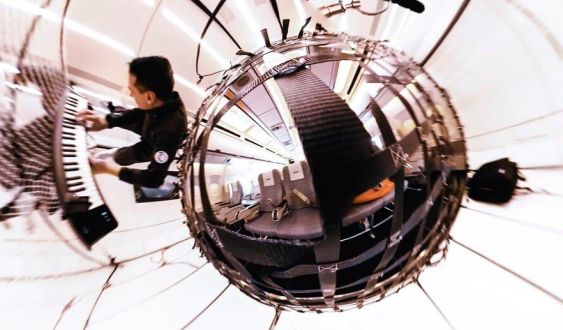
The Zero-Gravity Band is a project that asks questions and moves ahead in time to talk about music and art in a weightless space. "If we eliminate gravity from creative processes, we realize that the way of creating music and art changes totally," explains Catalan composer and producer Marc Marzenit.
We find ourselves in the middle of a hypothetical future, in which a space technological revolution has taken place that has managed to send humans to live outside planet Earth. How will art and its perception change when we are not restricted by the physical laws imposed on us by planet Earth? It is time to investigate and experiment with its potential cultural implications. This is the starting point ofThe Zero-Gravity Band, a project that asks questions and moves forward in time to talk about music and art in a weightless space."If we eliminate gravity from creative processes, we realize that the way of creating music and art changes totally", explainsMarc Marzenit. He is a producer and composer of electronic music and, together withAlbert Barqué-Durán, cognitive science researcher at City, University of London, has developed this project that will be unveiled at Sónar 2018. Recent research by Dr. Elisa R. Ferrè, professor at the Department of Psychology at Royal Holloway, University of London, on how humans perceive and experience aesthetics in microgravity conditions, has also motivated this project, promoted by the Quo Artis Foundation.
It has been more than half a century since humans reached the moon and spacecraft have also been sent to Mars, but outer space has always been seen as an inhospitable place for life. "One thinks that one cannot survive in a space where there is no gravity, oxygen, or protection from radiation. However, the latest progress is changing that perception and presenting the universe as a place full of corners that can be more or less welcoming," explains Marzenit. The Zero-Gravity Band wants to show them through a 360-degree immersive experience, which will take place at the Sónar electronic music festival and aims to induce sensations of zero gravity through sound. Precisely in the year in which the event celebrates its quarter-century, its more theoretical sibling (Sónar+D) will take a 25-year leap into the future to imagine what artists will be like then. As if we were in 2043, inspired by creativity that defies space and time, they will record music in space, use nanosatellites, and play alongside virtual companions, children of artificial intelligence. Welcome to the "extraterrestrial" musical avant-garde.
For this reason, they use an instrument created to play in space called Telemetrón. The creator is MIT (Massachusetts Institute of Technology) architect, Nicole L'Huilier, a doctoral student in a group that investigates musical expression beyond the atmosphere. «It is a parallel investigation to the one we are doing with Elisa and it was very interesting to see that we had had similar problems and that we had made errors with the same characteristics. In addition to the results of the predictions of how her instrument, designed for composition and interpretation in the absence of gravity, interacts in those conditions. I myself have designed a prototype, the Savnac, to be able to paint in space,» acknowledges researcher and artist Albert Barqué-Duran.