
It's a festival. Not the Grec, no: what is happening in the Catalan theater scene. You think you've seen the best play of the year and suddenly another one comes along that fills the podium. El misantrop we were able to see last week at the Grec and it is scheduled for December of this year at the Sala Fabià Puigserver of the Teatre Lliure. It kills me not to be able to tell you to go right away, but I can tell you to go as soon as December arrives. Directed by David Selvas, bravo. Dramaturgy by Sergi Pompermayer, excellent. Versification by Pablo Macho Otero, ovation. And a very prominent performance by Pol López in the role of Aceleste, brutal. Like everything. Like La Brutal. Let me explain.
As you know, El misántropo is a play by Molière from 1666 that deals with coherence, the firmness of principles, and the price one pays for remaining faithful to what one believes. How ridiculous it can even be to remain a coherent and noble person: as ridiculous, or more so, than selling or giving away one's convictions. It reminds a bit of Cyrano and his delirious sword fights against the moon, which is a scene as poetic and inspiring as it is pathetic and destructive. And the theme of El misántropo is at the same time coherence, that is, the protagonist's attitude, as well as hypocrisy, that is, the temporizing (or cynical) attitude of others. In fact, El misántropo was quite criticized by French society of the time: we could say that Molière clearly embodied his own character. Now we have the framework, then. The theme. Now let's see what these phenomena have done.
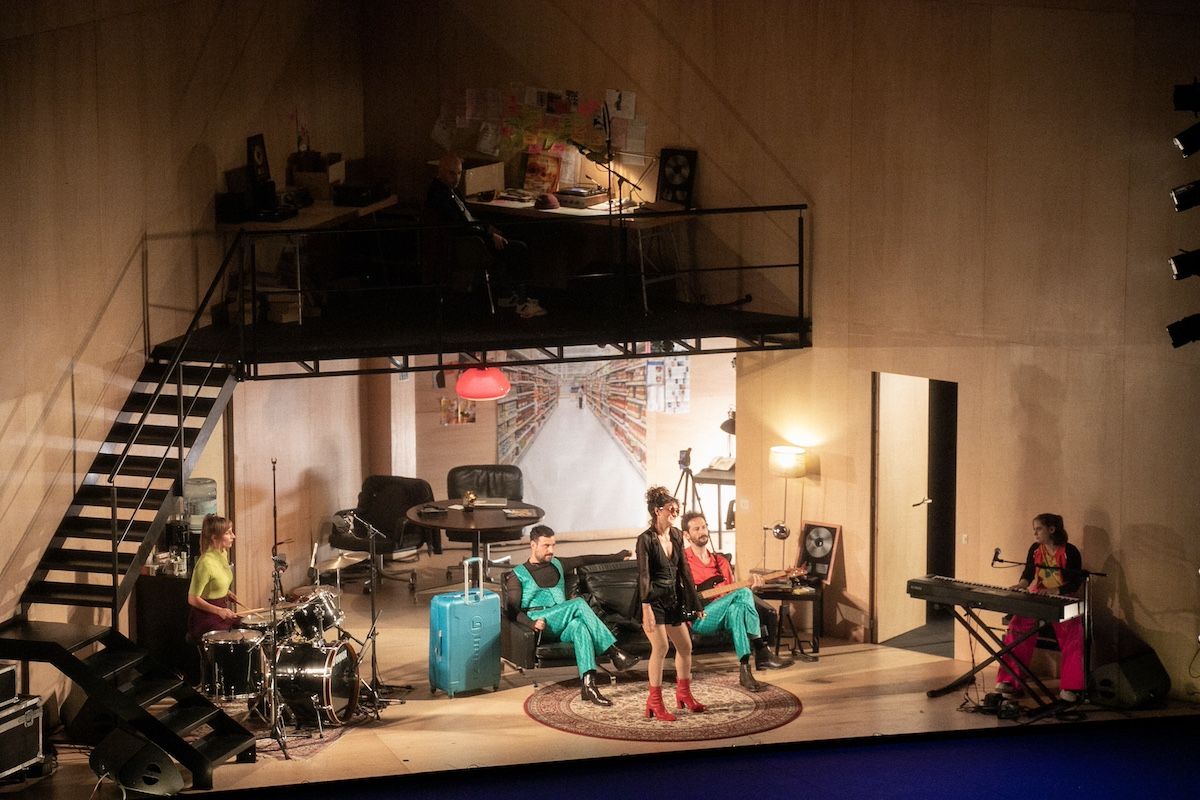
The adaptation to the current era is, in fact, the charm. So much so that from the very beginning the actors address the audience directly mocking why they have come. For a post, for a selfie, to make themselves interesting, right? Or to see how modern it looks to modernize Molière, to go see something cool, huh, Molière? And from this start (with a selfie included with the audience) we find ourselves in a record company, Misantrop records, which must debate between maintaining musical integrity (rock, indie, even Albert Pla covering Fonollosa) or selling out to the reggaeton and empty trends of the moment. But which are so popular. Which blow everything up. But which, like the so-called urban language, try to transgress but do so in such an inoffensive way that they don't end up reaching anyone's heart.
The contrast between the song about heartbreak sung by poor Cilitandre (with an unbearable hip-hop cheesiness) and the exhibition of unforgettable pieces that appear during the play (Lou Reed's Perfect Day, Fonollosa's own Sufre como yo covered by Albert Pla, among others well-executed live by the band of actors) is the same contrast that exists between the misanthrope's idealism and Célimène's (Mireia Aixalà) pragmatism, in a discussion that we must say does not end up forming part of the center of the play: in this version, the misanthrope discusses above all with himself and the characters around him do not end up taking the prominence that Molière would give them. Nothing happens: the general cause has been replaced with the individual cause, with the individual dilemma. And since we are all engrossed in our personal and untransferable mobile phones, the result works.
I don't think the task of Catalanizing, modernizing, and adapting 17th-century verses could be done better by putting them in a constant game that, now, perhaps monopolizes too much of the spotlight. It even takes the spotlight from the protagonist: the wordplays are so good, and we are so much in search of how one rhyme will tie into the other, that sometimes the word makes the situation lose strength. It is not a great defect, I have actually appreciated it very much and I think it is fine this way: the way to connect with the audience and convey the message, I believe, had to be this, with the word, and with very successful interpretations that elicit constant moments of laughter.
There is no drama, that is true: we do not suffer at any moment, everything becomes a kind of game that, as a game, is of capital excellence. But perhaps this is the sign of the times, that life has become a superficial game (like music, like love) where what matters is no longer having principles but being cool, not being real but being authentic. In record terms and as the text says, not being competent but creating competition. Well, I have seen a work that is authentic and real at the same time, with principles and that is also cool, and that not only competes well but is also highly competent.
Add The New Barcelona Post as your preferred Google source for free
Stay informed with the latest news.
