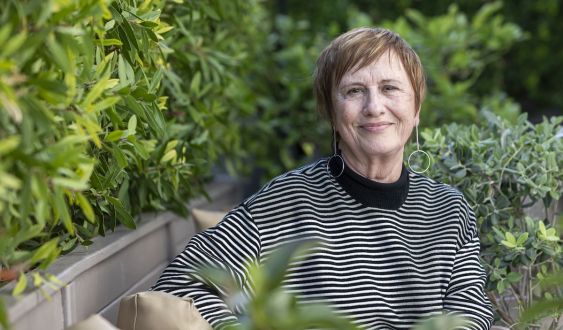

— A work of self-knowledge and knowledge of the external world that the Foundation advocates should be done from a very young age.
— It is essential. We must teach children to name emotions from the beginning. To know how to distinguish fear, sadness, anger… Because if we don't understand these emotions, it's very common to answer "I'm terrible" when asked how we are. But "terrible" is not an emotion, it's a kind of bag into which we put everything: sadness, frustration, loneliness, disappointment, rage… When we manage to name these emotions, we can begin to understand them, to order the chaos and then work on them. And this is a continuous process: it can be started as a child or at 70 years old. An essential process precisely at the current moment: where the world is uncertain and anxiety, depression, and hopelessness seem generalized.
"We are hyperconnected but incommunicado. Most of our relationships are superficial, topical"
— Especially at a time like the present, when, although young people in particular are increasingly daring to speak openly about mental health, anxiety, depression, and stress are also growing.
— There is generalized anguish, much sadness, an increase in depressions, anxiety, and even suicide attempts. Many young people look around them and see difficulties: housing, salaries, precariousness, the feeling that they will live worse than their parents. When you only see obstacles, you have fear and anger, and with those feelings you can harm yourself, and others. And also the planet: because the logical reaction is: "why should we take care of our environment if we see that everything is collapsing?"
— And, in many cases, these feelings lead to what is known as eco-anxiety.
— Yes, helplessness, disappointment with politicians, indignation with polluting companies, fear all come together. And in this scenario there are people who get stuck and drown in indifference or paralysis, and we find ourselves facing a concept that we define as "the globalization of indifference"; that is, people create a shield against misfortunes to stop suffering. And, at the other extreme, there is the opposite reaction: hyper-responsibility, young people who end up exhausted by all the restrictions they impose on themselves.


— And from here, how can we help someone in our environment if we see that they are suffering?
— When a person suffers emotionally, they need to be heard. Not to have their life fixed. Sometimes, with the best intentions, we say "if I were you, I would do this...", but you are not the other person. The most important thing is to feel that someone is there: to feel a "speak, I'm listening to you." A hand, a touch, a "if you need me, call me, no matter the time." I won't be able to calm your pain, but I can be with you.
— And we would only be missing the third planet: the outer world.
— We all coexist on this small planet, and we should row together in the same direction to preserve it, because we don't have a spare planet. But instead of rowing together, we fight, there are international wars, we hurt each other and pollute the environment. For this reason, we must take care of the three planets: our inner self, our relationships, and the outer world. And we must also take care of the Earth because its state will end up affecting our inner self: if we live in a dirty, aggressive, hurried city, then we will be unwell.
"If I go to the gym three days a week, why don't I also train my ability to be present, to breathe, to manage fear?"
— Can one live well in a city where everything goes fast, like Barcelona?
— It is possible, but only if we have the tools to do so. For example, if I think I can't do anything to make this city less hostile, I victimize myself. But if I ask myself: "what can I do today?", I regain control. And we must focus on these small actions. But also raise our voice when necessary: we must teach children to be more rebellious.
— Rebellious?
— Yes, emotionally rebellious. When the world seems hostile, emotional disobedience is more necessary than ever. And one of the dangers of the new generations is precisely this: that they are too obedient, that they believe everything. We must know how to say "enough is enough." Society pushes us to live fast, on autopilot: "don't think, don't feel." But we must know how to stop, move away from this system that pushes us to be continuously productive and focus on ourselves. We are very concerned about our physical health and go to the gym a lot, but we should also go to the emotional gym.
— To train ourselves emotionally.
— Yes, and especially because we see that we must prepare for unexpected situations: blackouts, pandemics, scenarios we can't even imagine now... And being prepared is not just having an emergency kit, but also having good emotional muscle. If I go to the gym three days a week, why don't I also train my ability to be present, to breathe, to manage fear?
— How could we improve Barcelona to make it more pleasant for its inhabitants?
— The people who design cities, politicians or architects, should consider the emotional factor more. And, in this sense, we work with the concept of the CAPA city: creative, loving, peaceful, and autonomous.
"The people who design cities, politicians or architects, should consider the emotional factor more"
— And is Barcelona like that?
— It has potential. Barcelona, for example, has always been said to be creative, yes, but creativity must be oriented towards humanizing, not towards making people consume more. But it must also be loving and peaceful: we need spaces of silence, friendly spaces, a city where we are not always cramped and irritable. But where there are also network spaces, to feel part of a community that drives us. And above all, we need kindness.

— Kindness! Where can we find this essential value for a kinder world?
— We can find it everywhere: because kindness is the sensitive care of the planet, of people, and of oneself. It is love for life, tenderness, generosity, humility, beauty... In fact, at the Emotional Ecology Foundation, we have an observatory of kindness, and for a few days, we dedicate ourselves to observing these everyday kind actions. And, once you put on the glasses of kindness, you see it everywhere: from the person who gives up a seat on the subway to the smile a neighbor gives us.
— Sometimes we find it hard to recognize these gestures.
— Yes, because we go too fast, on autopilot. And, for this reason, it is also important that we educate people, from a young age, to recognize and also spread kindness. And above all, to appreciate it, but not a mechanical thank you, like when in the schoolyard we force the little ones to apologize after fighting, but they don't really mean it. It must be a living gratitude.
"If everyone sincerely expressed gratitude, Barcelona would be less hostile, more breathable, more human"
— If we all practiced this gaze, the city would change…
— Just one week dedicated to gratitude would be transformative. If everyone sincerely expressed gratitude, Barcelona would be less hostile, more breathable, more human. And we can propose a sincere thank you a day or a week, and we would see the impact it has.
— In such a fast-paced and sometimes hostile city, you defend hope.
— Because I cultivate it every day and because I feel it is there. Because I don't intend to throw in the towel: we must be able to stand up against this fast world and sow hope, because we need it.
— How can we do it?
— First, by taking care of ourselves: and we can do this in many ways: from meditation, contemplation, a moment of silence, a book or a song that nourishes us. Sometimes it's as simple as taking five minutes a day. Because I can feed my brain or contaminate it: and how we treat others and the world will depend on this decision. And that is emotional ecology: taking care of the three planets so that life can flourish on them.
Add The New Barcelona Post as your preferred Google source for free
Stay informed with the latest news.
