Memoirs of Hadrian is soberly interpreted by Lluís Homar, who puts himself in the shoes of the old emperor. A man who has governed an empire, who has known intrigues, betrayals, social impositions, war, discipline, art, culture… and also love and pain.
“At 17, excess is a virtue.”
Hadrian already sees his end and knows what it will be like. And he faces it calmly. He has worked to make Rome great and powerful and leaves it in good hands. Marcus Aurelius will be his successor.
“…. Plato’s dream: to see a cold-hearted philosopher reign over men.”
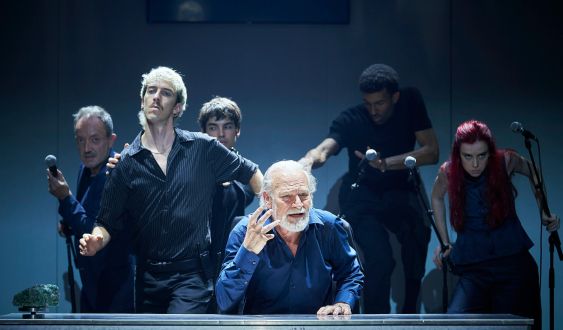
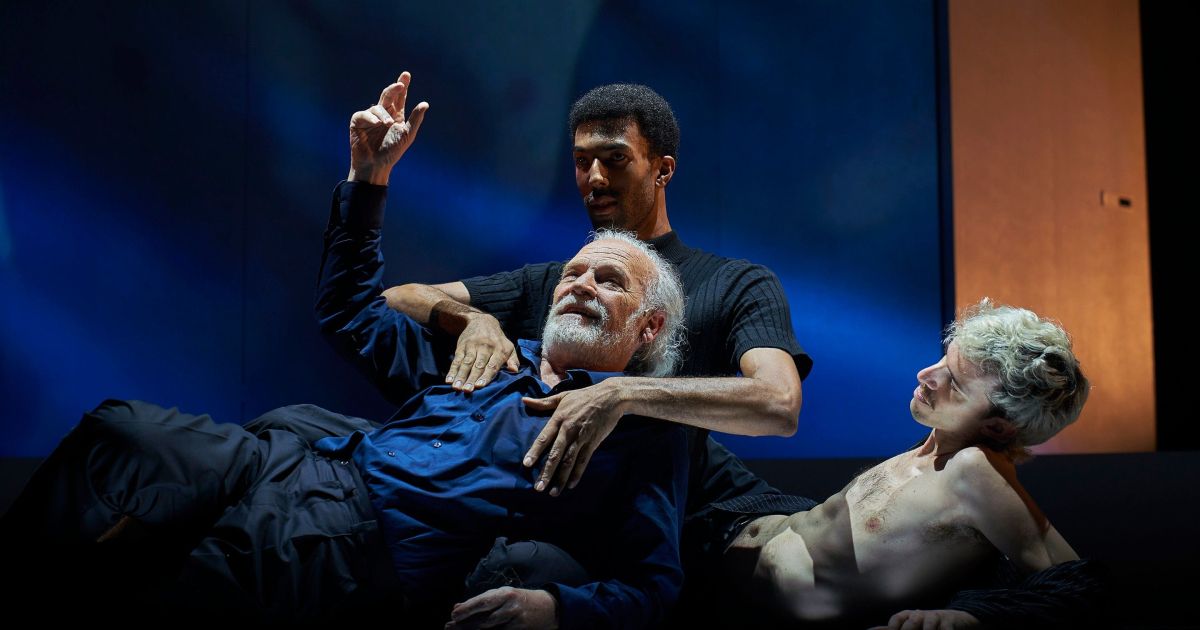
From this conscious end of life… or perhaps not so much, Hadrian recalls everything he has lived. Around him, five mute characters act as his entourage, his puppet, his support… five characters we don’t know if they are real or are the fruit of his delusions as a man who already sees death face to face.
The set design by José Novo, white as marble, could be a palace room, or a porch of the Forum, or perhaps a bench in the Curia Julia, where the senate met… or a garden… or Egypt… A set design that allows live image projections of what happens on stage, turning the scene into an dreamlike kaleidoscope… or with other images of the emperor. Three television screens also collaborate in building this visual puzzle. The costumes by Nídia Tusal, sober, dark, in contrast with the white set design in the background, turn the characters almost into shadows dancing with Hadrian’s thoughts.
Lluís Homar makes a magnificent Hadrian
Even in the most bitter and decadent moments, he gives the emperor great dignity and elegance. His monologue is full of subtleties both in the way it is said and interpreted. Around him, Clara Mingueza, Álvar Nahuel, Marc Domingo, Xavi Casant, and Ricard Boyle are Hadrian’s work. They recreate his words… but they also abandon him, pursue him, play hide-and-seek with him… The movements are sometimes very theatrical, but there are also moments where dance predominates, with very elegant and descriptive choreographies and a very well-designed musical background by Tagore González.
“… I have lied as little as possible…”
May pauses be an element of the staging. May every gesture have a meaning. May dance integrate into the text and merge with it. Memoirs of Hadrian, at the Teatre Romea, is a very good monologue based on a very good text. An adaptation that knows how to capture the original to convert it into another format without losing its essence. It is a very good monologue that allows us to enjoy Lluís Homar's performance. It is a very good monologue that makes Marguerite Yourcenar's book alive, palpable.
Before closing the chronicle: Lluís Homar had to interrupt the monologue to tell a spectator "do you want to turn off your mobile?"... Do you really not able to be 1 hour and 40 minutes without looking at your mobile? When they ask you to turn off your mobiles, why don't you do it? Is it necessary to be so rude to the performers and the rest of the audience?
Memoirs of Hadrian is a magnificent production, but it is not for everyone. If you like Lluís Homar's work, go. If you like history (and, especially, the history of Rome), go. If you like monologues in any format, go. But, if you are more into comedy, funny monologues, lighter productions... if you go, you will see the magnificent work that is done, but perhaps you will not enjoy it as much as you expected.
Add The New Barcelona Post as your preferred Google source for free
Stay informed with the latest news.