
Going to vote in person on February 14 is safe. The Government of the Generalitat and the city councils have adopted a set of measures to make it possible. The Department of Foreign Action, Institutional Relations and Transparency has prepared a protocol, which has been approved by Procicat and supported by the party table, with adaptations of polling stations and recommendations addressed to citizens to be able to hold an election day with the minimum health risks and the maximum guarantees to exercise the right to vote. In all voting centers there will be a health safety manager assigned by each city council who will be responsible for ensuring compliance with the protocols.
[subscribe_newsletter_esp]
[separator type="thin"]
MEASURES IN POLLING STATIONS
On election day, polling places will be properly prepared to be safe places. These spaces must have specific characteristics and will be adapted with the aim of minimizing the time spent inside, especially in the voting rooms, as well as the crossing of people.
What requirements will polling stations meet?
- Be pavilions or large spaces that allow a space of at least 2.5 m2 per person.
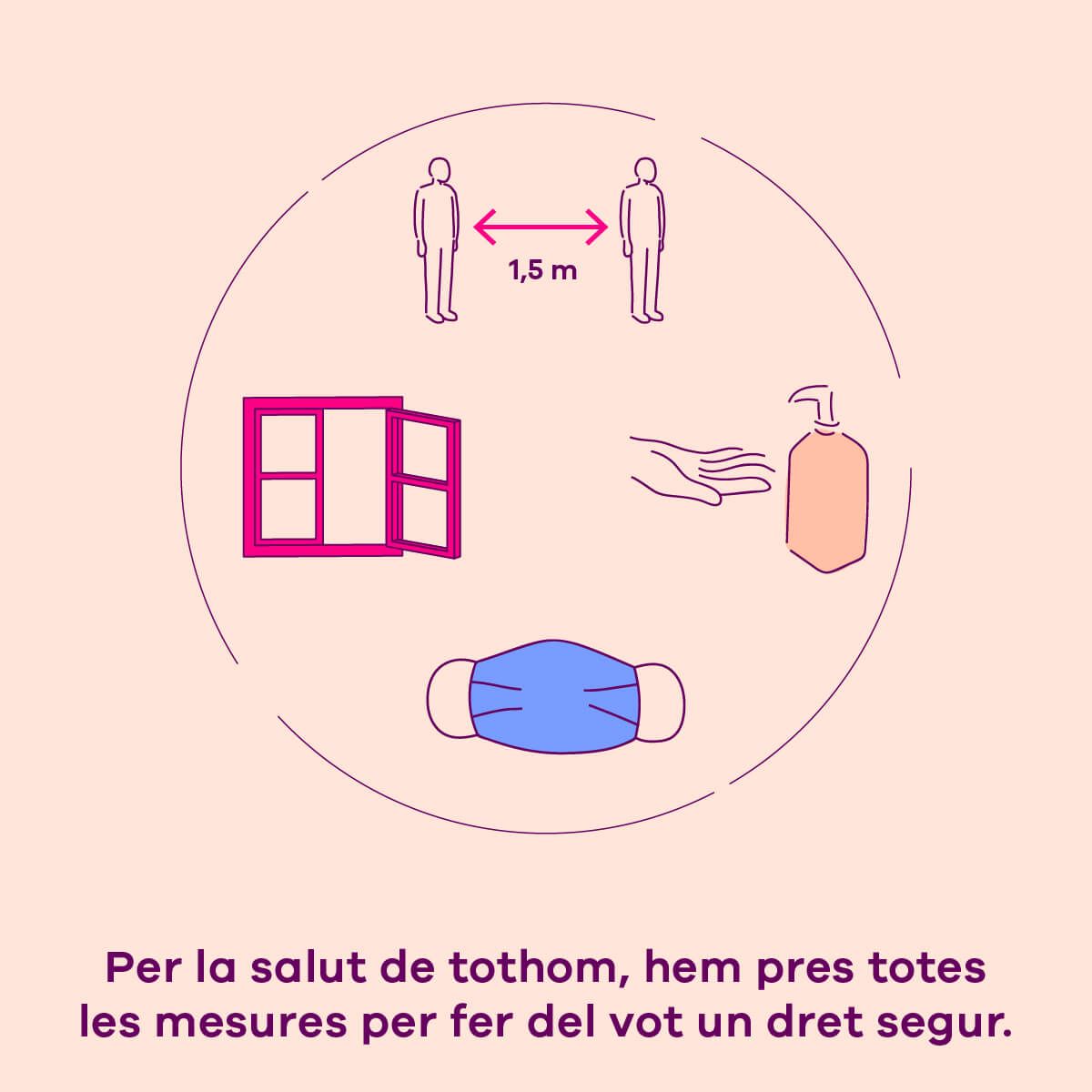
- Ensure constant and adequate ventilation for the expected influx.
- Have independent access and exit points.
- Allow maintaining safety distances: 2 m between tables, as well as 1.5 m between their members and between tables and voters.
- Their location must make street queues possible.
- There will be queues preferably outdoors to avoid crowds, where a distance of 1.5 m must be respected. In indoor spaces, order in these queues will be guaranteed with the use of fences, tapes or other similar systems.
- Voting booths will be distributed in such a way as to guarantee voters' privacy without the need to pass curtains, and one-way flows will be defined for access and exit.
- The use of a mask is mandatory, both inside and outside the centers.
- Schools will be cleaned and disinfected before, during, and after use. Inside the voting booths, this will be done frequently, according to technical health criteria.
- Access points to schools and voting booths will have hydroalcoholic gel dispensers.
[separator type="thin"]
MEASURES FOR VOTERS
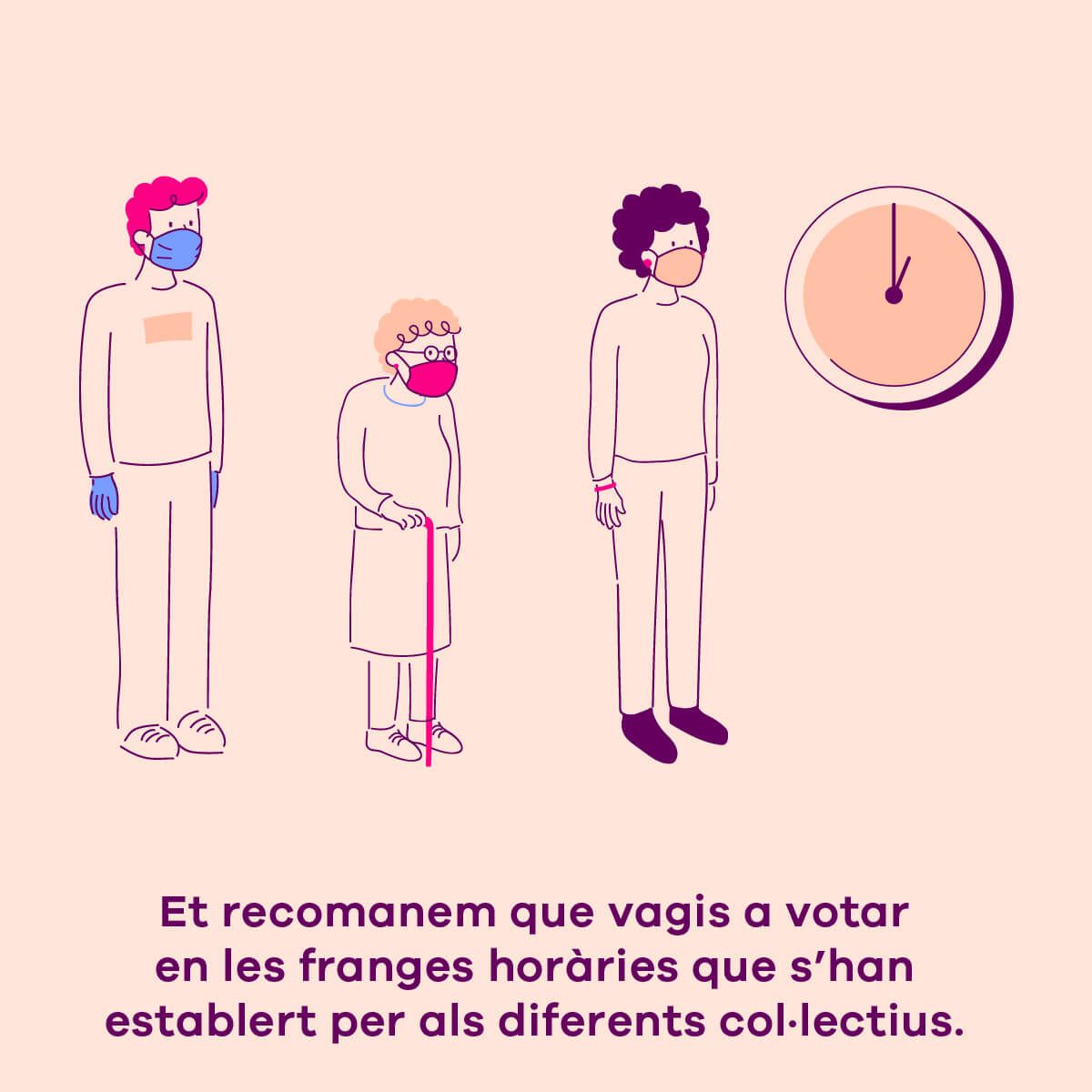
The Govern recommends that citizens bring the voting envelope prepared from home to speed up the process and spend as little time as possible in the polling stations. It also emphasizes the importance of voters respecting the time slots established for accessing the voting centers: from 9 am to 12 pm for vulnerable people, from 12 pm to 7 pm for healthy people, and from 7 pm to 8 pm for infected and confined people.
In these elections, only the person who has to vote will be allowed to enter the voting center. Only those who need assistance may enter accompanied. Voters will have to strictly follow the organized queues and maintain a physical distance of 1.5 m. Those who do not have their vote prepared will not be able to leave to collect ballots, nor move forward inside the center.
In addition to the request for a prepared vote, the Govern has made a commitment to postal voting, which on this occasion can be done entirely without leaving home.
[separator type="thin"]
MEASURES FOR POLLING STATION MEMBERS
Upon arrival at the polling station, the polling station members will have their temperature taken, which must be below 37.5 degrees. In the days leading up to the elections, Salut will offer them the opportunity to take an antigen test at their corresponding CAP. In addition, they will be provided with a personal kit with protection and disinfection material, which includes an approved protective suit for the last voting slot of the day, from 7 pm to 8 pm. Polling station members will at all times be accompanied by one or more health security officers from the polling station.
When voting, unlike in other elections, polling station members will not touch voters' identification documents, but they will remove the paper covering the ballot box before asking voters to insert the envelope.
During the count, they will be provided with an FFP2 mask and single-use gloves, social distancing will be maintained between people, and it will be ensured that the room where the scrutiny takes place has a capacity equivalent to 2.5 m per person.
The role of health safety officers is one of the notable novelties of these elections. There will be between 3,000 and 5,000, at least one per polling station, and they will be responsible for organizing and controlling the orderly access of voters to the polling station, ensuring that the established safety distances are maintained at all times to avoid contact between people. They will also be responsible for ensuring the use of masks at all times, as well as hand hygiene for voters and polling station members.
Both polling station members and the health safety officer at the polling stations will receive specific training to respect and enforce the measures and to make good use of the material provided to them.
All information about the security measures established for the elections to the Parliament of Catalonia on February 14 can be consulted on the website parlament2021.cat.
Add The New Barcelona Post as your preferred Google source for free
Stay informed with the latest news.
