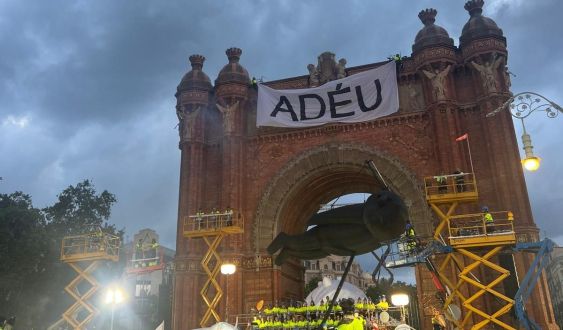
It is natural that one of the new heroes of this Barcelona of ours, without references or stars, is the set designer (and large-scale event organizer) Marc Salicrú, a native capgròs whom my fellow citizens have eagerly adopted after the review that Teatres de Campanya instilled in the Arc de Triomf. If you don't know what it's about, read the ecstasy of theater critics and culture-savvy journalists about this already mythological event which, as such, has its respective highlights to be narrated over beers; the sweetly forced occupation of an urban space by citizens (represented by the guild of technicians and pseudo-sweepers; what in heteropatriarchal times we called xispes, handymen, or directly suckers), the stellar appearance of Miqui Puig in an ambulance, and the canine howls of our poetess Núria Martínez-Vernis, al cel es mantingui.
It is normal, I insist, that a dramaturgical stampede of such dimensions (well coordinated by the very young Salicrú, who does not hide his condition as a demiurge with a apinganillado microphone) is, for now, the most celebrated bet of Leticia Martín's new Grec. In the context of a city irresponsibly sold to tourism, where forty-somethings still share a room with their high school friends because they cannot afford board and lodging, and where the PSC's autonomous pax is metaphorized in delusions like the America's Cup (a sporting spectacle that people cannot see, because it is not visible!), the public needed like fresh air to see these Brigades de Confusió Popular. The point was not to admire all that Cafarnaúm of musical bands, gegants, flying plastic clouds, and pyrotechnics ---of all this, we already have in La Mercè--- but to feel that the management of chaos, at that moment, was in our hands.
The first reading of this wonderful spectacle is the delicately indignant explosion of a citizenry that needs to abandon the addiction of secluding themselves looking at their mobile phone from the sofa to re-occupy the city's sidewalks ("els carrers serán sempre nostres", the naive procesistas used to say); indigenous Barcelonans who are fed up to the balls with guirismo and expats (killers of haberdasheries, ancestral ovens and everything that the snobs call "emblematic shops") making their neighborhood more expensive until it alienates them; people, in short, who need to expel the intruders from their city without looking like xenophobic militants of Aliança Catalana. This explains the much-celebrated appearance, right at the end of the revelry, of an enormous white sheet unfurled at the top of the Arc de Triomf where "Adéu" was read, contrasting with that big "HOLA!" that the children of Olympism have embedded in their memory.
It's funny, because most of my theater colleagues have stressed ---adequately--- that Salicrú is a notorious debtor of the furera aesthetic and of creators ---apparently--- perverters of order like the much-missed Carles Santos. But this is the point where a very pedantic Hegelian critic always appears (in this case, yours truly), to remind how, precisely within the framework of Olympism, Pasqual Maragall and company made use of this theatrical-sound aesthetic to incorporate it into Barcelona's mental framework of autonomous prosperity. 92. Some of us were still very young, but who can forget the genius from Vinaròs directing that cobla dressed in a barretina and cheetah jackets in the Lluís Companys; also how La Fura dels Baus was in charge of explaining the Mediterranean to the world, with a lot of fun but always under the noucentista gaze of cultural Maragallism.
There is no better news for power than for citizens to be content with this momentary possession of chaos tolerated by the system ("a movement promoted by the City Council," The Refrescos sang in the mythical Aquí no hay playa). But it must be warned that political control of dissent often ends in sterility, as certified by the fact that this bustle of the Teatres de Campanya was especially celebrated by the young people of the Corpo and other animals that feed the system through docile opposition. Salicrú is not to blame for any of this, of course, he already has enough work acting as the orchestra conductor of all this hullabaloo that docilely agrees to shake our conscience for an hour and also end up in one more photo on the Instagram of every good Barcelona progre. The theater maker deserves this momentary glory and one must predict juicy commissions for him in an... institutional future.
They say the show will be performed again in Tàrrega; it will be interesting to see its reception there, in the hot capital of Urgell, a place where there is no gentrification, tourism or other problems of urbanity, simply because almost no one ever wants to set foot there.
Add The New Barcelona Post as your preferred Google source for free
Stay informed with the latest news.
