This is a story of light and hope, as Marcel Barrena defines it. But also of shadows and darkness. This is a story that crosses borders, terrestrial and maritime, and that reaches the movie theaters of our country to make us reflect. Each one will draw the message they want, everything will depend on their political and moral convictions. But, as Marcel Barrena says, "this is not a political film, it does not have an answer to the conflict, nor does it even pose one".
This is the interview with director Marcel Barrena about a film, Mediterráneo, which has involved more than 1,500 people, 1,000 of them refugees. This is a film that had a budget of about 4 million euros, was made possible thanks to the production companies Lastor Media, Arcadia, Fasten Films and the Greek Heretic, and had the support of TVE, TV3, Movistar, the Ministry of Culture, the Institut Català de les Empreses Culturals, several Greek public institutions and the European Community. As we said, it is a story that crosses borders and tries to bring together different points of view. Do you know the story of the blind men and the elephant? One day, in a remote place in India, an elephant appeared. A group of blind men approached it. To get to know it, one touched its trunk and said: "It's a snake!" The other touched its ear and said: "It's a bird!" And another touched a tusk and said: "It's a bull!" None of them had the complete picture. Neither do we.
--- Who had the idea to make this film, Marcel?
--- Dani Rovira, one of the protagonists, and I had made a film called Cien metros. We were very satisfied and were looking for another project to do. One day with producer Tono Folguera we saw a news story about a lifeguard from Badalona who had gone to Lesbos and had saved I don't know how many people. At that moment we saw clearly that it had to be told. That same morning I called Dani, explained the story to him, he saw it clearly and the next day the three of us were talking to Òscar Camps to convince him to let us tell it. And that's how it started 5 years ago.
--- In these 5 years you have been doing all the script work, production…
--- Yes, the script was quite complicated. It was hard for us to find the balance between a commercial film ---this film made sense if it reached a lot of people--- and something with the utmost possible respect for the subject we were dealing with. It was a very, very delicate balance. The script took us a good, good 3 years. In parallel, we made a lot of trips to Greece with Òscar and the people from Open Arms, who kept explaining to us where everything had happened.
--- Had you been to Greece before? To a refugee camp?
--- No, never.
--- And how did you feel?
--- I visited many different refugee camps. The Moria camp, for example, was a rather hellish place, even though it tried to maintain a degree of humanity thanks to the team of volunteers who worked there. One of the times I saw a girl ---this really struck me--- who was looking at an iPad. And of course, you go with your preconceived ideas of refugees and all that, but when you see a girl with an iPad in a camp ---she was watching Friends--- then you say "that could perfectly be us." The first waves of refugees fleeing Syria were middle-class or upper-class people. This is very shocking. There is no longer that barrier from when I was little where you thought poverty was only in Africa. Then you saw it from a great distance and now it explodes in your face.
"With producer Tono Folguera, we saw a news story about a lifeguard from Badalona who had gone to Lesbos and saved I don't know how many people. At that moment, we saw clearly that it had to be told."--- Has it been difficult for you not to fall into sensationalism?
--- That was the great danger we had with this film. We had to be very careful and, at times, fight against ourselves. When you make a story for the cinema, which you want to reach many people, you want people to be moved, to learn things... And there was always this danger of overdoing it by victimizing refugees or by criticizing characters who are between two waters, like the police or coast guards. There were many things we had to be very careful with, which is why we tried to play in a gray area.
--- How did the actors prepare their roles?
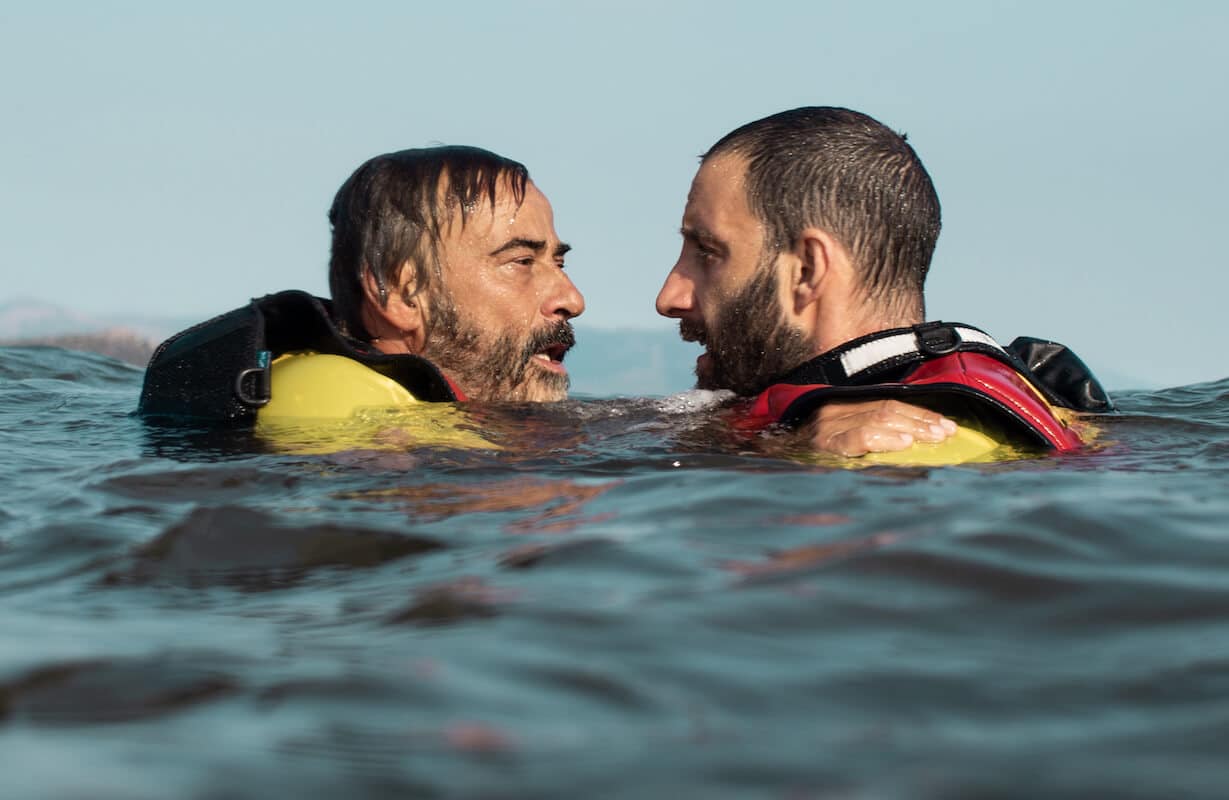
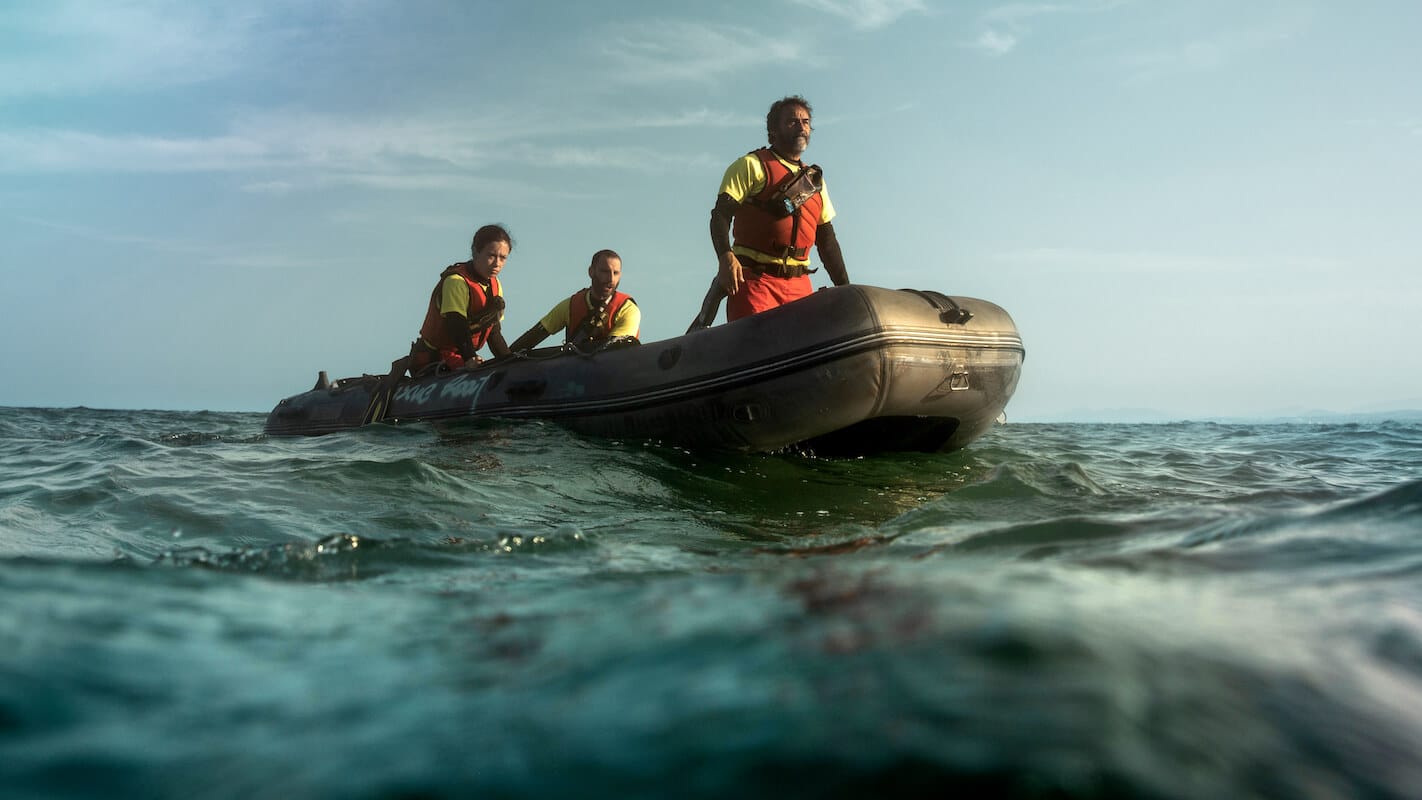
--- Our idea was to do something hyperrealistic. That's why each actor worked with their real character. Eduard Fernández worked a lot with Òscar, they became very close and that's why in the film they are practically identical: they move the same, they look the same... This is also what happens if you have a gifted actor. On top of that, Eduard had been runner-up in Spain for water polo, he knew how to swim very well. What we did in general were quite a few swimming trainings, riding the motorcycles... Technical things. It had to look like they were really doing it well. Then, one of the characters in the film, the one played by Sergi López, is a tribute to an Argentine lifeguard named Nico who was with us throughout the filming and made sure everything made sense: where we took the boat, where people were picked up... He helped us a lot. But, in general, the one who worked on his character the most, to the point of obsession, was Eduard with Òscar.
--- Is the film shot entirely in Lesbos?
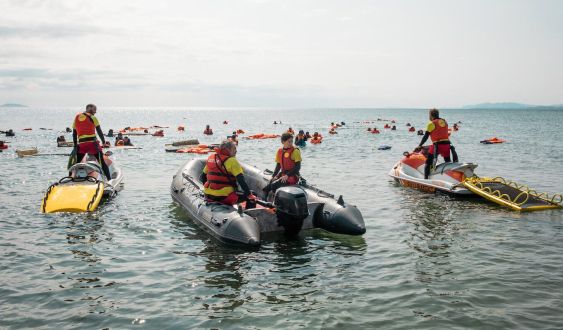
--- It is 98% shot in Greece and two days of filming in the Proactiva industrial warehouse, which is in front of Mataró beach. All the material we have used in the film is the same material they used in the great shipwreck that appears in the film. The same motorcycles, the same vests… Everything is the same. The big gamble I had made was to film in Lesbos. During the trips we made, we looked for the places where they had experienced it to film. I wanted everything to be the same, but it couldn't be. When we were in full pre-production, there was a series of neo-Nazi attacks on refugees. I think they even murdered one or two and the Lesbos authorities told us not to film a movie there with real refugees because we could have problems. We had to leave and start working somewhere else in Greece.
--- Are you saying that the extras we see in the film are real refugees?
--- Yes, they all are. We were able to hire more than 1,000 extras, who were refugees we went to look for in the camp. It was an idea I had from day 1, because I wanted the film to be as faithful as possible. I knew that our actors were top and would do very well, but that the film could die if the extras didn't work. With those images that we have all seen on the news of boat arrivals, of desperate people, of sad people, or happy, because they have arrived well. A whole range of emotions that if we could not transfer to the screen, it would end up being ridiculous. I was very worried about this and that's why I decided not to count on actors.
"The big gamble was to film in Lesbos, but when we were in full pre-production there was a series of neo-Nazi attacks on refugees. The authorities told us not to film there because we could have problems"--- And did you go to a refugee camp to look for them?
--- Exactly. We had a brutal job of going to camps, doing interviews to see if they wanted to participate... We were very careful because the psychiatrist at Moria camp had told us that this idea was very nice, but that realistically these people had come out of a boat, had lost family, friends... And that putting them back in a boat in the middle of the sea could be counterproductive. But what happened? They all came. They came every day, they corrected us, they explained how they had swum, how they had gotten out of the boat, everything, everything, everything. They needed to be part of this, to explain it. The story I could tell firsthand is that of the lifeguards, but I also wanted to tell that of the refugees from their point of view.
--- What has making this film meant to you emotionally?
--- I have only made one documentary, one television film, and two fiction films for the cinema, but I very much doubt I will ever experience anything similar in my life again. We had suffered everything one can suffer to make a film. When we started, we had the pandemic on top of us, we had to shoot in two countries, in six languages... Dani had just overcome cancer, two weeks before starting to shoot he was doing radiotherapy. We had two hurricanes, we had to stop filming due to fire risk... Shooting at sea is crazy, even more so with 300 people in the water. Everything was very complicated, but it was a brutal human experience every day. To see that we were there, that we shared filming with people who had risked their lives, but who at the same time were pure humanity. They had left their traumas behind to help us tell this story. But, at the same time, it has also been a deep sadness ---why not say it--- because we were in Greece making a film and then we would go to the hotel, but our companions would return to the refugee camp. Then you thought, first, how lucky I am and then, what a mess... I remember I explained this to a Syrian boy who helped us translate and he told me "well, you could be making a romantic comedy in Barcelona so calmly and instead you are here." It was complex, but we knew we were doing something that could help or that could be more than a film.
--- What message did you want to convey? Does this message change from being in Barcelona to seeing the situation in Lesbos?
--- The truth is, no. As it has been a long process, with many trips, meeting many people, and we were already quite sensitized and empathetic towards what Open Arms had done, in a way you are already prepared. You don't know what you will find or how you will experience it, but your idea of how to approach the film is the same. Emotionally it touches you a lot and moves you, but ideologically it doesn't. On the contrary, it reinforces you. We wanted to tell the story of good people doing good things. And to get a bit away from this cynicism and this darkness of criticism, of social media... From these places where it seems you can't talk about good things, because there are good things and there are good people. We wanted to do this and at the same time make a commercial film that would reach everywhere, that would be a film of light and hope, without forgetting that we were dealing with a highly sensitive issue and that we had to be very rigorous. And then, in a second reading, which I don't know if it will end up happening or not, try to make some of the people we already know how they are and what they think, if any of them see the film and ask themselves the question "are these NGOs really whitewashing mafias? Are they really trafficking people?" If any of these far-right radicals end up questioning it, we will also have won. We have to help fight against ignorance, because ignorance leads us to fear and fear leads us to hatred. But, in the end, it is a story of people who cannot even contemplate the option of leaving a person adrift.
--- It's the law of the sea, if there's a castaway you're obliged to rescue them...
--- Of course, one of the other paradoxes of this story is that these people who always talk about upholding the law then don't comply with the law of the sea, which is the most elemental. We are telling the story of people who comply with the law, guys who, without permission and with all the problems in the world, save 60,000 people. The others are committing omission of aid, which is a crime. In fact, it's almost murder.
"It was a brutal human experience every day. Seeing that we were there, that we shared filming with people who had risked their lives, who had left their traumas behind to help us tell this story," explains Marcel Barrena--- What do you think of the press coverage of all this?
--- To begin, I must say that if it weren't for the press, nobody would find out about things. In fact, one of the themes of the film is convincing Òscar to explain what they are experiencing. Afterwards, what happens is that there is such an avalanche of information that conflicts end up being dehumanized. The mistake that, at the same time, was a success, on the part of the media, is that Aylan Kurdi was given a name. He was a white child that everyone knew where he was from and where he came from.
--- It was his real name…
--- Yes, and this caused everyone to be interested. And I now doubt that the press will ever again give us the names and surnames of a victim. What they do now is talk about "refugees," about "the others." Obviously, the press is very important for everything. If I weren't talking to you, your readers wouldn't know about the film. And this is fundamental. The responsibility of the press is to explain it well and with respect.
--- What is your assessment of our country's reception policies?
--- As Òscar Camps' character says in the film: "I'm a lifeguard, I'm not a politician". I tell stories, you know? I don't know enough. I don't feel capable of assessing such a complex issue as this. But to the most excitable, to those who always explain things in the same color, what I can tell them is that for a continent of millions of people like Europe, 80, 90,000 or 900,000 coming is not a problem, I don't think. It never will be. I have always been in favor of welcoming, even more so when we are the ones who cause these crises. Refugees must be given a response, but I can't tell you what it is and the film doesn't know it either.
--- Good answer
--- It's the non-answer, because I don't know it. Nobody knows it. I trust that the political leaders who govern us are actually human, and they also see a five-year-old child drowned and their hair stands on end and they want to jump out the window, but they probably don't have the solution to fix it.
--- Is the Marcel of now the same as the Marcel before the film?
--- I believe so. I was already convinced from home, that's why I launched into doing this. This film is not a political film. It is not positioned anywhere, beyond what I told you that a castaway must be rescued. I would like to think that both people on the right and people on the left find this to be the most normal thing in the world. That said, if I didn't have empathy for Open Arms or so many other organizations that help at sea, I wouldn't have gotten involved. Beyond that, it hasn't changed me, it has reinforced me. I've been there, I've seen it with my own eyes. People have to be helped.
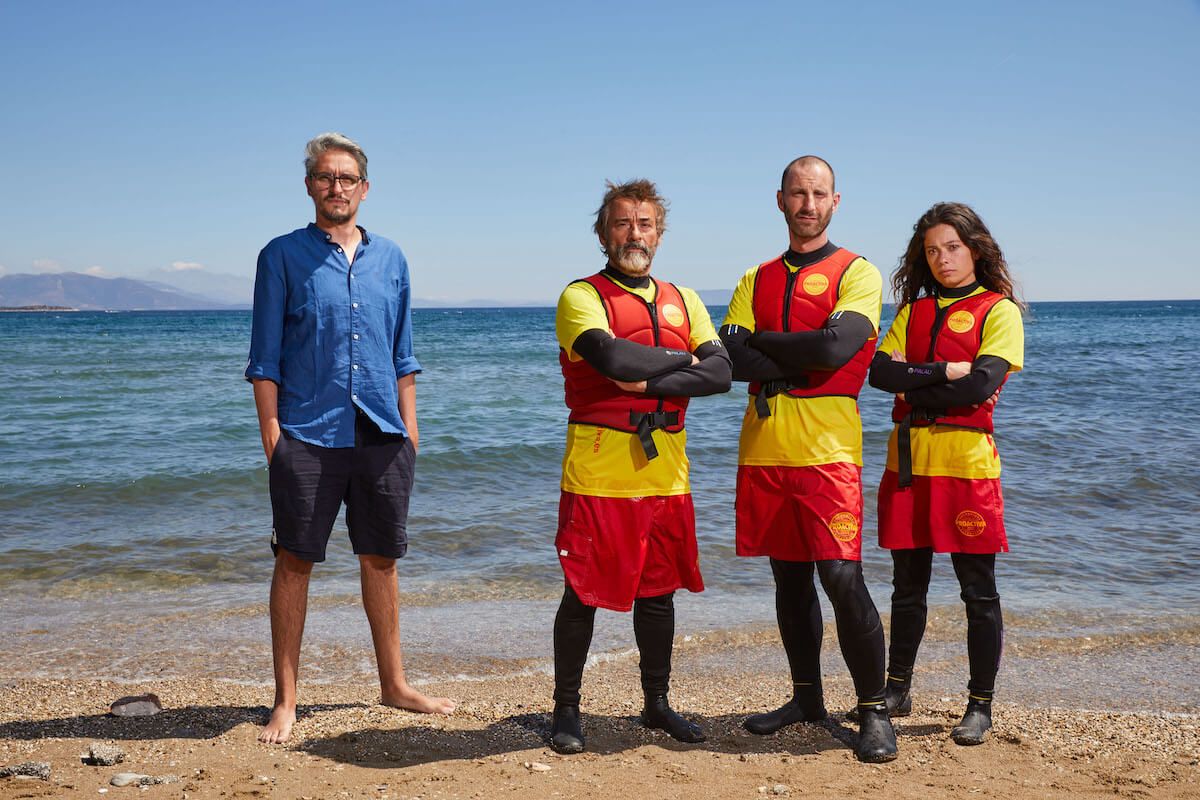
On Friday, September 24, one week before the premiere of Mediterráneo, solidarity screenings were organized throughout Spain to see the film. The money obtained from ticket sales went exclusively to Proactiva Open Arms. In the production process of the piece, the collaboration of the NGO was also remunerated. In addition, one of its actors, Dani Rovira, has given 100% of his salary so that the Badalona lifeguards can continue doing their work.
Mediterráneo by Marcel Barrena has been pre-selected to compete in the Oscars as best foreign film, along with Madres Paralelas by Pedro Almodóvar and El Buen Patrón by Fernando León de Aranoa. On October 5, we will know which of the three will definitely go to the most important awards in the world of cinema. Once again, Mediterráneo crossing borders.
Add The New Barcelona Post as your preferred Google source for free
Stay informed with the latest news.