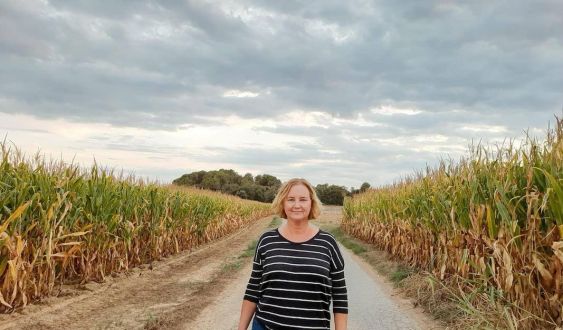
"If I were to be born again, I would do everything in reverse, although I am happy to be able to dedicate myself to what I like," confesses Mª Ángeles Cabré after entering the Bar, flushed, leaning on the bar and, fanning herself with some papers she holds in her hand, ordering a clara and turning off the radio so it doesn't disturb the conversation.
"I think I was born with the batteries of rebellion on ---affirms the writer, journalist, researcher and founder of the Cultural Gender Observatory, Mª Ángeles Cabré---, already at university I found that women continue to be almost invisible, we didn't even appear in the programs. So, I started reviewing books by women, a task I have continued doing. Later, already in my forties, I poured my energy into feminist activism with no possibility of return and, in 2013, I founded the Observatory, a small instrument to shake consciences and invite parity in culture."
A woman of letters, as she defines herself, Mª Ángeles Cabré has dedicated three decades to books body and soul, "especially in body, because the truth is it's tiring." To date, she has published thirteen of her own books, some anthologies, a hundred translations and many articles, because she started collaborating in the press very young.
The activist and writer is satisfied with what she defines as "some small achievements" ---in reality, not so small--- such as getting a figure of Madame Curie in the CosmoCaixa lobby or having organized the María Luz Morales Feminist Journalism Award, "which recovers that great figure of cultural journalism and encourages such necessary journalism."
The Barcelona that has been told less
The latest feat of this Barcelona native born in 1968 is the imposing essay, Flors i violes. La Barcelona literària en clau femenina, recently published by the City Council: "a voluminous, but informative volume that offers the other side of Barcelona, the one that has been told less," points out the author, who tells unknown stories starring women of this city in its pages: "In La Pedrera lived the beautiful Teresa Mestre de Baladia, of tragic history; in the Ateneu Barcelonès, the writer Aurora Bertrana spoke of feminism before a large audience; in the old Hotel Ritz the patron Isabel Llorach organized prestigious conferences and, in the Flash-Flash, the Gauche Divine dined in full. That's where my book ends, by the way."
With a proud smile for the work done and for all that remains to be done, in terms of cultural parity, Mª Ángeles adds that "I also dedicate myself to giving conferences that give a voice to women, who still have little and need many loudspeakers."
--- And are you preparing something new?
--- Among other things, I am preparing an anthology of articles by Anna Murià, one of the republican women of letters about whom much remains to be said. It will be released in 2022.
Civility and commitment
"I would like to be very proud of Barcelona, and that implies that we understand once and for all that turning it into a provincial city is not the way. Barcelona now has too many street drinking parties and lacks life. I see efforts to make it sustainable ---that's a saying---, but not to make it interesting," Mª Ángeles laments, before concluding: "There is a lack of imagination and commitment to a civic citizenry that already seems a clear minority."
The activist currently lives in Empordà, but confesses to still having "one foot in the city" and not having abandoned it. "Now my relationship is tense: it hurts me to see its deterioration and its resignation. This is not the Barcelona I want and I am not the only one who complains. I also regret that Barcelona's cultural life has declined so substantially. It is still a great city because no one steals its charisma, but either we get our act together or we will lose it."
Saddened by "how we have normalized so many people sleeping on the streets and begging for charity" and disgusted "by the incivility, which is increasing by leaps and bounds, bicycles and scooters and pseudo-graffiti artists", Mª Ángeles defines the current Barcelona as "an urban jungle where there seem to be no rules" and often misses a "Guardia Urbana, which is conspicuous by its absence," she utters before concluding her statement and immersing herself in reflective silence.
--- What is not conspicuous by its absence here is the gastronomic offer, would you like to eat something? Menu? Portions? Combined dish?
--- I usually meet friends for menus in the center of Barcelona. But I'm also very much into tapas, which is a great invention---, she replies, suddenly recovering her smile.
Add The New Barcelona Post as your preferred Google source for free
Stay informed with the latest news.
