
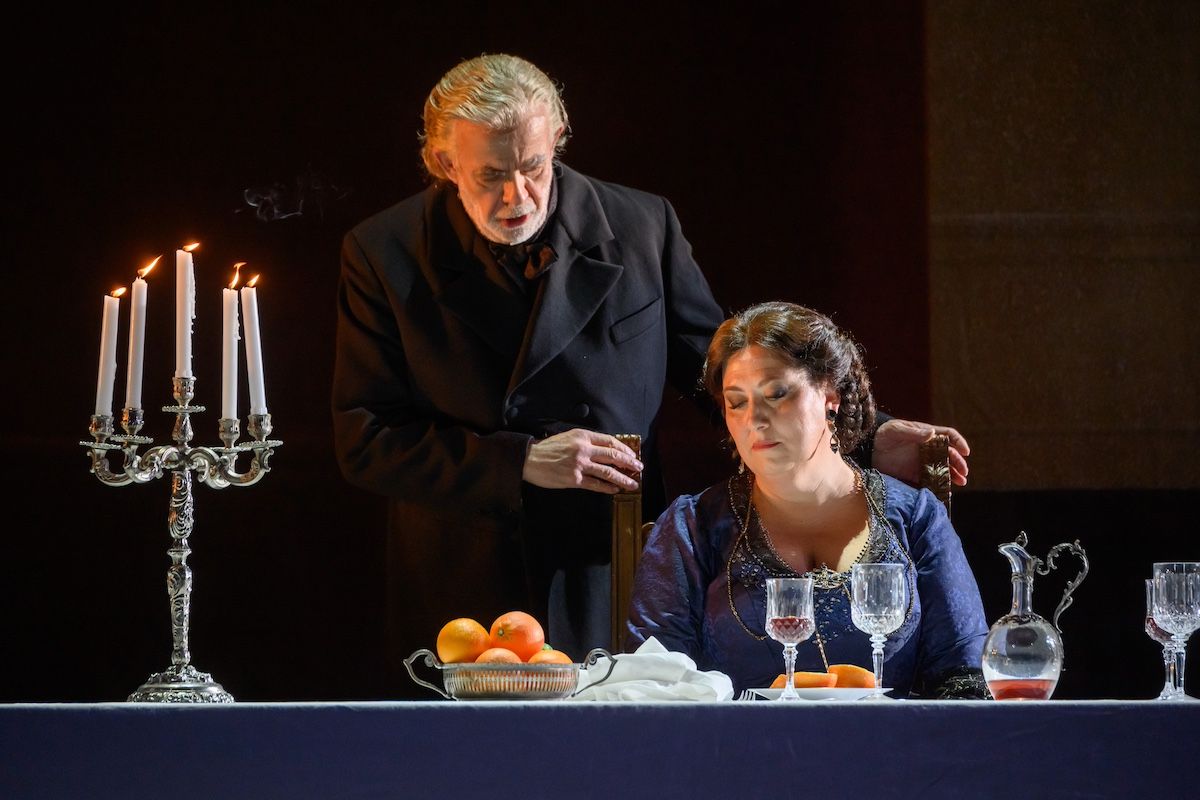
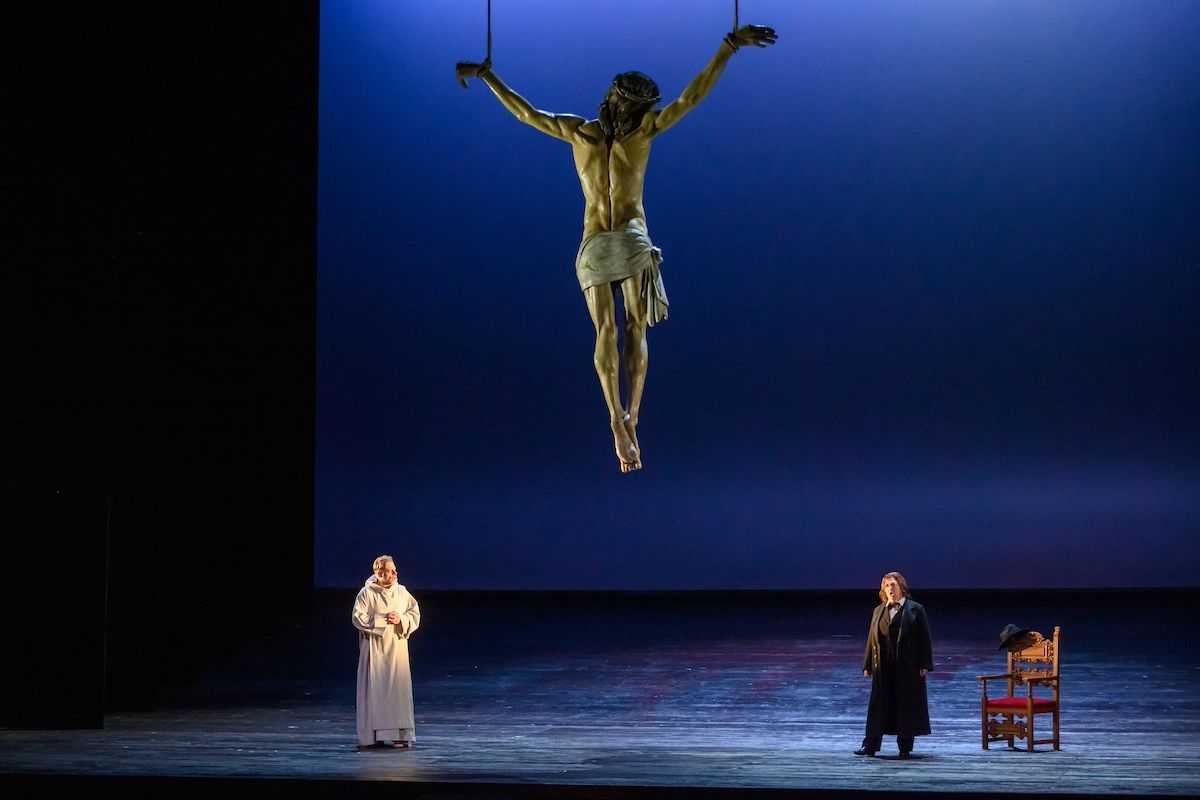
Undeniable success on the occasion of the premiere of La forza del destino at the Gran Teatre del Liceu: neither the length of Giuseppe Verdi's mature opera, increased by the presence of two intermissions, nor the plot twists of a shamelessly tragic story ---albeit seasoned with somewhat disconcerting comic numbers--- seriously conditioned the appreciation of an audience devoted to the vocal performances of the cast, with the brilliance of the leading couple, and especially of soprano Anna Pirozzi in the role of Leonora. Brian Jagde's Don Álvaro proved convincing from a technical point of view, although the libretto's drift almost fatally complicates ---we will return to this--- the acting deployment. The managers of the Barcelona venue opted to revive a staging by Jean-Claude Auvray, aligned with historical allusions and endowed with few, but effective, scenic elements ---such as Christian iconology---, which allow the focus to be placed on the interpretations, accompanied by a powerful orchestra, charismatically conducted by the titular conductor of the San Francisco Opera, Nicola Luisotti.
Possibly the in medias res beginning is one of the most surprising and opportune elements of the drama that is prepared: without overture or prelude, the spectator discovers the forbidden relationship between Don Álvaro and Leonora, and the accidental death of the father occurs, when the lover's pistol fires in an attempt to offer explanations and avoid the duel. A similar scene ---and, yet, in a certain way antithetical--- is the one that inaugurates the action of Don Giovanni. In that case, the affront seems explicit, and also the consequent confrontation; wonderfully ambiguous, however, the involvement of Donna Anna in the summoning of the dissoluto is intuited, announced in Mozart's opera by the vehemence ---between ontological and gallant--- of the overture. In the case of La forza del destino, the musical motif corresponding to fatum and its beatific counterpoint ---or at least hopeful--- will sound after the first death, offering semiconsciously a semiotic support for future interventions throughout the opera. This symphonic interlude separates the very brief first act from the second, in which the figure of an undisguisedly malignant Don Carlo will emerge ---despite his disguises--- and yet credible in his characterization by Artur Rucinski.
Leonora's brother and representative of the deceased commendatore, who seeks to avenge the supposed dishonor ---no details are provided in this regard--- by persecuting the lovers, will reappear practically throughout the opera until the final scene in which ---spoiler alert, though predictable--- he fulfills his purpose concerning her. Another regrettable staging of violence against women, which makes visible the implicit toxicity in many affective relationships, in which feeling is truly pathos, a suffering that wounds and traps. The long shadow of paternal authority and the fulfillment of the law not only do not clash with the blind adherence to internal, seemingly subjective law, but both eventually feed each other according to the Freudian duo eros-thanatos: the impossibility of satisfying desire ignites it to paroxysm, in the most pathological cases, while violence is wielded with the fallacious pretext ---never legitimate--- of imparting justice.
The pretense of bringing order to chaos and controlling, of drastically separating chance and necessity ---not realizing that they are the same reality viewed from different perspectives---, resembles that childish desire expressed by Alan Watts, consisting of mailing a package of water. The question of destiny enters the scene, and its powerful force, be it as fate (fatum) or ananké; an invisible net that connects all events, however remote they may seem, and the resulting causality is extremely "strange". The ---necessarily fruitless--- effort to understand the unwanted, that which is lived and suffered as unacceptable, has moved sapiens sapiens to coin terms such as "destiny", especially operative during the 19th century, under the prism or interpretive filter inherent to the Romantic mentality, which still conditions us; and not by chance, but as an alarmingly symptomatic discovery of the dark side of the Enlightenment project that ---as has often been recognized, but insufficiently--- Hölderlin perceived firsthand against the trend of his generation (some of whose most egregious members opted for a flight forward, in the evolutionary conception of the human spirit and the siren song of utilitarian materialism that accompanies so-called "scientific progress").
Søren Kierkegaard used to say that we only understand life retrospectively but that we are forced to live "forward." The ironic Dane, a regular in his youth at the old Royal Theater in Köngens Nytorv, and well acquainted with the plots and disguises required for the plausible staging of fiction, explained in his Philosophical Fragments that the understanding of events from a historical perspective grants a false sense of control, an equivocal understanding of "the necessary": once its causality is established a posteriori ---as, in fact, Hume had specified--- it seems clear that all a priori ascendancy, all universalizable or absolute truth, is deactivated, beyond the times in which human desires and wills unfold or precipitate. Thus, the fact that something "has happened" is not, against popular belief, proof that it "had to happen" ---as if it were already written somewhere--- but quite the opposite: that just as it happened, precisely for that reason, it might not have happened. Because necessity is a product of a (retro)projection, with which something that has happened is certified, which, in reality, is no longer even being, other than as a (re)presented fact. And here, in the absence of an answer to the sempiternal and irresolvable "Why?", lies the true drama, especially ---of course--- when what has happened fundamentally affects the most genuine desires or expectations of the human being.
The notion of necessity is a product of a projection, through which something that has happened is certified, which, in reality, is no longer even beingThe same urgency that drives one to reach a comforting explanation ("Why this, and why me?") is a symptom of its unavailability.Returning, then, to the Verdian opera, let us recall that beginning in which Don Álvaro's pistol "accidentally" goes off. Faced with the senselessness of what casually happens, the discernment of a pre-established causality, the notion of "destiny" ---which like fortune has a fateful side, detrimental to human interests, and another hopeful side, which outlines the possibility of a type of immaterial health---, possesses a consoling function. In fact, the protagonists of the drama aspire to achieve that health from the moment the father uses his last breaths to curse Leonora, not attending in any way to the reasons that are exposed ---supposedly incompatible with some code of honor--- and condemning his own lineage, which ---as is known--- the posthumous emissary, Don Carlo, will take care of.
As a counterweight to that authoritarian and discriminatory model, we cannot fail to elaborate on the potential toxicity of a loving paradigm with which ---as has been said--- it eventually feeds back; a paradigm of Platonic origin, based on the idea of mutual and inextricable possession, expressed as a mythical return to a state prior to time. Due to its reciprocity, it would seem more balanced and fruitful, but with regard to the surrender of one's own life, it interferes ---not always consciously--- in that sinister movement, denying it. The Tristanian version ---"love-passion"--- may sound nobler and more laudable, above all more poetic; however, it opens the door to a suffering in which the unavailability of the beloved ---inevitable, stricto sensu--- also alienates the lover, separates him from what is most his own. Not only does a worldview that revels in self-disconnection or loss, in the vein of what Flaubert illustrated in his particular Quixote ---by offering a parallel reality much more thrilling from an emotional point of view than cold reality--- fertilize the field of novelistic fantasy, but it also conditions the relationship model from then on.
At the moment we find ourselves, thinking about the Liceu's proposal in an aesthetic key ---and, therefore, without completely losing sight of what was learned at the dawn of reflection on the impact of stage representation on spectators, embodied in the first Poetics--- it seems undeniable that identification with the characters in the plot of La forza del destino and therefore the well-known catharsis, is at least complex. Years pass between acts, and the characters remain bound by the fantasy of a possibly unconsummated passion ---who knows if, for that reason, inexhaustible---; a self-inflicted suffering that at the same time feeds desire, and acts as a driving force. Jaufré Rudel, one of the inventors of gallant sentiment in the West, already sang the delights of lonh love. Many centuries later, in our era of virtuality, it would seem that the split between far/near is itself unreal, or if anything it is being realized as introjection, enhancing the narcissistic enjoyment of the image one finds in others (who, at the same time, could perfectly well not be).
It seems that the split between far/near is itself unreal, or if anything it is being realized as introjection, enhancing narcissistic enjoymentBeyond psychoanalytic disquisitions, neuroscience has shown that the brain feels the perceived image as real as the artificially recreated one; which explains the fateful blunders of the ---already alluded to--- Quixote and Bovary, as well as all generations of readers who unknowingly update their exploits, made explicit by recent audiovisual narratives, such as the celebratedHer, by Spike Jonze. In this context,the test for every knight-errant, wouldn't it perhaps lie in accepting the vertigo that the other has always existed only as a fantasy, and therefore cannot be possessed?This could alter the search for one's own consistency in the appreciation of others, jeopardizing Plato's metaphysical eroticism, which found in attraction a longing for reunion with one's other half, to recover a form of timeless plenitude.
In the original version of La forza del destino, which premiered in St. Petersburg in 1862, Don Álvaro himself lost his life, faced with the unbearable vision of the loss of what he believed to be most his own, which had truly become ---consciously--- impossible to possess. Seven years later, after the intense endings of operas like Rigoletto or La traviata, Verdi chose to modify it and make the beloved, on the verge of perishing, a vehicle for the living purge of Don Álvaro's follies; pointing, by her condition as dona angelicata, to the spiritual dimension as the only path to happiness. For the romantic mentality, a "transcendental path" ---according to Schiller's expression--- that musical vibration perhaps conveys in the best possible way.
Add The New Barcelona Post as your preferred Google source for free
Stay informed with the latest news.
