
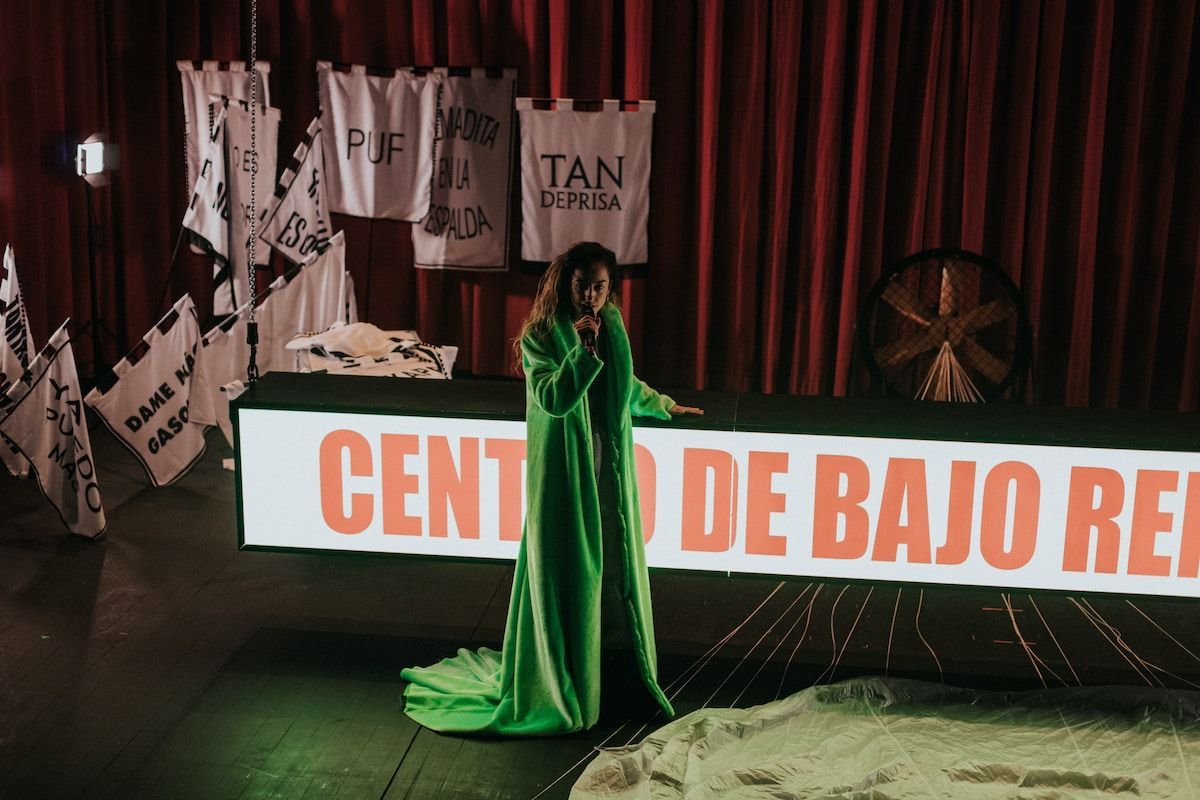
The latest work by José y sus Hermanas warns, from the outset, that it will not be what anyone expects. Neither "good theater" nor the new disruptive creation of the trendy emerging theater group. Nothing about finding existentialist answers about life or returning home feeling a little more human, more good. It thus seeks to prepare the audience so that everyone lowers their expectations and can immerse themselves in the Low Performance Center where the five members of the Barcelona company have locked themselves in, trying to survive, as best they can, the prophecies with which the future is socially constructed and aspiring to draw new, less catastrophic scenarios. And, above all, wanting to do as little as possible in the face of the passage of time, that "continuous present" that envelops daily life, which you never reach.
"We want to embrace laziness, working less, doing nothing," says Carolina Manero, one of the members of José y sus Hermanas, completed by Alejandro Curiel, Marta Díez, Gemma Polo, and Glòria Ribera, all of them former students of the Institut del Teatre. A passive claim with which they want to dismantle concepts that hover in the air, such as "if you don't work, the future will be worse." All of it, from constant irony and contradiction. For example, when they began to outline the play, they themselves wanted to dedicate less effort, share tasks, or finish early, and they ended up doing the opposite, even sweating when they put on a latex suit that laughs at the gym muscles they don't have. "The show has a humorous, sarcastic but also biting tone, like a meme," they explain.
The title of the play, Concurso de malos talentos (Bad Talents Contest), although they would have changed it if they could have, is nothing more than the continuation of that harsh and realistic joke about how the company sees everyday life. "It's a great metaphor: every day is a kind of bad talents contest. And we want to embrace error," says Alejandro Curiel. Between a run-down talent show and a training center where Single Ladies plays, there is also space for ceremonial processions with which to continue reflecting on what is to come in the play, which can be seen until Sunday, December 4, at the Teatre Lliure de Gràcia. "There isn't a single piece because there isn't only one future, so there are different pieces that lead to one," notes Curiel.
As in previous works by José y sus Hermanas, their characteristic style and social criticism are present, always based on sticker phrases and reggaeton songs. This acidic analysis of the future complements previous themes, such as the traces of Francoism in young people in Los bancos regalan sandwicheras y chorizos (2017); the history of the educational system in Spain in Arma de construcción masiva (2018), and the phenomenon of mass tourism in Explore el jardín de los Cárpatos (2020).
However, this time, in Concurso de malos talentos, there are no individual characters who tell their stories and converge with others, and the aim has been to give voice to a very complex and contradictory generation, with references as disparate as Federico García Lorca, Judith Butler, Shakira, and SpongeBob. Nor are there screens or videos; everything is based on the tools provided by theater itself, with sound as the sixth member of the company, daring to fill the stage with chumba chumba music and stale disco smoke. They even make misleading spoilers and scare the audience.
Despite the well-defined generational nods, José y sus Hermanas want to attract younger audiences, whom they believe are difficult to bring to the theater. That is, to do as with Pixar movies, which appeal to both adults and children, Marta Díez emphasizes. Furthermore, to connect with those for whom Corazón partío or La gasolina already sound old-fashioned, they advocate for being able to record with mobile phones during the play, rejecting that magic and secrecy that predominates when the lights of the hall go out. "Everyone has seen Rosalía's concert in stories and has gone to see her anyway," defends another member, Gemma Polo, also a composer for the music group Roba Estesa. Although the Barcelona company invites people to take out their phones during the play, the Teatre Lliure contradicts them and asks spectators to turn them off before it starts, lest an unforeseen alarm manifest itself. After passing through the Gràcia venue, Concursos de malos talentos can be seen in Madrid, at Teatros del Canal, starting in April 2023.
Add The New Barcelona Post as your preferred Google source for free
Stay informed with the latest news.
