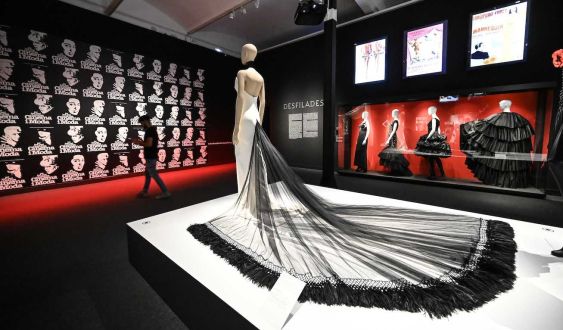
Jean Paul Gaultier has transformed the CaixaForum into a visual explosion, with iconic dresses that revive movie scenes many have etched in their minds, from universal classics like Rear Window or A Streetcar Named Desire to more recent titles, such as The Mask of Zorro or Pedro Almodóvar's Bad Education, with whom the designer has repeatedly worked. The exhibition Cinema and Fashion by Jean Paul Gaultier not only serves to understand the figure of this enfant terrible but also allows delving into the relationships that fashion maintains with cinema, Gaultier's main influence. Of course, without wanting to be exhaustive, just letting himself be carried away by the designer's references, to learn more about him and admire a little more the show that cinema and fashion offer.
The exhibition is organized through five spaces, with a circular layout and maintaining a staging worthy of a runway. Until October 23, after passing through Paris and Madrid, a heterogeneous collection of more than 100 pieces of clothing, with nearly 70 looks, recurrently accompanied by fragments of 90 films and a hundred posters, film stills, and photographs, can be seen in Barcelona. Mostly, they come from the collection of La Cinémathèque française, with whom CaixaForum already collaborated in the exhibitions Art and Cinema or, more recently, Vampires. The Evolution of a Myth. Gaultier's dresses are accompanied by others from designers such as Coco Chanel, Balenciaga, Pierre Cardin, Manuel Pertegaz, and Hubert de Givenchy.
The journey of Cinema and Fashion by Jean Paul Gaultier begins with the designer's early influences, clearly marked by his grandparents. Jacques Becker's melodrama Falbalas (1945) invades the first room, with scenes, veils, and dresses that serve to present why Gaultier ended up being Gaultier. On days without school, his grandfather let him watch movies. The one that marked him the most was Falbalas. He discovered it when he was only 13 years old. The story of the protagonist, a famous Parisian stylist, ended up becoming an epiphany of what he wanted to be. It is not surprising that the exhibition is dedicated to the memory of filmmaker Toni Marshall, daughter of actress Micheline Presle, the protagonist of that essential feature film in his career.
In this section, there are also corsets, one of the great hallmarks of the French designer. And it was all thanks to his grandmother. With her, a nurse by profession, he began to value this piece of underwear, which later led him to bring it out to be shown, as a liberating element for women. He popularized it so much that artists like Madonna made it their own. One of his corsets is exhibited at CaixaForum.
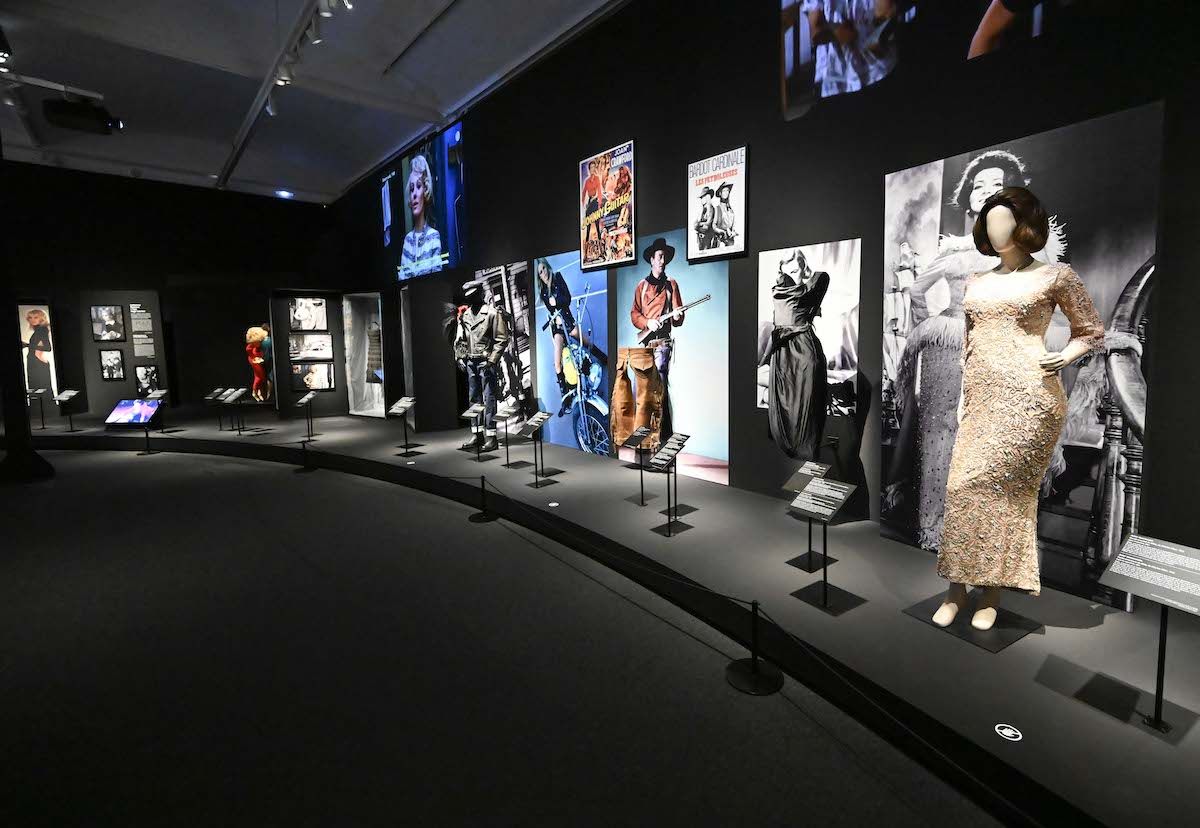
After these brushstrokes of Gaultier's roots, quite dreamlike, the exhibition leads to a paradise for cinephiles, where dresses and scenes from multiple films are mixed. They have not been chosen at random and serve to show how gender roles have evolved on screen, often precursors of what socially ends up coming. They parade, albeit statically, femmes fatales like Marilyn Monroe ---with one of the dresses she wore in All About Eve---, Sara Montiel, Rita Hayworth or Sharon Stone ---yes, the dress from Basic Instinct is on display---, but also virile cowboys like John Wayne or muscular types like Sylvester Stallone. Even so, in this space, one begins to see how stereotypes are breaking down, with figures like Coco Chanel, Marlene Dietrich or Marlon Brando.
These small cracks hatch in the next room, where the designer displays a range of transgressions, both external and his own. From The Rocky Horror Picture Show, Querelle and Jane Birkin to the dress with sequined pubis and ostrich feathers he designed for Gabriel García Bernal in Bad Education. His creations for other Almodóvar films are also shown, featuring one of his great muses, Rossy de Palma. A shared admiration that earned the Spanish actress to be one of the models in his farewell show. Precisely, De Palma has curated a film series for the exhibition, which can be seen starting in mid-September. In total, she has selected five feature films that she considers essential to understand the relationships between fashion and cinema. In many, she coincides with Gaultier. Among them is the film with which she first worked with him, Kika.
Add The New Barcelona Post as your preferred Google source for free
Stay informed with the latest news.
