[dropcap letter="T"]
rying to think about the idea of landscape in painting can leave us breathless or it can seem like a topic as broad as writing about what you did this summer when you went back to school in September. Just in case, this autumn has already reminded us how much landscapes change from one year to the next. In fact, it has reminded us so much that we almost begin to distrust the very truth that can be found in a still photograph. And perhaps for this reason, autumn, which is the changing season per se, is a good time to appreciate the phases and nooks of the landscape: a pretext to be aware of how we look at it beyond a fleeting moment. Exhibitions like the one that can still be visited at the Espacio Carmen Thyssen in Sant Feliu de Guíxols - "Nature in evolution. From Van Goyen to Pissarro and Sacharoff", until October 14 - allow us to entertain ourselves with the changes in perspective of landscape painting and admire the lushness of this pictorial tradition. Without discouragement and with specific details that avoid the impression of a summer essay or an unattainable ocean.
The curator of the exhibition, Pilar Giró, has strung together a coherent and orderly itinerary, in the best sense of the word. For the different stops it includes, for the choice and volume of works presented (well interwoven, if we consider that the Thyssen collection is characterized, above all, by landscape painting), and for the final gift it holds, a tribute to the now vindicated -deservedly vindicated- Olga Sacharoff.
This particular journey through landscape painting spans four centuries. From the 17th century, with the emergence of landscape painting as an independent genre, to the 20th century and the generation of a modern image of the immediate environment, with the sea as a sublimation of the taste for nature.
The exhibition is able to show that the landscape itself has not been a fixed external object that is out there to be captured. The landscape is also formed and conditioned by the focus, interests, perspective, choice, what illuminates and what does not. The era and trends filter into the landscape more than we think. At times it appears as a wild and exuberant force, with a more romantic gaze; at times, as a dominated or even colonized nature.
The visitor feels that modernity and the fleetingness of time transcend the canvas and the landscapes themselves. The marked playful tone or the touch of avant-garde also flickers in the paintings by Miquel Villà, Pere Créixams or Juan Alberto Soler-Miret (who paints, precisely, a Homage to Heade where the showy flowers already make the gesture of wanting to leave the painting)Van Goyen and Andrea Locatelli open the exhibition, with a landscape with a ferry and another with nymphs and satyrs, highlighting the contribution of Dutch painting in this field. Afterwards, "marines" cease to be simple representations of naval battles to become panoramas of maritime landscapes. This is when the horizontal format, which now seems to us to have been around forever, is introduced. In this section, a series of examples of 19th-century Spanish painting appear, along with a host of ports (Ramon Martí Alsina, Manuel Barmón Carrillo, Guillermo Gómez Gil, Emilio Ocón Rivas...). From there, we jump to the taste for the exotic, with painters who portray overseas colonies, from America and the Indian Ocean. Often, in one corner or another of the painting, the presence of the colonizing authority is appreciated, but also the way of life in the colonies. In this area, the contributions of Charton and Hastrel are particularly interesting. We see how little by little interests in landscape broaden and its complexity opens up. Charton's vivid colors announce this new gaze, which is driven towards perpetual renewal.
POETIC SUPPORT
As if the exhibition were designed to confirm the visitor's sensations, it is accompanied by some poetic supports. This is the case of some verses by Martí i Pol, absolutely opportune for the landscape journey and, since we're at it, for the somersaults of this autumn: "Fugiria de mi si no pogués / recuperar el meu temps i interrogar-lo, / tornar al passat com qui torna a la casa / en què visqué i, recorrent-la, troba, / lúcidament sorprès, tots els indicis / d'allò que és, i s'aprèn contemplant-los" ("I would flee from myself if I could not / recover my time and question it, / return to the past as one returns to the house / in which one lived and, traversing it, finds, / lucidly surprised, all the indications / of what one is, and learns by contemplating them" [translator's version].
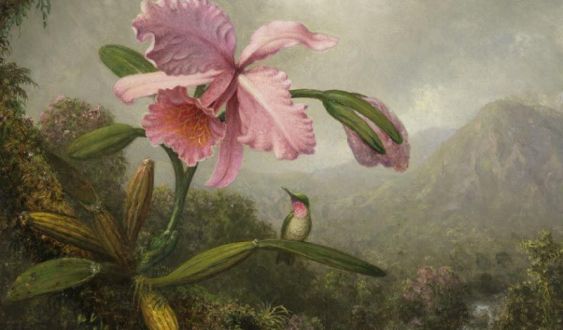
The journey progresses towards the taste for demonstrating botanical knowledge and for reinforcing the symbolic meaning of the landscape (for example, the tropical image is insisted upon as a synonym for earthly paradise). The Orchid and Hummingbird Near a Waterfall by Heade, which serves as the cover for the exhibition, highlights this meticulous desire to make nature explode in its splendor.
The transition to impressionism and how, beyond that, the avant-gardes dye the landscape with the color of new trends is captured through a cast of prominent names in Catalan painting. With spectacular gardens by Rusiñol at the forefront (that sensual and insinuating blue-green), very interesting pieces by Josep Amat Pagès, Eliseo Meifrèn Roig, Josep Maria Mallol Suazo, Pere Gussinyé, or the Frenchman Camille Pissarro can be seen. The visitor feels that modernity and the fleetingness of time transcend the canvas and the landscapes themselves. The marked playful tone or the touch of avant-garde also flickers in the paintings of Miquel Villà, Pere Créixams, or Juan Alberto Soler-Miret (who paints, precisely, a Homage to Heade where the showy flowers already gesticulate to leave the painting).
The culmination is the homage to Sacharoff, of whom La llotja i La colla is exhibited, where some of her artist friends can be seen. We have just appreciated work by some of them. For once, the tables are turned, the mirror tilts: it is a painter who has portrayed them, them.
Add The New Barcelona Post as your preferred Google source for free
Stay informed with the latest news.