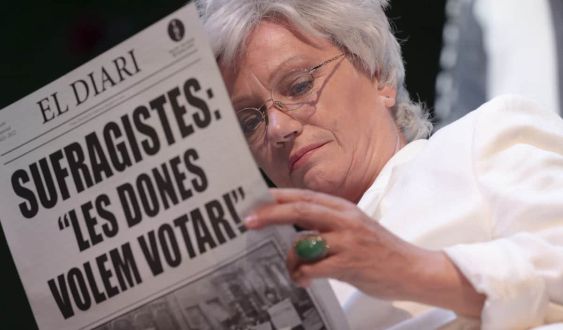
Gabriel Ferrater said about Víctor Català's pseudonym that it would be better if we all renounced it as soon as possible: "Because it is a ridiculous pseudonym and, in the end, it has to give way. Nowadays, no one says Fígaro when they want to talk about Larra; there are few people left who say Clarín when they want to talk about Leopoldo Alas, and, inevitably, no one will say Víctor Català in fifty years when they mean Caterina Albert."
More than fifty years after these words, the debate about whether to continue saying Víctor Català or to speak of Caterina Albert remains alive and pertinent, while interest in the writer has been rekindled beyond Solitud ---recently translated into Spanish---, about which the poet poured everything he wanted to say about the writer.
A matter of names
Biographical approaches such as those by Mita Casacuberta have helped us clarify that Víctor Català was much more than the literary pseudonym of Mrs. Albert, in the manner of a modernist epigone of the nineteenth-century George Sand (Aurore Lupin) or Fernán Caballero (Cecilia Böhl de Faber). It was a mask upon which a literary project was built.
In fact, fifty years after Ferrater's prophecy, we have not stopped talking about Víctor Català, but we have begun to question myths about the writer, which he, like others, swallowed without question. This debate of names and lives comes to mind with the premiere of La Víctor C., directed by the new director of the TNC, Carme Portaceli, which can be seen in the Sala Gran until Sunday, November 7.
Anna Maria Ricart, responsible for adapting classics such as Jane Eyre or The House of the Spirits, has expressly set aside the classic Solitud, to focus on the more autobiographical writings of the writer from L'Escala, especially those collected in Mosaic, recently reissued by Club Editor.
Mrs. Caterina's bed
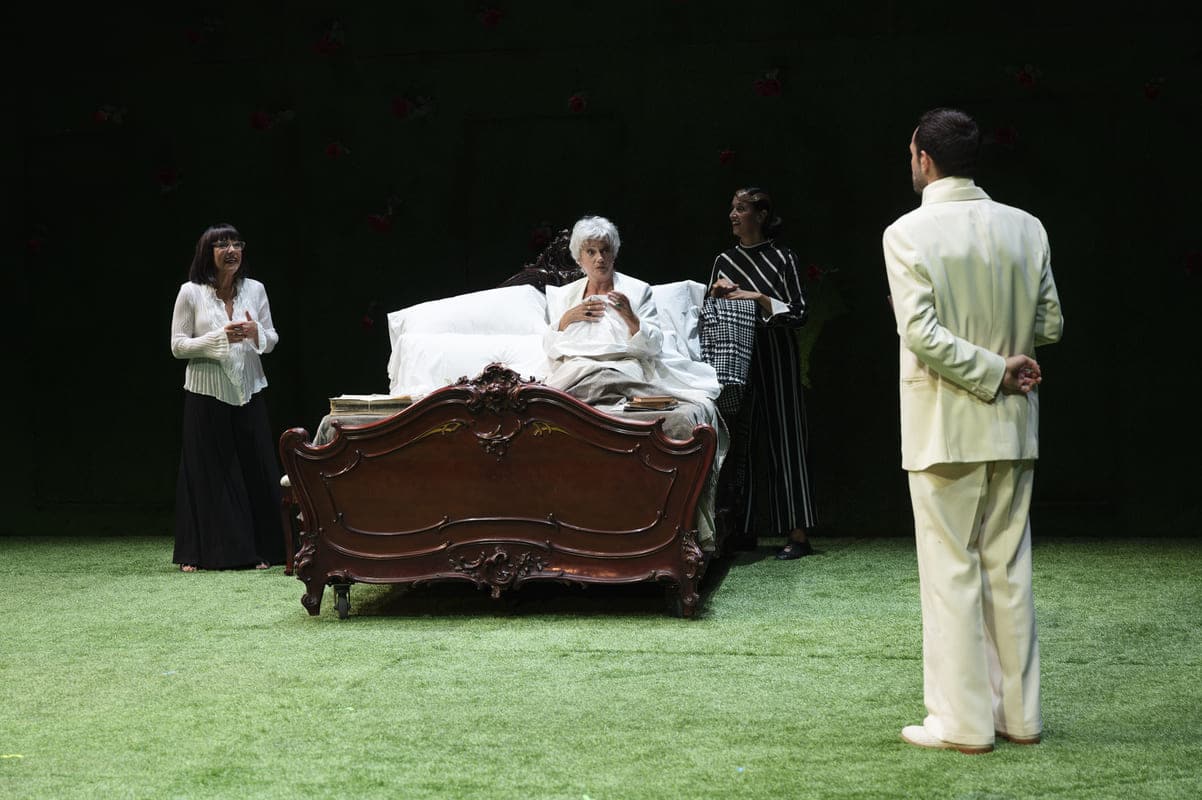
In the set design by Paco Azorín, a large bed presides over the play for a good while, on the theater stage designed by Ricardo Bofill. It is the bed where Caterina Albert decided to spend her last years and where, with her nightgown clean and white, she received visitors. A bed that, like Josep Pla's beret, served as a lightning rod, an anecdotal resource behind which she protected her personal truth. Her freedom.
The bed occupies Paco Azorín's set design. It is the bed with which Caterina Albert protected her freedom.It is in bed where Mrs. Caterina receives a journalist from L'Escala, partly inspired by the interviews she gave to Tomás Garcés and Baltasar Porcel, whom she warns not to ask her about "that," meaning those more intimate questions that have turned the writer into a subject of speculation: her single status and relationship with men, alleged lesbianism, androgyny, or the questionqueer avant-la-lettre.
To avoid these issues and, especially, the theories that wanted to see symbols, metaphors, and subtexts in her novels and short stories, Albert resorted to the appearance of a woman without reading curiosity, practically secluded in L'Escala, but who was completely unaware of the sea, all intuition, a simple amateur categorized as a rural author. Just as years before the masculine pseudonym had allowed her to approach the deepest themes of the human soul ---that four-wind chamber with a gloomy window that was her favorite---, without overly scandalizing the prudish fin de siècle society. She had already scared them enough when she presented La infanticida at the Jocs Florals of Olot!
Rosa Renom's La Víctor
That mask was a big lie, as Amelia, the writer's sister, reveals to us, recalling the European trips, the Barcelona residence, the sea outings of a character full of charisma that the great Rosa Renom has built without any desire for imitation, making it her own. Only the white wig can evoke the writer, with whom the Sabadell actress has no resemblance whatsoever. In her, we will see "her Víctor" ---or Caterina, because the C in the title plays with ambiguity---, around whom the rest of the characters revolve, as if it were a Greek chorus.
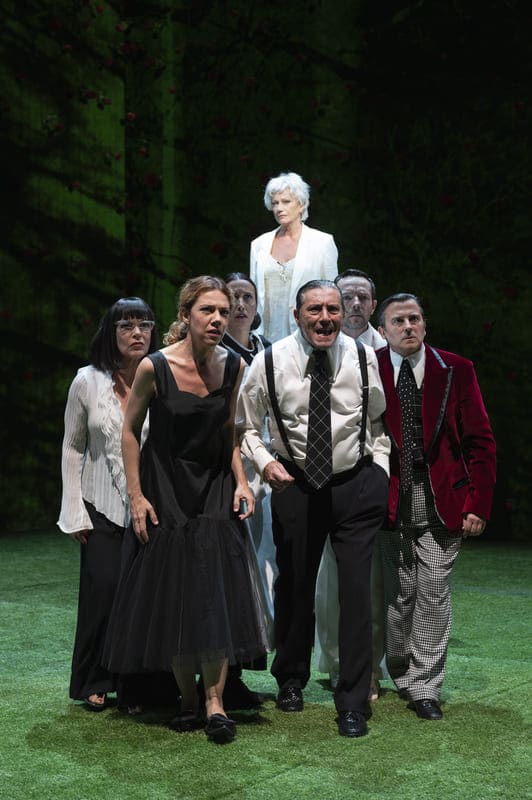
Rosa Renom, without any desire to imitate her, has managed to create her Víctor CatalàFerran Carvajal, Lluïsa Castell, Oriol Guinart, Olga Onrubia, Manel Sans and Anna Ycobalzeta are in charge of bringing to life both the characters who surrounded Caterina Albert's life ---Joan Maragall, the bullfighter, actor and poet Mario Cabré, the local chronicler, the sister, friends and the maid, the Olot jury...--- and the protagonists of her short stories. In this sense, it must be said that the play is excessively long when the narrative takes center stage, especially the long and dramatic short story ofL'Aleixeta, which ends up turning the protagonist-writer into a wallflower in her own work.
Víctor Català was born to hide the true name of the author of a monologue, who above all wanted to stand out in the theater. Now it is her life ---and everything she could not completely hide--- that becomes theatrical material, at a time when we are experiencing a true victorcatalana obsession. We may be left with the doubt of what she would think of all this, but we would never know if behind the mask ---or the face mask--- she smiles with satisfaction.
Add The New Barcelona Post as your preferred Google source for free
Stay informed with the latest news.