
Around 800 residents, 320 businesses, and 460,000 visitors accommodated per year. These are some of the data that depict the Rambla of the present, and which are now being collected to outline that of the future. Taking advantage of the avenue's renovation, Amics de la Rambla has launched an observatory to gather, organize, and analyze data, with the aim of facilitating decision-making and measuring the repercussions of those decisions taken for the city's most emblematic street.
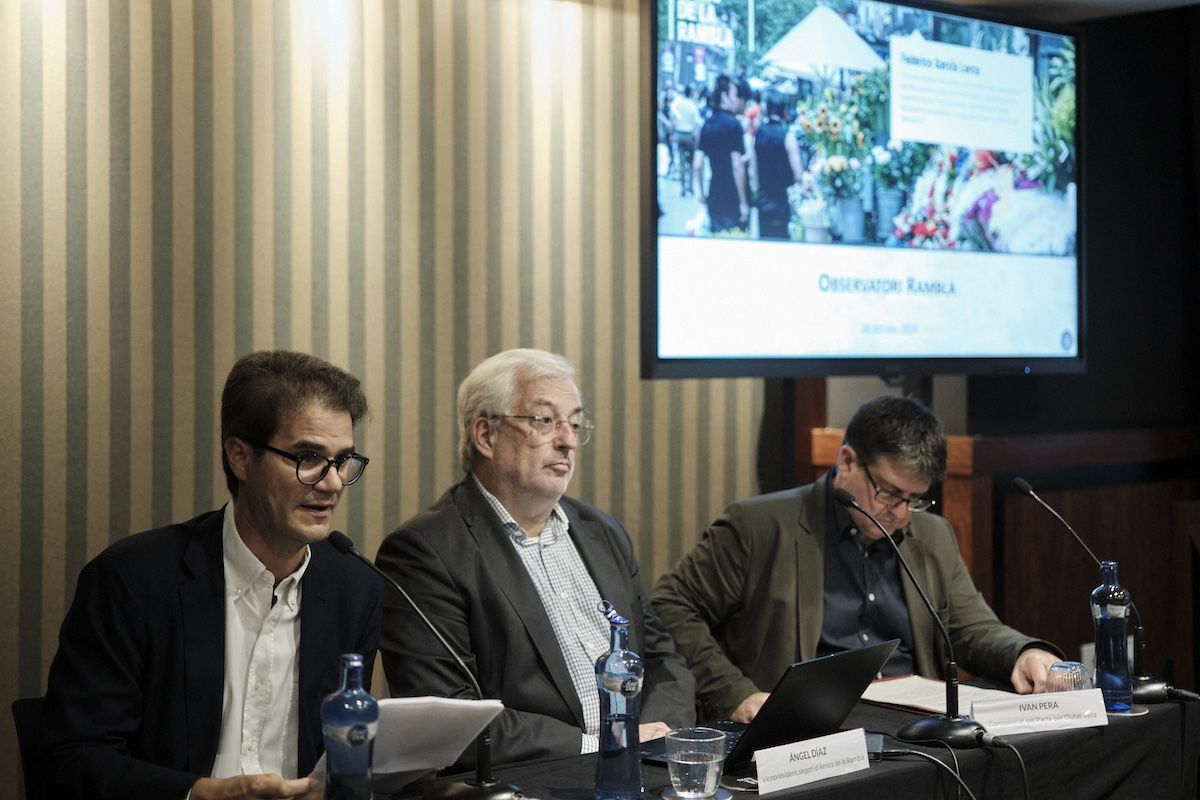
"Barcelona is an increasingly attractive city and we have to think about how we manage that attractiveness," highlighted the head of the initiative and second vice-president of Amics de la Rambla, Ángel Díaz. And it is that the Rambla is as emblematic as it is complex, and at a time like its renovation "it is fundamental to make decisions based on reality and knowledge." In this context, the observatory looks at the promenade from a social, economic, and tourist point of view, also in its relationship with the rest of Ciutat Vella and the city as a whole, with the desire to act as a meeting and reflection point to imagine and build the Rambla of the future. All of this, with two premises: the preservation of its legacy, and the transformation of what does not fit with the model that the avenue is intended to embody.
The observatory, which plans to produce reports periodically, will work to collect and analyze data that will allow "sizing facilities and services," including security and cleaning, as well as the cultural offerings of the Rambla, according to the president of the entity, Pau Bosch. To promote the avenue as a cultural hub, the street could expand its offerings through buildings currently without activity, such as the Club Capitol and the Principal, as highlighted by Bosch, who recalled the association's commitment to opening the Territori Rambla space to promote and disseminate its offerings.
For the launch of the observatory, Amics de la Rambla has an agreement with the company inAtlas from the Informa group to have access to data affecting the promenade in an organized manner. In addition, the entity has the support of the City Council and GetYourGuide, in an initiative that "can help consolidate sustainable tourism and generate a positive impact on local communities," according to the company's Regional Manager of experiences, Toni Bennasar. To move in this direction, according to the City Council's Commissioner for Ciutat Vella, Ivan Pera, it is necessary to have a data-based diagnosis, "that goes beyond what each person sees from their balcony." For this reason, from other spaces, an observatory and think tank on Ciutat Vella is also being promoted, and an advisory council on La Rambla will soon be presented, to help rethink and revitalize it after its reform, which is expected to finish in 2027.
460,000 accommodated visitors
According to the first data from the observatory, La Rambla has nearly 800 registered residents, more than half of whom are foreigners, double the global figure for the city. Of the foreigners, 40% are from European countries, 28% come from Asia, 22% from the American continent, and another 10% are originally from Africa, "a very different composition from the rest of the city," according to Díaz. In addition to being multicultural, La Rambla is young: 46% of its residents are under 35 years old, and 41% have a university education. The average household expenditure and average income are below the city's global average, at 24,500 euros and 28,200 euros, respectively.
And the visitors? The observatory quantifies more than 460,000 tourists staying in La Rambla annually, which represented 1.6 million overnight stays last year. Also in 2023, it is estimated that 76% of tourists staying in La Rambla were foreigners, above the 69% average for Barcelona. Of these, 75% stayed in hotels and guesthouses, also higher than the city's 71%, with an average expenditure per tourist of 1,041 euros, also above the city's average of 896 euros.
The observatory not only seeks data to help quantify how many people the avenue attracts, but also wants to analyze what they focus their experience on in La Rambla. Based on GetYourGuide data, the new body will analyze which proposals gather the most public, of what type and according to their origin, since not all nationalities enjoy La Rambla in the same way. The range is wide: it goes from museums to shows and events, including seaside walks. Close to 50% of the reservations registered for the different proposals of La Rambla come from France, Italy, the United States and Germany, and close to 30% of tickets are bought on the same day, while 37% are acquired up to a week in advance.
La Rambla has five sensors to analyze the flow of people walking along the avenueThe new body also focuses on the economic dimension of the street, where 320 companies operate, which together invoice 445 million euros per year and employ 1,800 people. Of these, 32% are engaged in commercial activity, while 22% correspond to hospitality. "La Rambla is one of the economic engines of the city and we also have to look at it from an economic point of view," Díaz claimed.
In addition, the observatory proposes not only to analyze La Rambla, but also its surroundings, either by census sections or by district. The viewer also extends to the 15-minute Rambla, the one that can be reached on foot from key points in a quarter of an hour. In it, the data expands, and for example, companies become more than 16,000, with a turnover of 13,000 million euros and 88,000 employees.
Apart from the data on overnight stays, cultural reservations, residents, and businesses, there is another crucial piece of data that conditions any reflection or planning of the avenue. How many people walk along La Rambla? This figure is already being studied through sensors located at strategic points along the avenue, which also discriminate by repeated pedestrians. This will provide a more accurate figure than previous counts, such as the one a decade ago that estimated 100 million people walk along the avenue annually. After installing these five sensors, "more antennas are needed," Bosch said, advocating for sharing data with the three sensors available to the Port of Barcelona that affect La Rambla.
In search of a counterpart
La Rambla will X-ray itself while looking outwards to find someone to reflect on. "We cannot focus only on what we are, but we have to look outwards, towards other models, other realities and other mistakes," Díaz pointed out. In this process, La Rambla has not yet found a comparable model to bet on, not even in large emblematic streets, such as Times Square in London, the Champs-Élysées in Paris and Fifth Avenue in New York: the first impulse is to compare itself with them, but they do not respond to the same models as La Rambla. Thus, the Barcelona promenade is in search of streets with high traffic and historical and cultural personality and character to look to.
In this process, the Rambla Observatory will act as a "tool to generate knowledge to be able to make informed decisions and assess the consequences of the decisions that are made," Díaz concluded. All of this, with a main objective: to decide and promote the role that La Rambla wants to play in the future and in the city, to invite not only visitors, but also Barcelonians, to approach the avenue and redefine the concept of ramblear.
Add The New Barcelona Post as your preferred Google source for free
Stay informed with the latest news.
