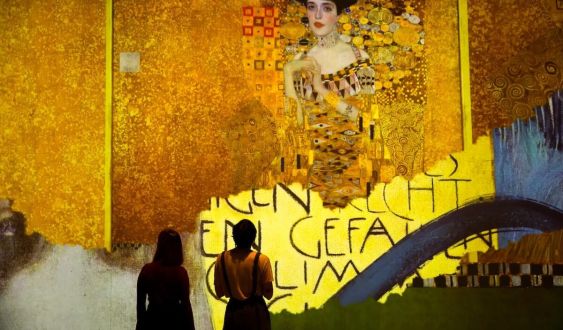
Gustav Klimt was born in Vienna during the golden age of the Austro-Hungarian Empire, a city very interested in promoting decorative arts and which, above all, took care of its artists. Straddling Symbolism and Art Nouveau, and a founding member of the Vienna Secession group of artists, his work is characterized by the ornamental use of gold—an influence from his father's work as a gold engraver—along with geometric motifs, and the exquisite balance between curved and straight lines of the feminine bodies of his femmes fatales.
The sensuality that permeates his work even led it to be described as pornographic, which caused Klimt to stop accepting commissions, but not to refine his style, borrowing from the German poet Schiller the maxim "If you cannot please everyone with your merits and your art, please a few. To please many is bad," which he even included in his Nuda Veritas.
From the hand of the Belgian studio Exhibition Hub, we receive a spectacular exhibition that allows us to feel the essence of the painter through his artistic career, and analyze his role in the birth of two of the most important movements of his time: modernism and feminism. In turn, it establishes links between artists and activists from Vienna and Barcelona at the end of the 19th century, unknown until recently.
The curators of this exhibition, which mixes art and audiovisuals, Imma Fondevila and Theresia Nickle, wanted to highlight the spirit of modernization embodied by Klimt and link it to the Catalan Modernism movement. But perhaps more interesting is how they have linked the painter's work and his representation of femininity with the gestation of feminism at the end of the 19th century, dedicating an exhibition space to the general context of women of the era who fought to participate actively in society and who, even today, remain almost anonymous.
Fashion designer and businesswoman Emilie Flöge stands out, who for a long period maintained a romantic and mutually inspiring relationship with Klimt, representing that new modern woman. There is also another space dedicated to ladies where important women from activism and feminism in Catalonia and Austria are compared.
Premiered simultaneously in the Catalan capital and in Brussels, the proposal is suitable for all audiences and consists of large-format immersive projections on more than 1000 square meters of screen, a virtual reality glasses experience, different exhibition spaces and interactive tools that allow the viewer to feel inside the paintings and buildings where Klimt intervened, such as the Secession building, where in 1902 he painted the great frieze in commemoration of Wagner's interpretation of Beethoven's Ninth Symphony, the famous Kiss, Judith or The Tree of Life, among many other pieces.
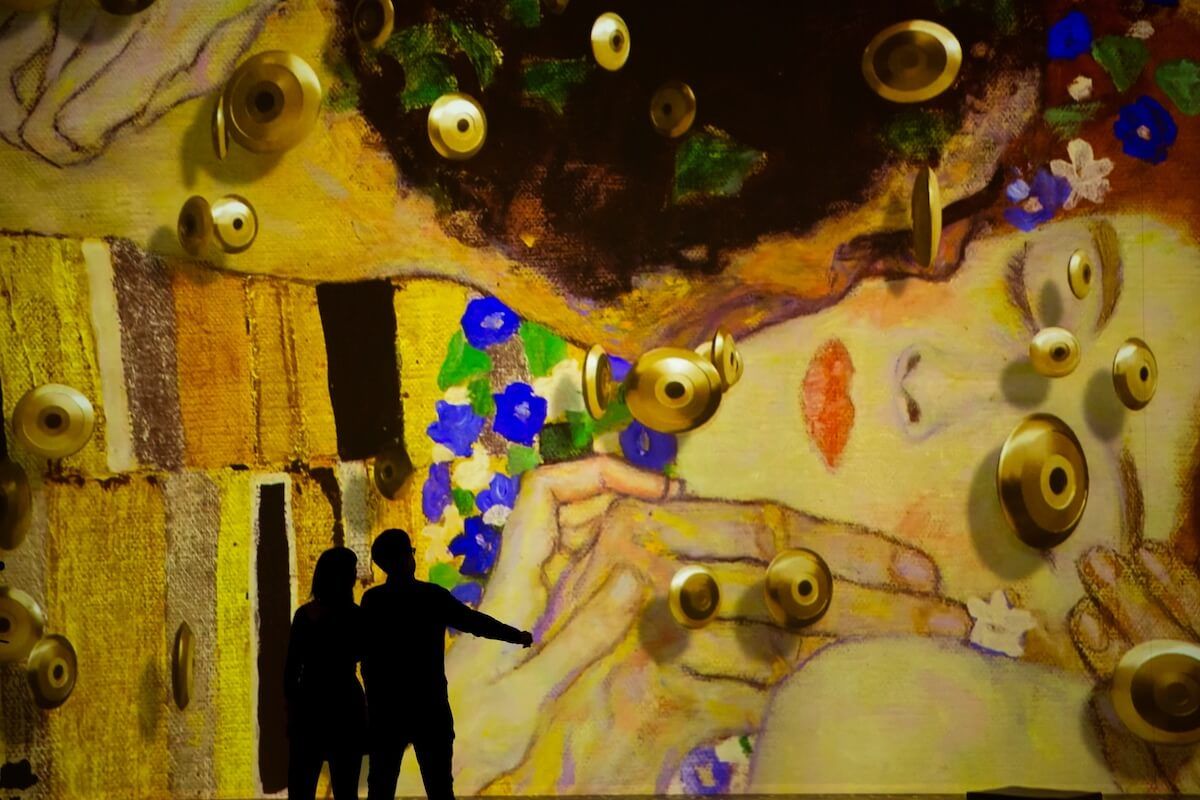
It is not the first exhibition of this type organized by the IDEAL Digital Arts Center, as we already enjoyed the exhibition dedicated to Monet in the summer of 2020 or the more recent Barcelona Photographic Memory. What is new is the 300 square meter interactive room that, maintaining the appearance of some elements of its previous use ---Taoist Chinese Temple of Barcelona---, has integrated them by enhancing experimentation with digital arts. Here we can find the VIENNA 1900 installation, where the viewer can interact on a 180-degree screen. There is also a parallel scenic proposal of music and other performances, which will liven up the sunset once a week in a space inspired by the Kabarett Fledermaus, a Viennese venue from the early 20th century where Klimt and other artists belonging to the Secession collaborated.
The proposal is suitable for all audiences and consists of large-format immersive projections on more than 1000 square meters of screenKlimt said "I am sure that, as a person, I am not particularly interesting. I have nothing special.Whoever wants to know something about me must carefully observe my worksand so it is. Although the Nazis burned a large part of his paintings, if something those that have survived to this day show us is his inexhaustible passion for women. He loved many throughout his life and was discreet about his relationships.
Never a scandal came out of the doors of his studio. And seeing his paintings, we can realize that women fascinated him until his last day. They, from their paintings, seem to murmur siren melodies, like that song by María José Llergo that says "I am like gold, the more you despise me, the more value I gain", and it is as true as the figures that the Portrait of Adele Bloch-Bauer II has reached, becoming the third most expensive work of art in history.
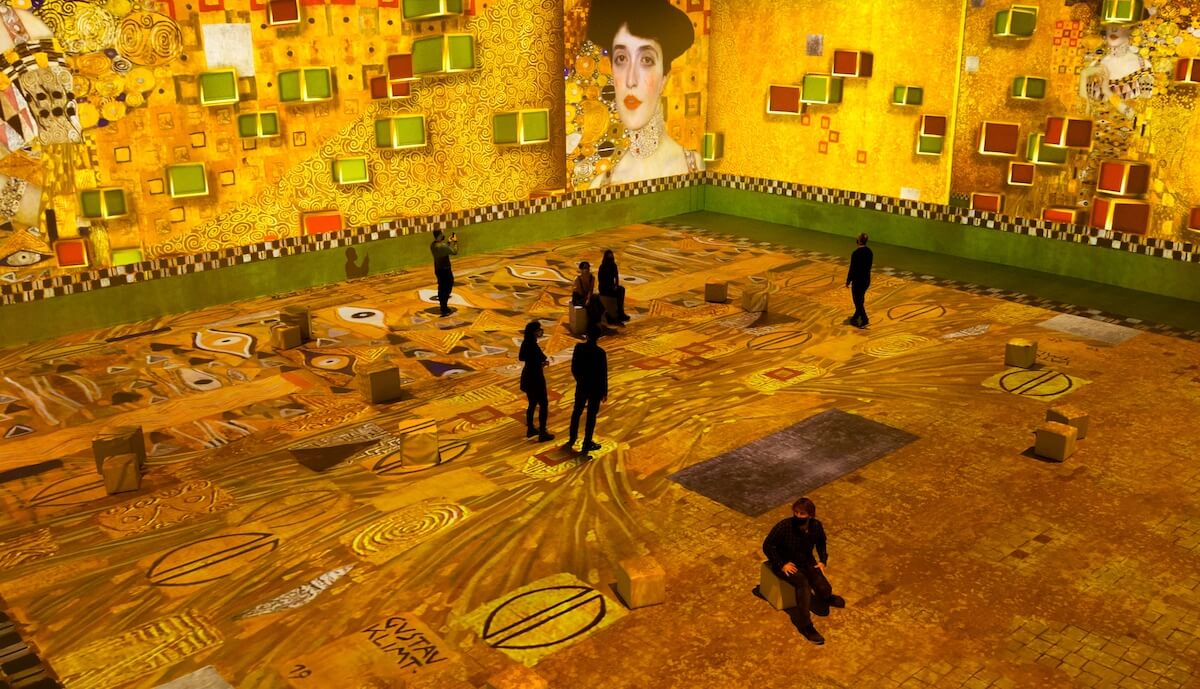
Initially, the exhibition was going to end on May 16, but tickets sold out quickly and Ideal extended the calendar until the end of August. Until then, we have the possibility of immersing ourselves in the brilliance of Gustav Klimt's gold leaf, of looking over the edge of the cliff of his famous Kiss, and of dreaming, for an instant, that we are nereids floating in a sea of light.
Add The New Barcelona Post as your preferred Google source for free
Stay informed with the latest news.
