Keybotic is expanding its client portfolio in Spain with its robot-dog, which patrols chemical plants to autonomously detect anomalies and incidents. After closing 2023 with purchase orders worth 500,000 euros, the company founded in 2020 by Irene Gómez and Hilario Tomé aims to reach one million euros this year: "The goal for 2024 is to double last year's result," says Gómez.
The deep tech startup is in the process of delivering the first ten of its automatons to clients in the chemical sector nationwide, such as Carburos Metálicos, Basf, and Kao Chemicals. Now it is preparing for its internationalization, with the forecast of launching it next year. The co-founder and CEO of the startup reveals that foreign companies have already shown interest in Keyper, their robot-dog. "We have postponed international deliveries precisely because we want to be very close to our clients," according to Gómez. In this context, the company is finalizing the partners with whom to enter new markets and embark on an internationalization that they face with good prospects. In fact, Keybotic has received requests from markets such as Japan, Malaysia, Singapore, South Korea, Hong Kong, and Chile: "We haven't gone looking for them; they come to us because this need exists."
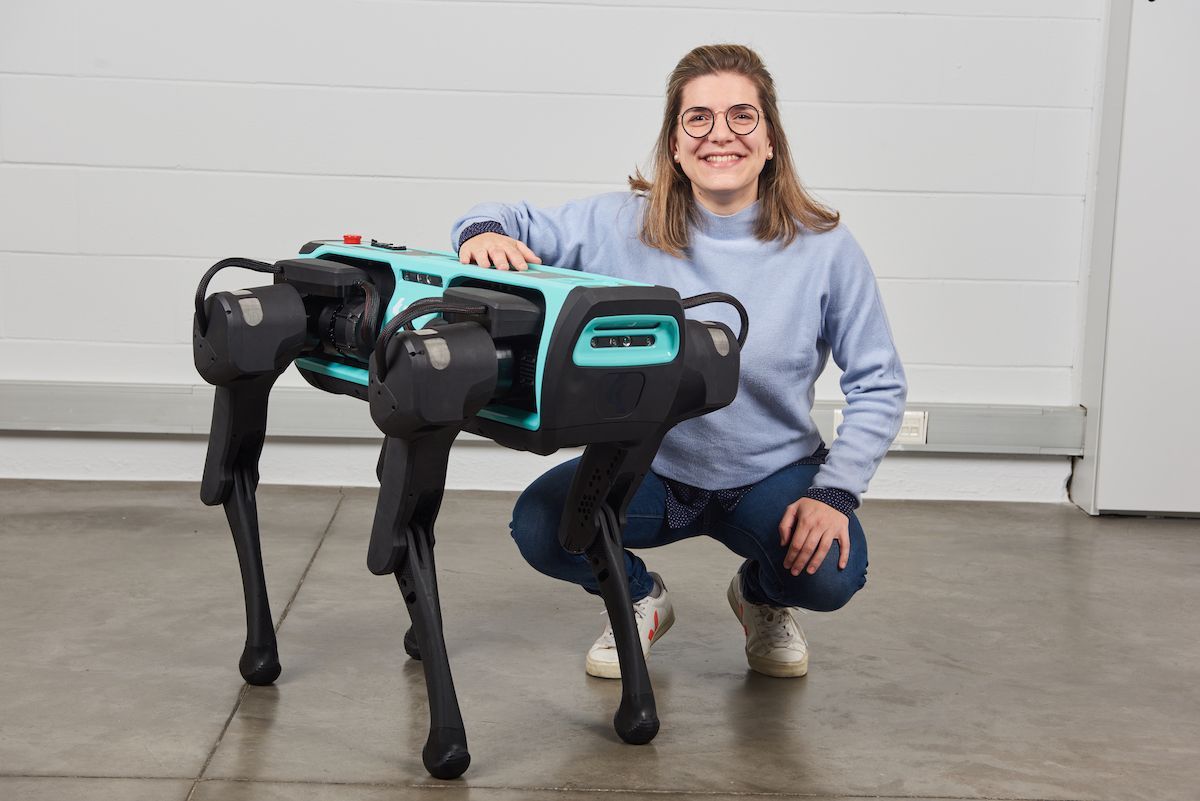
And it is that their robot represents an innovative proposal for detecting anomalies and sending real-time alerts. To detect them, Keyper has the ability to conduct inspection rounds in industrial areas autonomously, through its advanced camera, sensor, and gas detector technology, which allows it to go beyond the human eye and capture irregularities that are sometimes imperceptible to the senses. With these characteristics, the robot increases safety and sustainability standards in the plants it patrols, which have real-time information on what is happening in their facilities.
Furthermore, its quadrupedal structure is key to providing it with greater movement capacity, and forms a "very stable machine that can go wherever anyone can go." Thus, its four legs allow it to inspect the plant without stairs, pipes, and uneven surfaces posing an impediment to its rounds. Despite being prepared to work in complex environments, its handling is designed to be operated simply: "Only basic safety rules and programming its mission are required. The goal is for anyone to understand how it is used," highlights Gómez.
Keyper's functions and capabilities, moreover, are constantly evolving. "We are an R&D company, and 76% of our budget goes to this area. We will always be focused on launching new evolutions or new robots," assured the co-founder of Keybotic.
In addition to opening Keyper to new markets, the company is also looking at new sectors. One of them is mining, which connects the startup with its origin: searching for people trapped in caves and underground galleries, although in that case it was virtually. It was in 2020, during the most relevant robotics award worldwide, organized by the US agency Darpa. The Subterranean Challenge competition attracted professionals and teams from all over the world, Hilario Tomé among them. Despite competing with contenders such as a team of 40 people from MIT, Keybotic's co-founder won the challenge.
The software of Tomé's proposal, of which Gómez was part at a strategic level, won a prize of 750,000 dollars, with which they have developed Keybotic. After winning this award in 2020 —equivalent to the "Nobel of technology"—, the company began designing its first robot in 2021, which was ready in 2022 and began reaching customers in 2023. Now, and just one year after closing an investment round of three million euros, the startup focuses on consolidating its client portfolio and propelling its international expansion strategy.
Add The New Barcelona Post as your preferred Google source for free
Stay informed with the latest news.