A silent, but profound, change is shaking Barcelona's art scene. Traditional limits are shifting, established frameworks are being questioned, and new ways of producing, exhibiting, and inhabiting art are emerging. This revolution is led by a new generation of artists who experiment and open paths, accompanied by gallerists who are also dismantling paradigms and stereotypes of the art market: rethinking how discourses are constructed, how to connect with the public —including young people— and what it means to collect today.
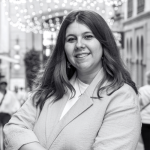
Breaking stereotypes is, at heart, the starting point of Juliana Sorondo's project, founder of Sorondo Projects. Faced with the image of the gallery as a hermetic space and collecting as a territory reserved for a few, her project aims to open, bring closer, and stir, with the goal that art be accessible to everyone and, at the same time, invite reflection on profound issues such as identity, community, or diaspora. Her trajectory also does not fit the usual narrative: she does not come from a family linked to art nor did she grow up among collectors. Her approach to art was, in reality, through fashion, fascinated by designers like Alexander McQueen. Before imagining herself as a gallerist, she saw herself as an opera stylist. "Nobody grows up thinking they will be a gallerist," she assures. "It's an abstract profession, almost invisible."
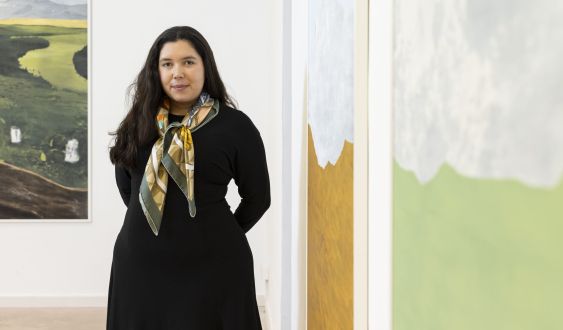
This rethinking of the gallery is reflected in each of Sorondo's exhibitions. These days, Sorondo's white room is filled with color with Montaña Sagrada, by Suwon Lee, an exhibition that well synthesizes the spirit of Sorondo Projects: works that seduce from a formal point of view —for their serenity, their composition, and their use of color—, but which contain a strong conceptual, even political, charge.
— How did your relationship with art come about? What is your first memory?— The first time I intuited that art interested me was in a crafts class at school. I have the privilege of coming from a country, Venezuela, where there is a deeply rooted awareness of the importance of creativity and art. In my case, fashion fascinated me, but little by little I discovered that behind it there was something much broader: references, stories, universes. I realized that what really interested me was not just the object, whether it was a piece of clothing or a painting, but the story it contained and its ability to build worlds and narratives.— When do you decide to dedicate yourself professionally to art?— At fifteen, I decided I wanted to study art, although that didn't mean I wanted to be an artist, much less a gallerist. I think no one grows up thinking they'll be a gallerist, because it's an abstract, almost invisible, and extremely misunderstood profession. I studied a bachelor's degree in arts in Venezuela, which I combined with fashion design. Although I didn't know how to paint or produce work, I was interested in understanding it, analyzing it, reading it... from a curatorial or cultural management perspective. And, somehow, life led me towards gallery work. 
— So, your approach to art was more conceptual than technical.
— But without forgetting the form. In fact, for me, this balance between conceptual load and formal investigation is fundamental. A good artist must build a universe, develop a discourse, but also work with materials and question the limits of disciplines. If a work is only political, but lacks a solid formal investigation, it loses interest; and vice versa.
— Precisely contemporary art is often perceived as too conceptual and hermetic. How can it be brought closer to the public?
— When a work has a lot of conceptual weight, gallerists play a key role as mediators: we help to explain it, analyze it, and generate dialogue, but always from proximity, never from superiority. But if the work has a powerful visual dimension, it can attract even those who don't understand the concept or art, drawing attention through color, texture, or composition. This interest is already an excellent starting point, because it awakens questions and curiosity.
"I think no one grows up thinking they'll be a gallerist, because it's an abstract, almost invisible, and extremely misunderstood profession"
— In your gallery, you work with concepts like diaspora and identity. Where do these concerns come from?
— Undoubtedly, they stem from my personal experience: after graduating in arts, I came to Barcelona to pursue a postgraduate degree in styling for visual theaters. I wanted to be an opera stylist, but the reality was complex: I was in an irregular situation for over a year, working in precarious conditions. This feeling of being between places generates many questions about identity: who you are, how you define yourself, how you are perceived.
In addition, I observed that Catalan galleries worked mainly with local artists and that there was little Latin American representation. For this reason, I decided to bet on these creators, working mostly with Latin American artists, especially women, such as Suwon Lee, María Elena Pombo or Lucrecia Lionti. But I decided to broaden my view and also represent artists who perhaps do not yet have much presence in the Catalan scene, such as the Russian artist Nikolay Morgunov. All of them are artists with a strong discourse on alterity and community.
"Art can be part of anyone's life, it is not a luxury reserved for a few"
— How do you come to found your own gallery?
— After more than twelve years working in various galleries and discovering their inner workings, I felt ready to create Sorondo Projects, also with the intention of breaking some rules of the sector that seemed indestructible.

— What did you want to do differently?
— I have always had a notepad on my phone titled "for when I have a gallery". There I wrote down ideas, artists, dream exhibitions. Little by little I materialized them. But, above all, my goal was to create more horizontal processes. I am not interested in the figure of the gallerist as an authority, but as a dialogue, someone who works alongside the artist. I like to build accompanying relationships, not just represent on a one-off basis.
In addition, I try to foster connections between artists: that they themselves propose collaborations or dreams they would like to fulfill, and see how these relationships continue beyond the exhibition. Sometimes I feel like a proud mother or aunt when I see long connections being created between artists.
"While sharing a flat with seven people, I saw a tourist buy a 6,000 euro artwork almost without thinking. And I thought: how can someone spend so much while others face economic difficulties?"
— How was the process of understanding art from a market perspective?
— It was a complex learning experience. I remember when I was doing my internship in a gallery, while sharing a flat with seven people, and seeing a tourist buy a 6,000 euro artwork almost without thinking about it. This episode generated an internal conflict for me: how can someone spend so much while others face economic difficulties?, despite being aware of the value of art. I feel more comfortable working with emerging or mid-career artists, with more accessible prices.
— Art continues to be perceived as a luxury.
— Unfortunately, yes. And it is fundamental to dismantle this stereotype that art is reserved for the wealthy. We also need to break with certain social norms: there are still those who believe that one can only enter a gallery in a suit and tie or with prior knowledge. The reality is that you can come however you want, even in a tracksuit, with a coffee in hand or with your shopping bags. Galleries must be accessible and attractive spaces for all audiences.
But it is also a matter of perception: there are original works by emerging artists for 200 or 300 euros, and many galleries offer installment payment options. I myself started my collection this way. I like to claim that I am a collector, even if I don't have great pieces or great purchasing power, precisely to claim that anyone can be one, with an obvious economic effort. In the end, it's about defining priorities and investing in what really excites you, whether it's a work of art, a culinary experience or a ticket to the opera. Art can be part of anyone's life, it is not a luxury reserved for a few.

— How could collecting be encouraged among young people?
— With transparency and communication: showing prices, making information accessible and eliminating that sense of opacity that often surrounds the art world. But it is also a structural issue. Public incentives would be needed, such as a reduction in cultural VAT, because in the end everything responds to the same mentality: if institutions conceive art as a luxury, it is logical that citizens also perceive it that way.
Specific measures could even be considered to encourage young collecting, reducing VAT on the first work acquired by a collector and applying it progressively as the collection grows. In Barcelona there are very interesting initiatives to bring culture closer to young people, such as LiceUnder35 or Cultura Jove, but there are no specific policies aimed at the field of galleries and contemporary art.
"If institutions conceive art as a luxury, it is logical that citizens also perceive it that way"
— What role can emerging galleries play?
— We are breaking the distance with the public. We want people to enter without fear, not to feel out of place: to create spaces that do not intimidate, but invite people to enter. Galleries are free and accessible spaces, where you can look, return, have a coffee, reflect and feel curious, without the pressure to buy. Emerging galleries in which, moreover, a different model of representation is promoted: establishing more horizontal, human and committed working processes with artists.
— Is it difficult to attract young audiences?
— It's still hard, but it's possible through clear communication, accessible texts that can excite both the expert and the outsider, and the potential of social media. It's key to generate this sense of community: for people to come back, bring friends, and feel part of something.

— And can this community also become a collector?
— Of course. You never know where a purchase might start. It has happened to me to be explaining an exhibition to a group of teenagers and someone who was listening ended up being interested in the work. Taking care of the community and working with honesty eventually pays off, even if not always immediately.
"Galleries must stir, generate questions, emotions and reflection. That visitors leave with unease, not with closed answers"
— What should a gallery achieve?
— To stir, generate questions, emotions and reflection. That visitors leave with unease, not with closed answers. That something they have seen makes them think about other cultures, realities or ways of thinking. The essential thing is that art leaves you thinking.
We must not forget sales, of course, nor fall into too naive a discourse: attracting collectors is fundamental, because artists and gallerists need to live from our work. It is not about hiding it or feeling ashamed to sell, but about doing it with respect and humility towards all audiences. In the end, any visitor can become a buyer or a support for the project.

Questionnaire
— A contemporary art fair?
— Liste Art Fair, in Basel.
— An emerging artist we should know?
— Luis Rentería. His work is consistent with his context and, at the same time, recovers traditional techniques such as textile.
— Which work would you like to have at home?
— Any by Teresa Lanceta.
— An exhibition in Barcelona that you have liked or been moved by in recent months?
— Un lugar en el mundo, by Karlo Andrei Ibarra at the Zielinsky gallery. His work is magnificent, extremely political and, at the same time, fun.
— And, a lesson you have learned about the art world?
— The art world is tough and heavily conditioned by the political and economic context. As a gallerist, supporting artists involves assuming production costs that are not always recovered if the works are not sold, which can lead to losses. I am learning to seek a more sustainable balance: finding ways to accompany that do not depend solely on economic investment, but also on time, visibility, and commitment.
Add The New Barcelona Post as your preferred Google source for free
Stay informed with the latest news.