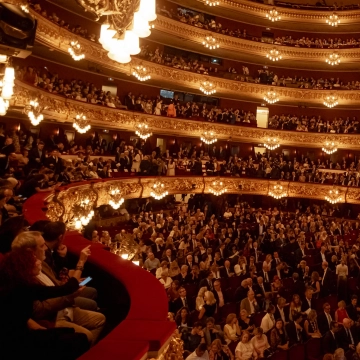
If I were running a musical institution built around a symphony orchestra—especially one that was not among the top tier but clearly had the potential to improve—and I were looking for a chief conductor, Josep Pons would undoubtedly be one of my leading candidates. Looking back over the career of the maestro from Puig-reig, it is striking how many ensembles he has either built from the ground up or left in a far stronger state than he found them: the much-missed Teatre Lliure Chamber Orchestra, the National Youth Orchestra of Catalonia, the City of Granada Orchestra, the Spanish National Orchestra and, finally, the Symphony Orchestra of the Gran Teatre del Liceu. The latter is perhaps the clearest example of his gift for institution-building. During his tenure, Pons has forged an orchestra capable of producing a sound that can stand comparison with many of Europe's finest ensembles.
Now that he has taken his leave to sustained ovations, crowned by a monumental performance of Mahler's Eighth Symphony, the time has come to take stock of a tenure that has been overwhelmingly successful. The Liceu's artistic leadership would do well to regard it not as the culmination of an era, but as the foundation on which to build something even greater. Pons, I insist, has laid the foundations of an orchestra that now plays better than it has in decades and possesses a distinctive musical identity. At the same time, however, it must be acknowledged that his relative lack of experience in the operatic repertoire was not without consequences. Opera demands a conductor who understands that musical expression is inseparable from the movement on stage and from the constantly shifting stylistic requirements of the repertoire. Pons has never conducted an opera badly, but neither has he given us a truly landmark interpretation. The reason is straightforward: throughout much of his career he came to canonical masterpieces—Verdi's Falstaff, for example—remarkably late, conducting them for the first time only after arriving at the Liceu.
Aware of these limitations, the theatre's management quite sensibly steered Pons towards the composers who best matched his musical instincts, particularly Wagner and those who followed him: Britten, Debussy, Shostakovich and Janáček, all of whom inspired performances of considerable distinction. To be fair, he has also proved an outstanding Mozart interpreter. Regrettably, though, and through no fault of the maestro himself so much as the institution's reluctance to take artistic risks, we heard far too little contemporary opera during his tenure. Productions such as George Benjamin's magnificent Lessons in Love and Violence in the 2021 season deserved to become part of a broader commitment to repertoire that challenged audiences instead of endlessly recycling familiar titles. What can perhaps be attributed to a certain excessive restraint on Pons's part—as one of our own—is his failure to press more forcefully for the revival of our own operatic heritage.
It is worth reminding those who may have forgotten—or prefer not to dwell on the fact—that the Liceu is Catalonia's foremost publicly funded cultural institution. One of its principal artistic responsibilities is to preserve, champion and place in context the country's own operatic tradition. After all, if for the past fourteen years the Gran Teatre has been led by a management and artistic team made up entirely of Catalans, how can no one be troubled by the fact that our language and our composers continue to receive little more than token representation on its own stage? It bears repeating, however tiresome it may sound: if we do not perform and uphold our own music with the seriousness it deserves, who on earth can we expect to do so? Pons could have pressed the Liceu's leadership more forcefully to put an end to this regrettable anomaly—particularly given his deep appreciation of the quality of this repertoire. I have no doubt that he tried, but good intentions alone are not enough to bring forgotten operas from the archives onto the stage.
From February onwards, coinciding with the beginning of a new Ring cycle, the Liceu will welcome its new chief conductor, the Englishman Jonathan Nott. Last April I had the opportunity to hear the Solihull-born maestro conduct Messiaen's magnificent Turangalîla-Symphonie at L'Auditori, and he struck me as a musician through and through: an inspiring leader on the podium, blessed with impeccable technique. Unlike Pons, and thanks to his years at institutions such as the Frankfurt Opera, Nott has been conducting opera regularly for almost four decades, which should ensure a seamless transition into the core repertory. Even so, if I were in the Liceu's management, I would take a thoroughly pragmatic approach and build his programming around the repertoire that best suits his strengths. However much attention each generation chooses to lavish on stage directors or star singers, the true driving force behind any great opera house remains the musical vision and judgement of its chief conductor.
Be that as it may, Josep Pons leaves the Liceu with every reason to feel proud of what he has accomplished, and it is only fair to hope that, after a suitable interval, he will one day return to the theatre. Indeed, one could argue that his natural home lies closer to Carrer Lepant than to La Rambla... but that, as they say, is another story.
Add The New Barcelona Post as your preferred Google source for free
Stay informed with the latest news.