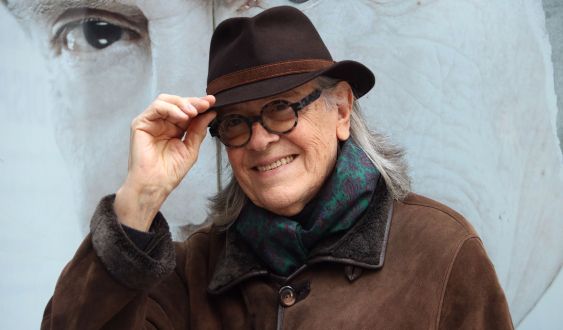
After a long and storied career – and having fielded countless requests to write his memoirs – Josep Maria Flotats has found the most honest way to look back: taking to the stage alone through the literature of one of his favourite authors. This Saturday, 14 November, the Teatre Romea raises the curtain on La promesa de l'alba, the premiere of a self-devised project in which Flotats handles the adaptation, direction, and performance of a story rooted in the narrative universe of French writer Romain Gary, translated by Salvador Oliva.
The production marks Flotats’s return to the Romea two seasons after the triumph of Voltaire/Rousseau. La disputa. Speaking at this morning’s press presentation, the theatre’s artistic director, Josep Maria Pou, welcomed back one of the essential figures of the country’s stage: “We are thrilled to once again host a production by Josep Maria Flotats. Now he brings us a world premiere – a deeply personal project that is, in all likelihood, one of the most intimate works of his career.”
The rapport between the two stage veterans was palpable throughout the event. Indeed, Flotats thanked both Pou and the Focus group for placing blind faith in a staging they agreed to produce without having seen or read it beforehand, noting that today’s presentation coincided with a landmark date for them both: “Thirty years ago today, Josep Maria Pou and I premiered Angels in America at the TNC. It was an unforgettable experience for both of us, and remembering it today moves us deeply – not least for all the colleagues who took part and are sadly no longer with us.”
An author who is also the portrait of an era
The project began the moment the Voltaire/Rousseau tour wrapped up. Flotats set aside the notion of writing a conventional memoir and instead set about revisiting the books, music, and memories that have shaped him over the years. During that search, he reconnected with Gary’s autobiographical novel. “I started rereading it at home and didn’t get up until I had finished it. And at that moment I knew this was the story I wanted to share with audiences,” the actor explained.
Flotats finds in Gary’s literature the exact mirror of the society and cultural values.
While the show takes its title from the novel, the stage script does not merely transfer the book onto the boards: it interweaves passages drawn from other works and writings by the French author to forge an original dramaturgy. Flotats’s bond with Gary stretches back decades: in 1980, just as the actor was embarking on a chapter in Paris at the Comédie-Française, the writer took his own life. Although the two never met in person, Flotats finds in Gary’s literature the exact mirror of the society and cultural values that welcomed and shaped him as an artist and citizen in the French capital.

An impossible promise and the imprints of the craft
At its core, Romain Gary’s story – spanning a childhood in Russia to a youth scarred by war and exile – is the tale of the bond between a son and his mother, a visionary woman who prophesies a glorious destiny for him, and to whom he swears he will live up to that impossible dream. It is a raw narrative, yet brimming with irony, tenderness, and humour, serving Flotats as a vehicle to reflect on the very essence of theatre.
“For an actor, the past is not merely their own life, but also the sum of all the characters and identities that have inhabited them”
“For an actor, the past is not merely their own life, but also the sum of all the characters and identities that have inhabited them,” he reflected on the Romea stage, celebrating the privilege of having coexisted with extraordinary beings throughout his career: “When a character weeps, the tears are real. They are the tears of the actor inhabited by that character. And in this coexistence lies a profoundly poetic dimension.”

With La promesa de l'alba, Josep Maria Flotats signs his second stage adaptation of a narrative work, more than three decades after Ara que els ametllers ja estan batuts (1990), drawn from the writings of Josep Pla. Thirty-six years on, he repeats the experience by turning to another writer’s words to revisit his own memories and affirm the lasting imprint left upon us by lived experiences and affections.
Add The New Barcelona Post as your preferred Google source for free
Stay informed with the latest news.