
At the age of eight, Jordi Sierra i Fabra suffered a serious accident thanks to which he understood that in his life he wanted to be a writer and nothing more than that. "I went through a glass, which almost left me without an arm and without a nose. I spent a long time in the hospital and there, unable to read, I started writing. I understood that I was born for this," he explains, leaning on the bar, in front of a lemonade and with Annie Briggs' version of Baby I'm gonna leave you, performed by Led Zeppelin, playing in the background.
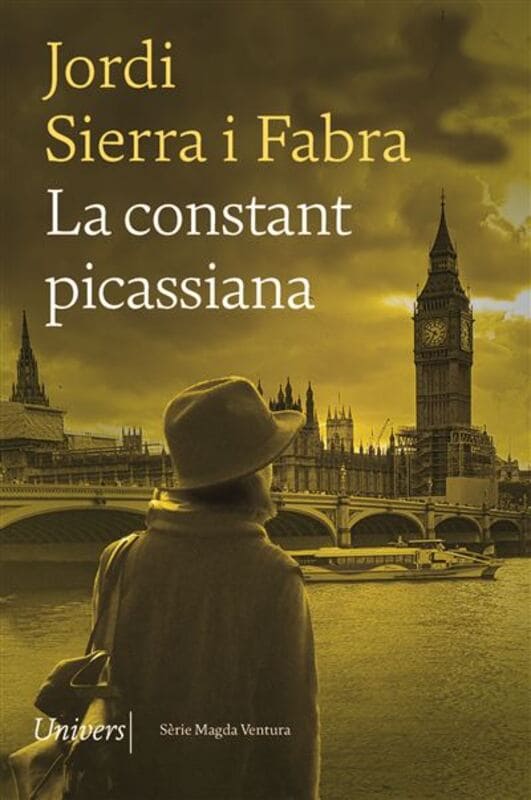
"Nobody could stop me," he continues, "neither my father, who thought writing was a waste of time that would lead me to starve, nor school, nor the bullying I suffered from my classmates because I was also a stutterer. Every blow made me stronger." By the age of 12, he had written a large number of stories and even a five-hundred-page novel, and now, at 76, he is close to reaching six hundred works, including young adult, detective, biographies, music books, and already canonical characters in our literary heritage such as Inspector Mascarell, Commissioner Soler, or Magda Ventura. Her latest adventure, La constant picassiana (Univers), has just landed in bookstores, after a work of only twenty-seven days between the script and the writing of the work, "to which must be added the incalculable time it takes to research and shape the story in your head, before getting down to work."
--Okay, but less than a month to write this book! Amazing!
--And wait, I already have Magda Ventura's next novel finished and delivered for release next year. It will be titled La conversió de Habib!
A constant challenge to destiny
"When it was my turn to go to the military, I bribed an officer to declare me unfit. I risked a lot, because that could have ended with me behind bars." But the plan worked out, and in the year he would have had to be parading under the Ceuta sun, Jordi got married, had his first daughter, and published his first book. It wouldn't be the last time he took a risk.
At 22, he worked in construction, studied, and collaborated in the music press. That's precisely where he saw a possible future. "I got into music to become known and, that way, be able to dedicate myself to writing". One day, a golden offer came his way. "They proposed that I join as director of Disco Express." But instead of saying yes, before he even finished hearing the offer, he took another gamble. "The only way I had to get my father to respect that I was going to dedicate myself to this was to earn more money than him, who at the time earned thirteen thousand pesetas a month, a good salary. So I told Disco Express that I would accept if they paid me fifteen thousand, which was a huge salary. I spent a week terrified. If they said no, I would continue working in construction and lose a great opportunity. Finally, they said yes, and when I told my father, he was amazed.
In 1976, at thirty years old, the writer was one of the most respected names in music journalism in Europe. "I traveled first class to New York and London, went to concerts, dined with musicians, Bowie, Ian Anderson, Incredible String Band, Dylan… Although I never got high on any drug, my head has to serve me for writing." He directed Disco Express, had founded Popular 1, had written the first history of pop ever published in this country, and anyone who wanted to know something about the Who, the Kinks, or John Mayall, had in him the most reliable source. "And then, I gambled again. I left music. I put aside the luxury and power I had, because whether a record sold better or worse could depend on my opinion." But he wanted to write. So, he exchanged Concorde trips to Manhattan for tourist trips to India. "My wife, Antonia, told me 'we'll eat later'." The thing is, once again, facing destiny worked out well. "From that moment on, I'm still involved in music, but tangentially, as an advisor, writing biographies of people like Springsteen, Serrat, or Sinatra; or founding Súper Pop magazine where I never wrote a single line." The point, he emphasizes, is that "if you don't take risks, you don't get anywhere."
Today, writing saves his life. "In November, Antonia, my wife, died in an accident. We had been together for 54 years, since the day I asked her out at La Cova del Drac on Tuset street to declare my love." Thinking and putting stories into words is the anchor that allows him to face such a complicated moment. "That, and the fact that at the Jordi Sierra i Fabra Foundation, we have added another award to the literature prize for young people: the Antonia Cortijos illustration award."

Not murdering the city
To explain the total and unreserved love he feels for Barcelona, the writer refers to an episode in Inspector Mascarell's next adventure, "which takes place during the Eucharistic Congress of Barcelona in 1952. There, a character plans to attack the ordination ceremony of 820 presbyters that took place in the Montjuïc stadium, and Mascarell warns him that if he detonates that bomb, he will not only kill the priests, but he will kill the memory of Barcelona. From then on, everyone will remember it for this event. He will have murdered any other of its attributes."
Tired of the excess of construction, "everywhere and at the same time, throughout the city," the local would not want to live anywhere else. "I could have moved to Madrid in 1974, with the offer to direct my own program on Televisión Española, but I said no. I could have stayed to live in New York or London, when I was involved in the music world. I always miss my city. I travel a lot, but after a month I always need to return."
--- It's just that the food here is very good. Without going any further, in this very Bar we have an unbeatable gastronomic offer, in case you want to eat something after the lemonade.
Jordi Sierra i Fabra pauses, savoring a few seconds of the six minutes of Dylan's Like a rolling stone, which is now playing in the background. Then he speaks:
---My two great vices are Italian pasta and dark chocolate.
---Well, let nothing be missing!
And the local smiles, as Dylan continues, with that expression of someone who recognizes one of his songs to go to the end of the world with.
Add The New Barcelona Post as your preferred Google source for free
Stay informed with the latest news.
