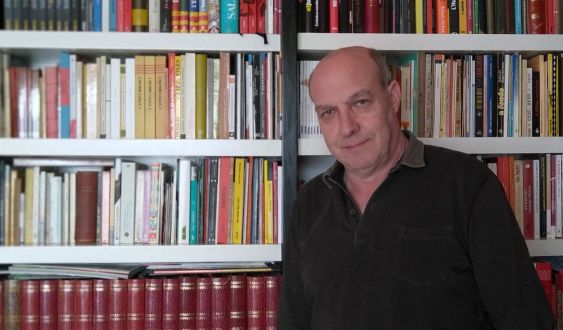
"These are good times for people who like culture. The number of interesting works to discover and enjoy has multiplied thanks to minorities gaining a certain visibility and the powerful recovery of female talent, buried for decades by misogyny." These words gain weight because it is Jordi Riera Pujal who utters them, at the bar, after having chosen to order the same as another patron, to indulge in being able to say "make it two."
Unable to understand what all those people are doing going up and down when he has to get up early, he arrived at the Bar at dusk. "I see no interest in watching the sun rise, I prefer the reds and purples of when it disappears, which anticipate darkness."
Plastic artist with thirty exhibitions under his belt, writer, director of the cultural magazine Tentacles, scholar and popularizer of the world of comics and graphic humor of reference, author or co-author of several titles on the subject, he defines himself as "a man navigating middle age, although if I double my age, the numbers don't add up". His smile betrays deep satisfaction with his new work, the recently published Historia gráfica de la Guerra Civil (RBA), conceived together with Jaume Capdevila: an impressive compendium of graphic humor from the war years, which explains the war and its complexities through drawing and humor. "I loved immersing myself for months in private and public archives to find and select little-known graphic wonders."
A task, that of explaining stories and History through graphic and humorous work, which he also maintains day by day through Humoristan, a digital museum dedicated to graphic humor created by the cartoonist JL Martín and where the patron serves as content director. "There we upload exhibitions, interviews, texts, and many drawings."
--- Between books, exhibitions, talks, and the virtual museum, you must barely have time to breathe.
--- Well, I'm also playing at hiding my contradictions in a novel. I'm optimistic, I believe a day will come when I can give it the green light.
Death (figurative) of a salesman
There was a time when Jordi woke up early. "I sold objects I liked to retail stores for many years. It was interesting to meet people and visit some countries. It was a life like Willy Loman's in Death of a Salesman, with a wife and two children, but I felt mine was closer to comedy than tragedy." At that time, he confesses that he started driving the car early "in autopilot mode" and woke up parking in cities like Manresa, Olot, or Tortosa. "That's where my day began."
In 2009, when he was close to fifty, he suffered the loss of his brother, the clarinetist Carles Riera, "a very close person and a brilliant professional musician." It coincided with the time that the professional sector he was in was on its way to disappearing. "Society's priorities are always changing, and mine at that moment also did."
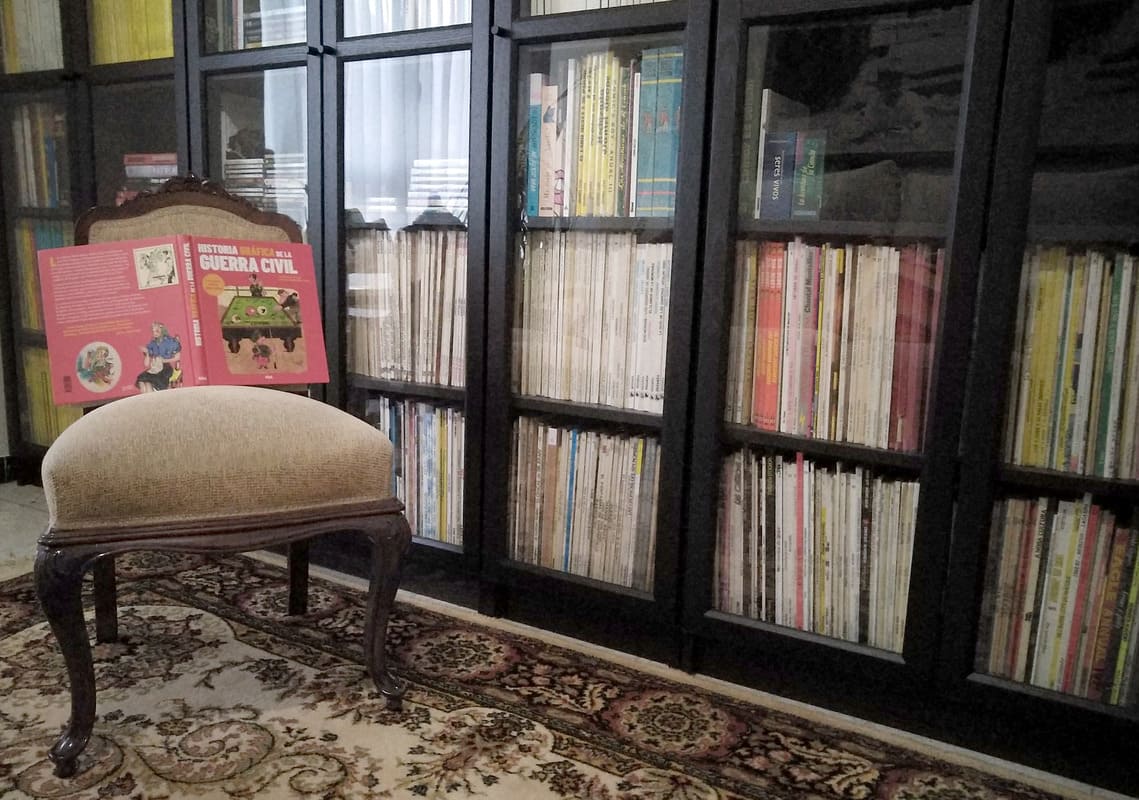
It was then that he decided to take the plunge and write a book about the history of comics in Catalan. "To my surprise, the guild of comic strip scholars accepted me as one of their own. I transformed into a researcher and disseminator of cultural content related to drawings and history." This is evidenced by a frantic activity that has characterized him in recent years.
"In my professional life, I would highlight the ability to tell stories and make them interesting to some people. I think stories serve to help fill the void we all carry. I believe it was Ricardo Bofill who once said that the satisfaction from the successful completion of a creative work should last the span of an orgasm. I tend to think that having ideas and projects makes you feel more alive than the act of finishing a project."
A city where life accelerates
"For those of us who live in the metropolitan area, Barcelona is our capital. Where interesting things happen. A space where life accelerates. It's always a pleasure to discover its corners," explains the local, who identifies the city with his primal notion of freedom. "I remember as a very young boy going down with my family to the Capsa theater to see El retaule del flautista. We were at the end of Francoism, almost everything was gray, boring, and mediocre. That musical in Catalan with modern staging, an unpretentious performance, and a message that seemed transgressive to me was etched in my memory. Another reality was possible. I didn't stop until I got an album containing the songs, which I played a thousand times."
Part of that extremely free spirit seems to have been buried by "the puritanism of the city's current rulers. I'm not interested in their sermons, nor the imposition they make of their city model. Barcelona has always been the sum of many Barcelonas".
--Just like our culinary offer! We have everything for you to have a good dinner: menu, à la carte, tapas, portions, sandwiches, or the always helpful combined dishes.
Jordi Riera Pujal then lets out a loud laugh: "the combined dish, I don't know if it will be politically correct to say it, I think it's an aberration." And he continues laughing with the complicity of other locals.
--- I hope the Club of Defenders of the Combined Dish doesn't sue me. In my opinion, tastes should be mixed in the stomach, not on the plate or in the mouth!
Add The New Barcelona Post as your preferred Google source for free
Stay informed with the latest news.
