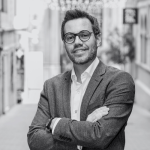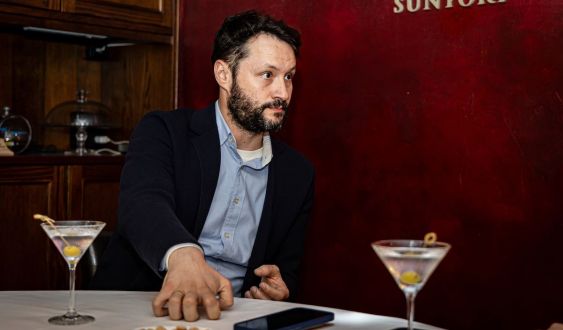
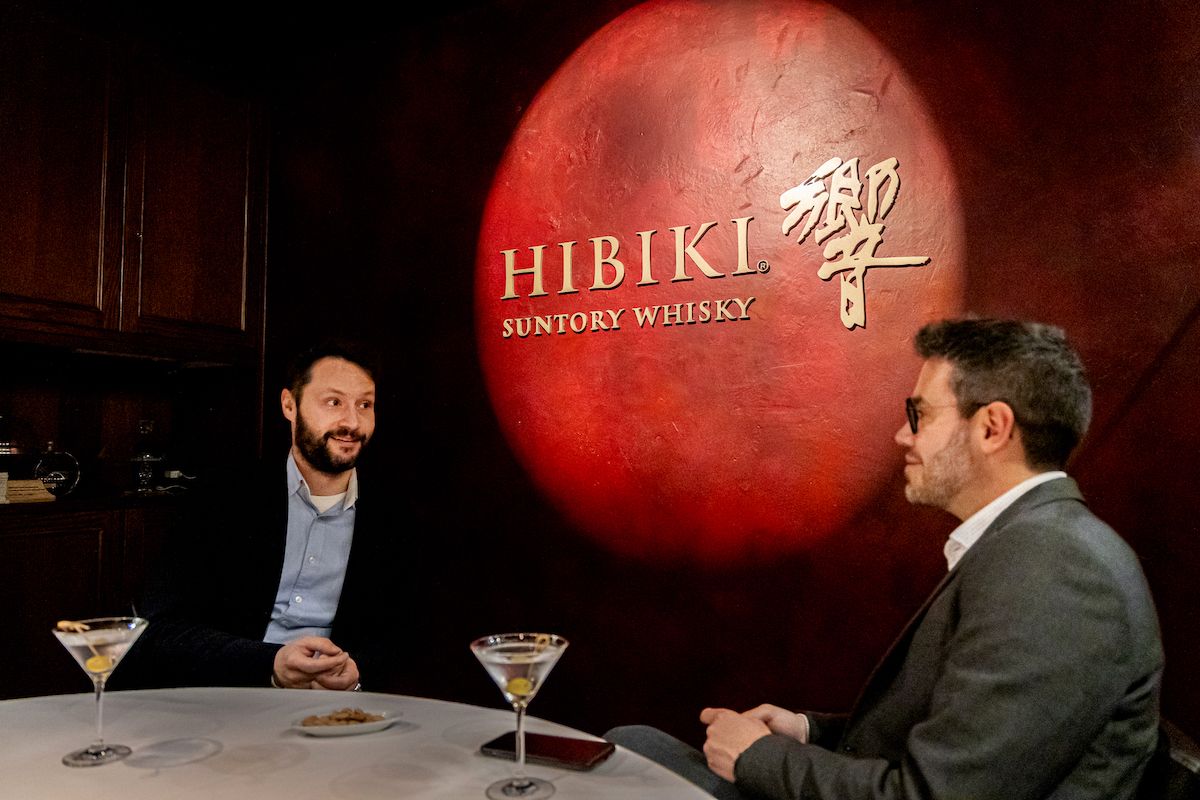
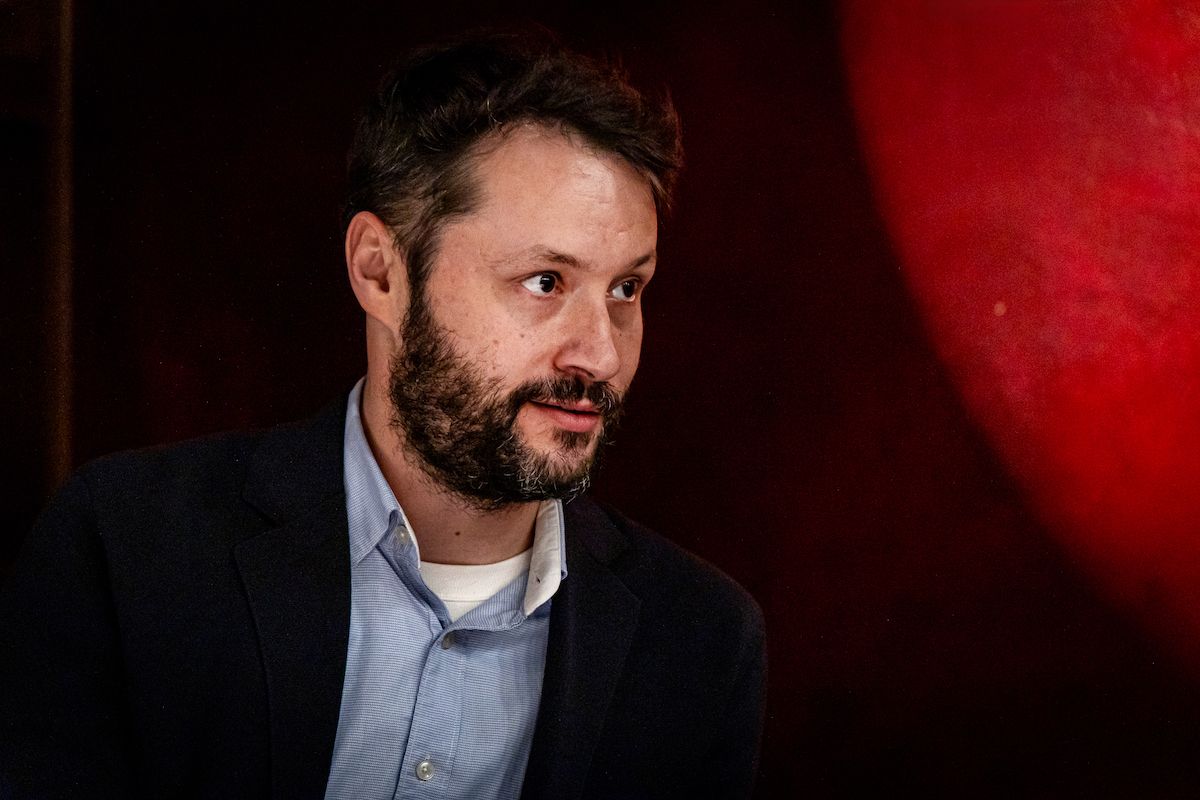
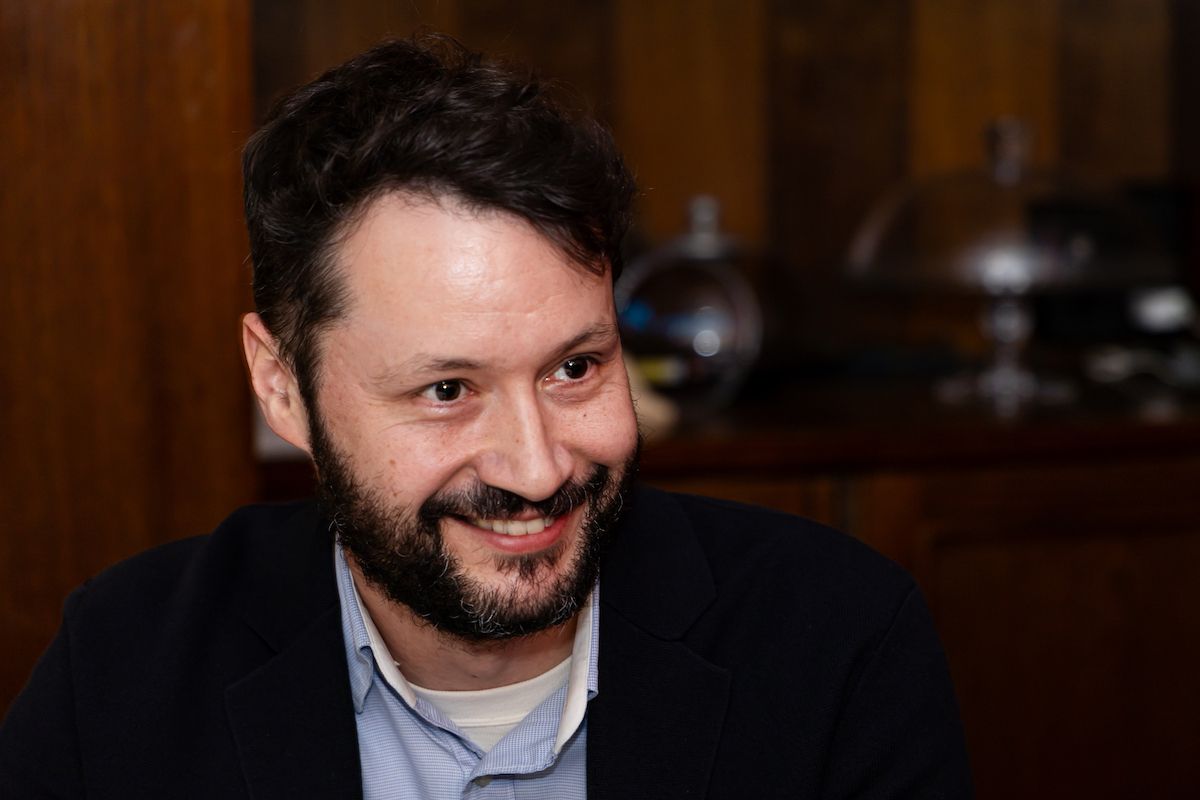
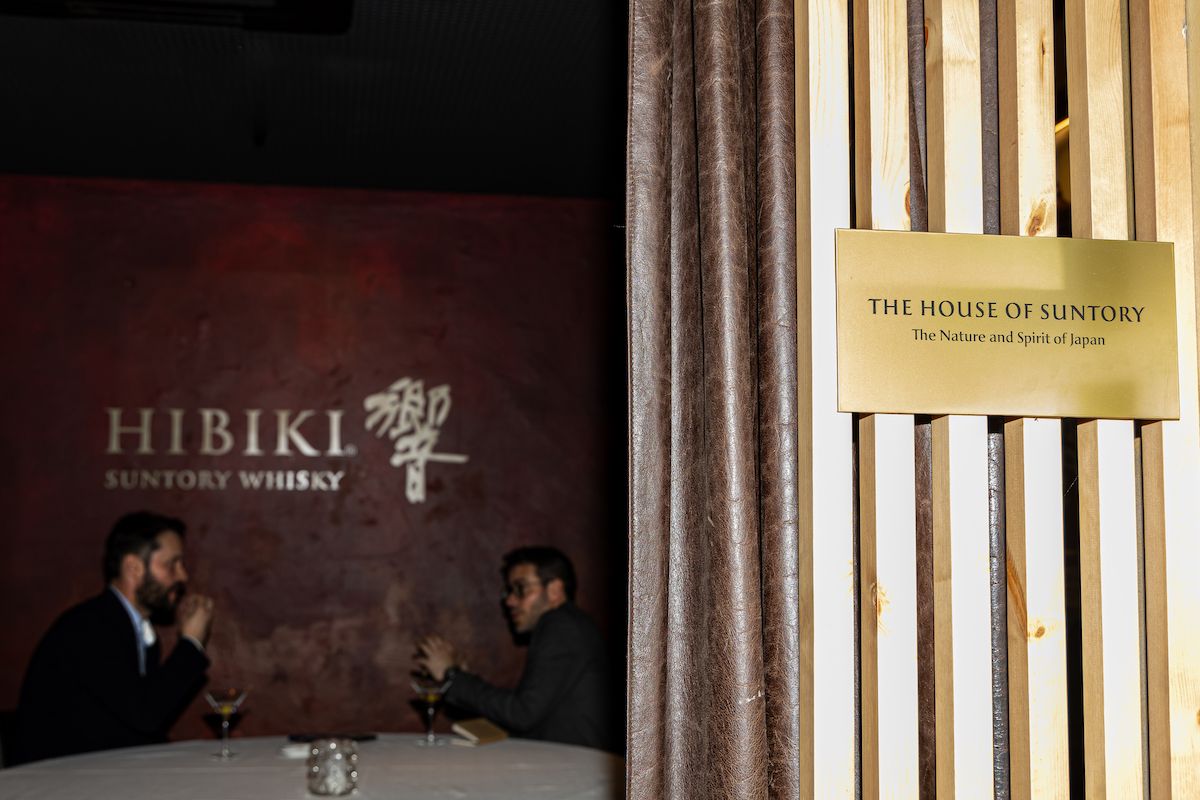
There are interviews that happen in a place. And there are others where the place also interviews. At the Speakeasy restaurant of the Dry Martini, amidst the elegant gloom, the noble wood, and that feeling of a well-kept secret, Jordi Diaz Alamà fits in as if he were a character written for the scene: painter, entrepreneur, cultural executive, and a rare bird in the best sense. The conversation moves like himself: between ambition and irony, between classical discipline and the constant need to break molds. The result is the portrait of an artist who not only wants to paint, but always push the limits of his own path a little further. At the Speakeasy, where everything seems to have a touch of ritual and confidence, Jordi Diaz Alamà speaks as he paints: with ambition, intuition, and a constant discomfort with repetition.
--- Jordi Diaz Alamà: I am a very fortunate person. Very ambitious. I have always pursued my dream since I was little. I am very nonconformist and, even if I find a formula that works —a gallery or a style—, I always want to evolve, learn, or simply have a good time. In the end, in this life we have to be happy and enjoy what we do. I am fortunate because my job is my passion. When work becomes repetition —I do a series that works and the gallerist wants more—, for me that stage has already passed and I want to paint something else. This also has to do with the fact that I have the school behind me. I am privileged and a bit of a "weird painter."
--- "A weird painter"?
--- Yes, I am. There's a countercultural aspect, because I direct an academy and also a museum. It's a difficult mix to label. I come from an environment where my father was an entrepreneur, a man of numbers, and all that has permeated me. I have always liked to undertake, but at the same time I am creative and a painter. With the school, I have brought these two passions together: I like to lead, structure projects, and also paint. I have this dual perspective: the family one, more business-oriented, and the facility for plastic arts. Curiously, if I could have, I would have dedicated myself to music. I tried for many years —I still have my saxophone in the studio—, but I saw that it was not my natural terrain. And I stuck with painting, which I obviously also like very much.
--- And how do you discover that you like it and start painting?
--- This gets a bit lost in time. When you are little, teachers or parents detect it. They saw that I had good hearing and a facility for drawing, and they signed me up for both music and drawing. When you become aware of it, you've already been doing it for years. The good thing is to start early, but then you realize that you excel more in one branch than in the other. And in both music and painting you have to throw yourself into it completely: you can't do everything well. If you want to stand out, you have to be 100% involved.
"When work becomes repetition —I do a series that works and the gallery owner wants more—, for me that stage has already passed and I want to paint something else"
--- Even with your style, you're hard to fit in...
---I am very stubborn and very Renaissance. In a context where many references went against what I was looking for, it was very difficult to say that you were a traditional or classical painter. Here, for political and cultural reasons, art has wanted to differentiate itself from a more classical model, more linked to Madrid. We have had references like Miró or Tàpies who have made a big mark.
--- What do you mean by that about politics?
--- Barcelona and Madrid have always had this desire to differentiate themselves. Madrid has represented a more conservative and classical emblem, and Barcelona a more modern and progressive one. When I was growing up, figurative and classical galleries were in Madrid; in Barcelona there were few. Now this is changing, because it also depends on what the public wants. If society demands an art with more tradition or more "craftsmanship", the market adapts. And today the world is much more global: you can paint however you want, and you will find a market here or on the other side of the world.
"Barcelona and Madrid have always had this desire to differentiate themselves. Madrid has represented a more conservative and classical emblem, and Barcelona a more modern and progressive one"
--- I have the feeling that there are painters of your generation who are better known here, but that you, on the other hand, have more of a name abroad.
--- That's how it is. First you have to succeed abroad to end up succeeding here. I don't have it easy either for school or for classical painting, because in Barcelona another type of art has predominated. Now I notice a strong approach towards this painting, but we are still on our way. But it doesn't worry me much either. I want to be able to paint what I want, and if I have a market here, fantastic; and if not, I'll look for it abroad. I'm not in a hurry either. In fact, succeeding too early can be bad. Success has to come when it's time.
--- But you can consider that you have had a certain success.
--- Yes and no. I am very demanding and I still don't consider myself satisfied. And I think that's good. The moment you believe it too much, you stop learning. When I finish a work, a week later I think I could do it better. Maybe I demand too much of myself, but I also think that's what makes me move forward and improve. The difficult thing is to find the balance: if you are too hard on yourself, you stop enjoying, and that shows in the work.
--- You define yourself as a classical painter, but your work has evolved a lot.
--- When I say "classical" I speak above all about the study of tradition: drawing from life, good foundations, and then moving on to painting. A more traditional "kitchen". I didn't go looking for languages like performance or video art, but rather I stayed with Fine Arts. When I was studying Fine Arts, I was already a bitxo raro (strange creature). Even the professors didn't encourage me towards traditional media. They failed me several times, but I also had honors. It all depended on the professor's criteria. In the same subject, one professor could tell me I had innate talent and the other fail me because he didn't believe in that way of painting.
--- And how do you take that?
--- After finishing my degree, I joined as a Fine Arts professor. At 23, I was teaching fourth year. They hired me because I had already studied a year in Florence and had a more solid foundation than what was worked on here. In order to access the doctorate and pursue a career as a teaching professor, I had to go through a master's in painting. And there I had a very bad experience. The drawing department was more traditional; the painting department, on the other hand, didn't even want to hear about classical painting. I entered as a figurative painter, and they made my life impossible. Luckily, there was a professor who told me: "Don't listen to them, keep going, because tomorrow you will be alone and you will succeed." And so I continued doing it, outside the university.
"Picasso broke all the rules, yes, but he knew perfectly well where he came from. The academy gives tools: knowing the “kitchen”, the product, the pigments, the language"
--- And of course you listened to him.
--- This gave me a lot of confidence. I am very stubborn, and I also had people by my side who confirmed that I was on the right track. Teaching, especially in the artistic field, is fundamental to be constructive and not seek to discourage and compete with the student. Due to this discomfort and because I didn't feel in my place, I decided that I didn't want to continue at Fine Arts. After that, I set up my own school, the Barcelona Academy of Art.
--- And at 26, you create the Barcelona Academy of Art which, in a short time, becomes a global reference where people from all over the world come to study with you.
--- I am a bit the soul and the one who designs the program, but we are 40 teachers. When people see the academy, they link it to a very classical art, but if you look at my work, it's not entirely so: I also do abstraction and experimentation. What I defend is the foundation a student should have. In music, no one disputes that one must study solfège and the classics before doing jazz. Jazz is knowing the rules to be able to break them. In art, this reference has been lost. One must have control and criteria. Picasso broke all the rules, yes, but he knew perfectly well where he came from. The academy provides tools: knowing the "kitchen," the product, the pigments, the language.
--- And if that wasn't enough, you also direct the MEAM, the European Museum of Modern Art.
--- I do it for the love of art and out of debt to José Manuel Infiesta, who supported me greatly. When he died, the project was left limping and the team came looking for me. I have been directing it honorarily for more than two years. I like to think about exhibitions and have contact with artists, but what I want is to paint.
"My goal is to end up having a painting at the MNAC"
--- Well, it seems like you're sabotaging yourself with new projects.
--- Yes, but the school is already very organized and I have a team that works on its own. This allows me to pursue opportunities. An artist's dream is to enter a gallery and make a living from it, but I am more ambitious. Many gallery owners want you to repeat a line that ends up boring me. The school gives me autonomy: it pays my bills and allows me to do crazy things or personal projects that a painter who depends only on painting could not undertake. For example, for the church in Vic, they commissioned a two-meter painting and I told them: "Pay me the same, but let me make it seven." I spent eight months producing it. Without the school, this would be impossible. The same with the Divine Comedy series, which took me four years. If I depended only on a gallery, I couldn't have started it. And in the end, it has ended up in important collections and museums.
--- And next challenges?
--- Many. Now, for example, I have just returned from Vietnam. There, they have commissioned a large mural for the hotel-museum. It is an enormous challenge. But my challenge is always to continue producing a new series that is successful. Every year I ask for the same thing: to find new projects and paths that excite me and are more ambitious than those of the previous year. My goal is to end up having a painting at the MNAC. I already have work in museums all over the world, but to be recognized as an important artist in my homeland would be very special.
"Success is a complicated cocktail: talent, perseverance, sacrifice, business vision, and artistic foundation. Talent counts, but it is not the most important; work and discipline are much more so"
--- But how is success achieved?
--- Success is a complicated cocktail: talent, perseverance, sacrifice, business vision, and an artistic base. Talent counts, but it's not the most important; hard work and discipline are much more so. I've met more talented students than me, but I've stood out for hard work, discipline, and instinct to pursue opportunities. And also for ambition. Many painters are excellent, but they settle; I want more, as a personal challenge.

--- For example?
--- Now I've been commissioned to paint the world's largest whiskey bottle in Vietnam and also a macro-mural for a hotel. The price matters little to me: what attracts me is the dimension of the challenge. This motivates me much more than repeating the same painting for a gallery. I really like to work and do new things. This pressure makes me move forward. Right now I'm starting to work with Tang Contemporary Gallery, one of the most important galleries in Asia. The problem is that they like a series that I no longer want to continue working on. Experience has taught me not to suffer, and that new opportunities always arise for what you are doing anew. Furthermore, today I have a lot of direct sales outside of galleries thanks to the visibility that the school and the museum give me.
--- And do you feel like you always have to go abroad?
--- I don't want to leave so quickly; I like to be connected to the public here. I still have a lot to do and create to be fully recognized, but I hope that, with time, hopefully, I will be valued as other artists have been valued. For now, I continue learning, having fun, and avoiding repeating myself. The time to relax will come; now is not the time yet.
Add The New Barcelona Post as your preferred Google source for free
Stay informed with the latest news.