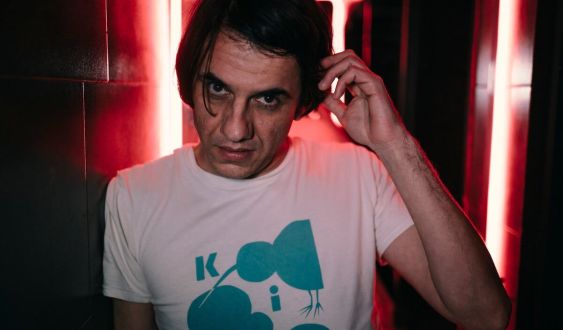
When one meets Joan Colomo, he seems like a person incapable of being sad. Naturally cheerful and a constant joker, the musician from Sant Celoni presents his most pessimistic album, Disc trist (Bcore, 2021), an exercise in high-flying pop nihilism: everything is wrong and there seems to be no way out.
And although it may seem quite the opposite, it is a work written before the pandemic. What Colomo has not lost is his innate ability for melody and playful phrases. As calm always follows the storm, we just have to wait for the rainbow to sprout again from the songs of an essential musician to understand Catalan music of the last decade.
--- Disc trist begins by talking about the inability to be positive. Are things that bad?
--- In the specific case of Cançó animada, the inability is to write positive songs. When I started writing lyrics for this album, they all came out related to negativity. Perhaps it's because of my trajectory, very linked to punk and hardcore, that I've spent my whole life feeling that everything is terrible. I see it as a personal flaw.
--- This punk's No future also hides a nihilistic discourse.
--- Yes, the tendency leads you to fall into it. I try to avoid it because I have hope and I believe that things can change. If you don't maintain this glimmer, you end up entering a well from which it is difficult to get out.
--- In the song En un món paral·lel you talk about an individualistic departure...
--- It's a contradiction: I am against the individualism promoted by certain strata of the system, but sometimes I have little empathy with humanity. I am aware that the feeling of not belonging to anything is pure individualism.
--- As a result of the pandemic, there has been much talk about the dichotomy between individualism and community feeling. How have you experienced it?
--- From an emotional point of view, we have suffered an event that has affected everyone. Although some less than others, since in higher income brackets there have been 45% fewer infections. This means that we all got screwed, yes, but not to the same extent. The feeling of living a historical moment in which we all went together had a beautiful point, but collectivity cannot be understood from obeying uncritically: when there is an imperative order that everyone obeys blindly, start to tremble.
"We have suffered an event that has affected everyone. Although some less than others, since in the highest incomes there have been 45% fewer infections"--- We have obeyed without questioning what was asked of us.
--- It's just that our lives were at stake! Even today I'm afraid of catching COVID, because I've seen people who had a very hard time: young, old, all kinds. You do whatever it takes to save yourself. It's curious because we know perfectly well that we shouldn't drink two beers and get in the car, but in that case we don't obey with such vehemence, even though our health is even more at risk.
--- You are one of those people who had to go through lockdown with small children at home. How was it?
--- Because of my daughters' age, they haven't had the need to go out and see friends, so it was fine, they were delighted to be home with their parents. For me, the fact of not having anything to do for a few weeks was already good, but with children of other ages it must be more complicated. It was exciting to think that you were experiencing the end of the world live and doing it without obligations. I also thought that I wasn't missing any events, a common feeling when you're a parent: I haven't missed any these months.
--- I live very intensely the existential unease of knowing that we are nothing, just a thousandth of a second in the history of the solar system, which is also a tiny bit of the universe. That life is ephemeral keeps me awake at night.
--- Is it the answer to Ode to Joy?
--- Yes, it was the joke. The title is conceived as an opposite to joy. It's like therapy: you have to accept that sadness is not always a negative feeling.
--- I have the feeling that in your previous album you pointed to capital as the culprit for everything. In Disc triste everything is more metaphysical, so to speak. Have you run out of people to blame?
--- I always follow the same process when I start writing an album: I start making songs and when I have a handful of tracks that talk about the same thing, I go that way. In the previous album it happened to me with neoliberalism, but in this one everything led me to sadness: first the music and then the lyrics. There was nothing premeditated.
"I live very intensely the existential unease of knowing that we are nothing, just a thousandth of a second in the history of the solar system, which is also a tiny bit of the universe"--- In Currículum you talk about the things you don't do well, and detailing them is a constant in your songs. What things do you think you do do well?
--- I try to be a pleasant person, so that everyone feels comfortable when we interact. I think I have a certain sense of humor, people have a fun time with me.
--- In the song En Bernat i la Maria, besides being a protest song, you do the closest thing so far to a narrative song. Would you like to delve deeper into that?
--- It's one of those lyrics where I force myself to do something different from the usual. I don't have too many tools when it comes to writing, but I try, from time to time, to go in other directions. To force myself to do something that goes outside my norm. I've always thought that I would like to tell stories in songs, many bands I like do it, like Hidrogenesse, but I lack narrative tools.
--- Many of the pop musicians of your generation have chosen to strip down their songs a lot, but you haven't...
--- Here enters the horror vacui: since I consider that I don't play the guitar too well or sing beautifully, I keep adding layers and layers to cover myself. On the other hand, I've realized, when rehearsing the songs, that this is quite a rock album. My main weapon is eclecticism, I'm not clear about what style I want to do and these things happen to me.
--- Yes, we re-released it on vinyl and I played it at home. All the hatred it generated in me back then, which is something that happens to me with every new album, had vanished. Time has allowed me to see it from the outside and appreciate it properly.
--- Would the Joan of ten years ago like Disc trist?
--- Probably not. You are a slave to trends and back then I hated chorus ---a guitar effect widely used in the eighties--- or Stratocaster guitars ---a classic Fender model--- and now I use them a lot. If they had told me a decade ago, I wouldn't have believed it. Tastes change and, without going any further, five years before releasing the first album, if I had heard it then, it would have seemed terrible to me.
"I've always thought I'd like to tell stories in songs, many bands I like do it, like Hidrogenesse, but I lack narrative tools"--- In Cançó de la por you talk about what keeps you awake and your daughter's voice appears. Is that what it's about?
Everything scares me, but then you have home, where there's your daughter, your partner, family... something that protects you.
--- Avui is to say that they won't be able to against love and color...
--- The album follows the idea that we are aware that tragedies and injustices happen in the world, but at the same time we are capable of living knowing it. And despite everything, I want to be happy, joyful, and have a good time.
--- Will this be a breakup album because of everything that has happened to you this year?
--- It comes from before the pandemic and before my father died last February. The reflections were about the dynamic we were in, without any hopeful future. Then a year came that has been horrible and the album has become premonitory. I was very happy and suddenly I have experienced sadness like I had never experienced it before.
Add The New Barcelona Post as your preferred Google source for free
Stay informed with the latest news.