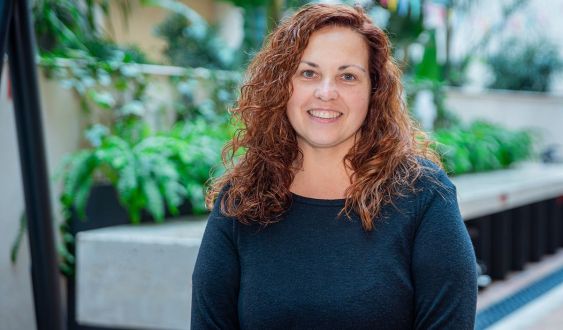
The Taula d'Entitats del Tercer Sector de Catalunya was created in 2003 to represent all Catalan social entities, defend social rights, and fight to eradicate poverty and exclusion, thus reducing inequalities. Jèssica Celda Rescalvo is vice-president of this umbrella organization for people's rights. Specifically, she is responsible for improving the financing of this third sector.
--- How many social entities are represented in the Taula?
--- There are 37 federations that bring together more than 3,000 Catalan entities grouped by thematic areas. There are those dedicated to physical and organic disability, addictions, intellectual disability, childhood... Together, they serve two million people. That is, if we are already eight million in Catalonia, we are talking about 25% of all of us. We must never forget that all these entities are a network of support and accompaniment for people who at some point in their lives need it, because they are at risk of exclusion. And this can happen to any of us. Everyone at any time in life may need this support.
--- How are they financed, where do all these foundations get their resources from?
--- According to the latest barometer, presented on April 28, the sources of financing are diverse. 51% comes from public funds; 31% from self-generated funds, that is, what they can raise in their campaigns, or by doing training, and the remaining 16% comes from the private sector, such as donations from small or large donors, private foundations or companies through patronage. A fact that surprised me is that, compared to the previous barometer, the dependence on public funds has decreased, and own funds have increased. This means that the social sector is moving to have stable financing to serve the needs of people. And this is also thanks to donors and anonymous people who participate.
--- What is the culture of donation like in Catalonia?
--- If we compare with certain countries, like the United States, we can say that there everything is patronage, but it has to be contextualized, because there everything is private, they don't have a welfare state provided by governments. Here the culture of donations is very different, because here the responsibility lies with the public administration and we have to guarantee rights and opportunities for everyone. What we promote is leaving no one behind. And what we can say about Catalonia is that it is a territory with a very broad, rich, and deeply rooted associative volume.
--- Leaving no one behind, what does that mean?
--- That we set as an objective that every person can have a dignified life. Dignity is an inherent concept in the person. At the moment of birth, we already are. But as society is structured, this is not respected, that's why the third sector exists, so that this dignity is respected. And that's why I don't like to talk about inclusion, because we are all already part of the community. We are all different and that is the magic. Sometimes it is easier for us to put labels, but all people have different conditioning factors, some from the moment of birth or that are added throughout life. There are many specific cases, immigrant people, women... but we cannot categorize all people the same, because, in addition to the main condition with which we label, we can have many other conditioning factors.
--- For example...
--- When we talk about disability, it is not the same to have a 96% disability, but to have your own vehicle and be 45 years old and be able to lead a standard lifestyle, as a lady who lives in La Seu d'Urgell, with a 33% disability, but without a vehicle. Everyone carries their own backpack. And when we talk about accessibility it is not just for one group, it is for everyone. Third sector entities have a lot of experience in this type of needs, and in very heterogeneous areas, such as poverty and inequalities, justice, education, health, leisure, and not from a welfare-oriented vision. We work with people's autonomy and empowerment. The common objective of the third sector is to advance towards a more just society with equal opportunities, and here we cover all bases.
--- Returning to funding, what work do entities do to help with this?
--- I interact a lot with the public administration. I make them aware of needs, through the studies we conduct. We are a support for the administration. This way they know what is happening on the street and based on this they can create policies. I make the connection, I transfer what happens on the street, I go hand in hand with the administration to guarantee equality. The entities are the ones on the street, in soup kitchens, providing job orientation, in prisons, and the administration needs our support. Funding is very important because the entities we work with are non-profit, and we have many needs. A DANA, a COVID epidemic, make us aware that the ecosystem changes needs, and we have to provide a very quick solution, knowing very well how it is financed.
"We must strengthen social services as an essential pillar of the welfare state"--- La Taula presented last week a dossier explaining how social entities are facing the housing emergency and what legislative and public policy measures they propose to combat poverty and residential exclusion in Catalonia. The housing problem is at the root of many other personal problems.
--- There can be many, many causes, but we have some transversal priorities, regardless of the group in question, and one of them is housing. I wonder if younger generations will be able to access housing. Our parents were of the generation that could afford a second home, and now we have a very big problem as a country with access to housing, and that it be accessible and affordable. But what salaries do we have for the current housing prices? This does not allow for people's autonomy. 25% of the Catalan population lives precariously. And what do we do with this? How do we work on these priorities that are a social right? We have to advance in guaranteeing these rights that the far-right, with its hate speeches, is questioning, trying to break social cohesion. This is a threat, and one of the fears we have. That is why we have to strengthen social services as an essential pillar of the welfare state. We all have to resort to health, education, and social services at some point in our lives and, therefore, we have to dignify them. As a country, I feel that we do not yet have shared prosperity.
--- What other transversal priorities does the Taula face?
--- The fight against poverty and social exclusion. If you look at the 2024 data for the Catalan economy, you see that there was a growth of between 3 and 4 points, but the poverty and exclusion rate only dropped by a tenth. Therefore, we see that there is no distribution, which is why it is very important to strengthen the Third Sector. Also to address dependency, from people with disabilities or the elderly or any other type of dependency, and mental health.
--- How can the Third Sector be strengthened?
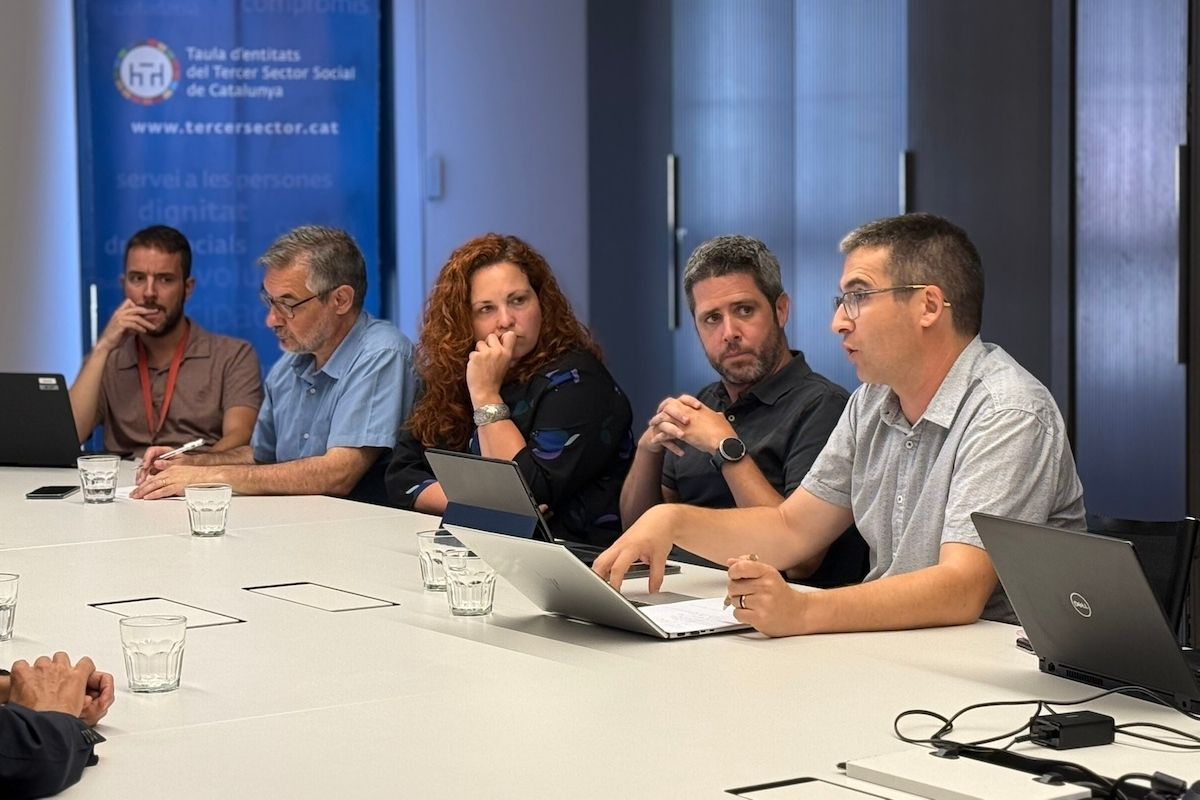
--- It could improve if the Social Third Sector law is approved. It already entered Parliament before the summer and passed the debate and votes, and appearances are expected soon. We need to approve it because it has to regulate a fairer financing system. Most of the other autonomous communities already have it approved. Here we have to get our act together. First of all, it is very important to recognize the work of social entities and the 100,000 professionals who work in them, a not inconsiderable figure, as well as the thousands of volunteers, who are also essential in this social task.
--- What would this law allow?
--- We could participate in public policies, in their co-creation, to better adjust them to the real needs of people. If we are on the street, we can explain a reality, create policies as a recognized agent, find solutions as adequate as possible and fair financing. This affects the continuity and quality of projects. We will already do management engineering, but we are concerned that financing may affect the people we serve. And we also know that the conditions of many workers in the social third sector are not always dignified. Therefore, there should be a salary equalization for professionals, equal work, equal salary, whatever the sector. We call on the parliamentary groups to accelerate the approval of the law. Now Catalonia has to take this step. It is an essential task.
"Everyone can collaborate and make a more just and egalitarian world"--- In parallel, people need to know that donations to foundations are tax deductible.
--- Yes, if a donation is made to a social entity, there is a return at the tax level, provided it is to an entity declared of public utility. And we must not forget the enormous solidarity work that volunteering entails. We know that many times action is not taken if the story does not hit close to home. I believe that what citizens should do is keep their eyes and ears wide open and empathize and, from there, volunteer, offer our time and also donations. If you do not have economic capacity, a brutal way to collaborate, I believe, is to be attentive and see what moves you, because all causes are just. Be attentive to what the person next to you needs, do not lose humanity, and do not let hate speeches break social cohesion, especially out of respect for those who built it. We have to return to the community, cohere society, find its meaning and soul.
--- And anyone can contribute to this work.
--- Everyone can collaborate and make a more just and egalitarian world, and I believe that doing so is our responsibility as human beings, that our mission is to make the world a better world, and the Third Sector can be a bridge to help people achieve it. And not with a welfare vision, but with equal rights, where we help people grow, and not just give them fish. The impact can be very great. Therefore, contributing to the Third Sector is changing the world. We were born to be happy, and we have to guarantee it for everyone. With the help of the administration, with rights that appear in the Constitution.
Add The New Barcelona Post as your preferred Google source for free
Stay informed with the latest news.
