Jeff Wall began his professional career in the world of photography in the 1980s in his hometown, Vancouver, where he was born in 1946. His work has unquestionably contributed to defining or redefining photography as a crucial element of contemporary art. His technique of the tableau, photographic tableaux, or photographic picture is a clear heir to the most fundamental aspect of pictorial art: composition.
The exhibition at La Virreina Centre de la Imatge, scheduled until early October, gathers 35 selected works of different formats from 1980 to 2022, and constitutes the most important exhibition of his work in Spain to date. Pieces of different format and size, and great thematic diversity, also of resources and palettes, but where something crucial always predominates: an enigma.
The exhibited works move between registers and tonalities, mixing documentary and fiction in a deliberate way, in what we would call a particular imaginary of the author, which becomes something collective due to its references. There is, therefore, a common narrative similar to that of stories. Fictions that start from a real basis, and in that contradiction, become possible. His works are everything and a portion of something at the same time. They represent an instant, something ephemeral and particular, which becomes a universal representation of the world. They look like paintings encapsulated in their supports. Framed, thus, autonomously, they have full self-sufficiency, but they irremediably refer us to a kind of continuity.
Jeff Wall admits that he treats instant photography with the prototypical respect for the plausible, but never renounces the dreamlike.Wall's complete work consists of 800tableauxmade from 1978 onwards. He is not a prolific artist (the average is four or five pieces a year), he does not work in series and, if he does, it is for mere descriptive purposes.He titles his works in a scrupulously indicative way, moving away from any interpretation;hence its anti-narrative, its lack, many times, of context. Its large two-by-two-meter formats stand out, and it is characterized by its diagonal compositions. It recreates realities with great precision, carefully placing each element in the frame.
An insatiable reader, he does not consider himself a hunter of images; perhaps, an imaginer of them. Framed within the photoconceptualism movement, he holds the celebrated Hasselblad Award from 2002. He has exhibited at the Tate Gallery in London and admits that his reference in painting is Édouard Manet, in composition, and that he deeply admires the work of Velázquez.
His enormous photographs function as light boxes that generate transparency. His tableaux offer the viewer the same proposals that painting can offer, but with all the innovations attributed to photography. The artist confesses that he got the idea while contemplating a huge illuminated advertising billboard in front of the Prado Museum in 1977, specifically, at a bus stop, during a long trip from Spain to London.
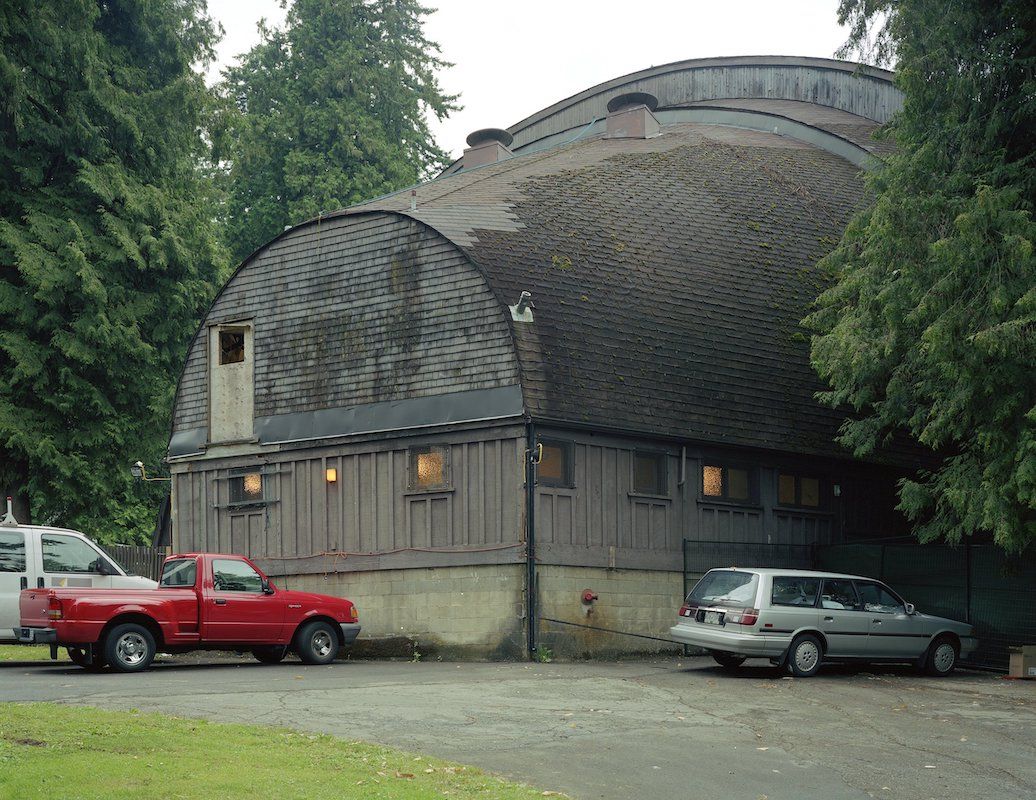
Architecture and machinery are fundamental axes of Wall's figuration, which establishes a relationship between the fragility of the body and the robustness of the machineIn the exhibition, we can seeDestroyed Room(1978), which we would consider his first serious work. In it, references to the beginnings of cinema and its repercussion on the static image are observed.Steves Farm, Stevenson(1980) is one of the examples of the documentary tone it references.Diagonal Composition(1993) stands out as a cornerstone of his style and composition through that construction of the image.The structure and geometry do not match the place it presents to us: a sink in a dirty corner of the artist.
Trap Set (2021) proposes an invasive artifact in nature: in a close-up shot of undergrowth, an animal trap is hidden. A visual trap, too. A trap, also, for the viewer. The critique of man's pernicious hand over nature. Forest (2001), where we see the first action photograph of the exhibition: a dramatic incident. There is no context, no plot, but there is the enigma of the woman who leaves an improvised campsite with her back to us.
Obsessed with his hometown, Vancouver, Jeff Wall reflects on mobility in cities. After 'Landscape Manual' (1960/2003) focuses on those who walk, while Siphoning Fuel and Men Move an Engine Block (2008) focus on those who drive cars.
Architecture and machinery are fundamental axes of his figuration. He establishes a relationship between the fragility of the body and the robustness of the machine. A girl is bored while a man siphons gasoline from inside the tank, supposedly, to reuse it. In Men Move an Engine Block, the transfer of an engine covered by a tarp reminds us of the transfer of a corpse.
The photographer also works with the tension between the near and the far. Between allegorical realism and a homage to the monumental, to the representative in art, we find one of the exhibition's standout works: The Thinker (1986). A true monument to disillusionment. An ode to the human. With Dürer as a backdrop, we see Rodin's thinker, embodied by an elderly German worker, heir to the peasant revolt persecuted by Luther in the 16th century, who has been stabbed in the back.
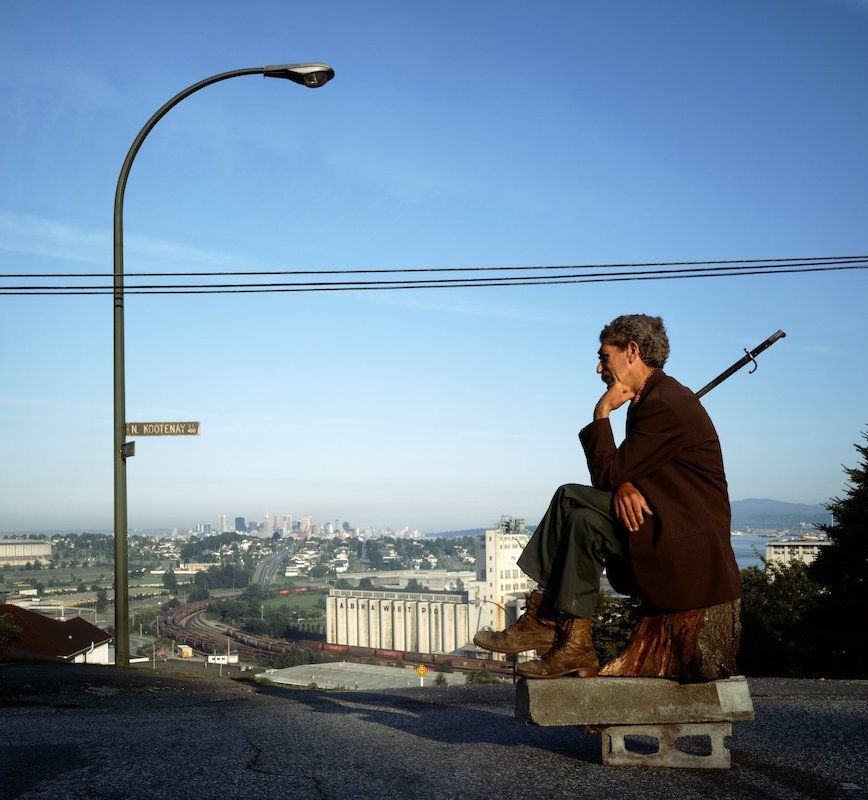
We continue the exhibition and return to the enigma. In A Man with a Rifle (2000), no such rifle exists, and in The Listener (2015), we cannot hear what is being listened to. In Wall's words, "what we seek and respect in art is not an original expression nor the interest of an audience, but the very process of figuration when it tries to produce a simply precise image; a precision that has in itself a formative value in the experience of the world."
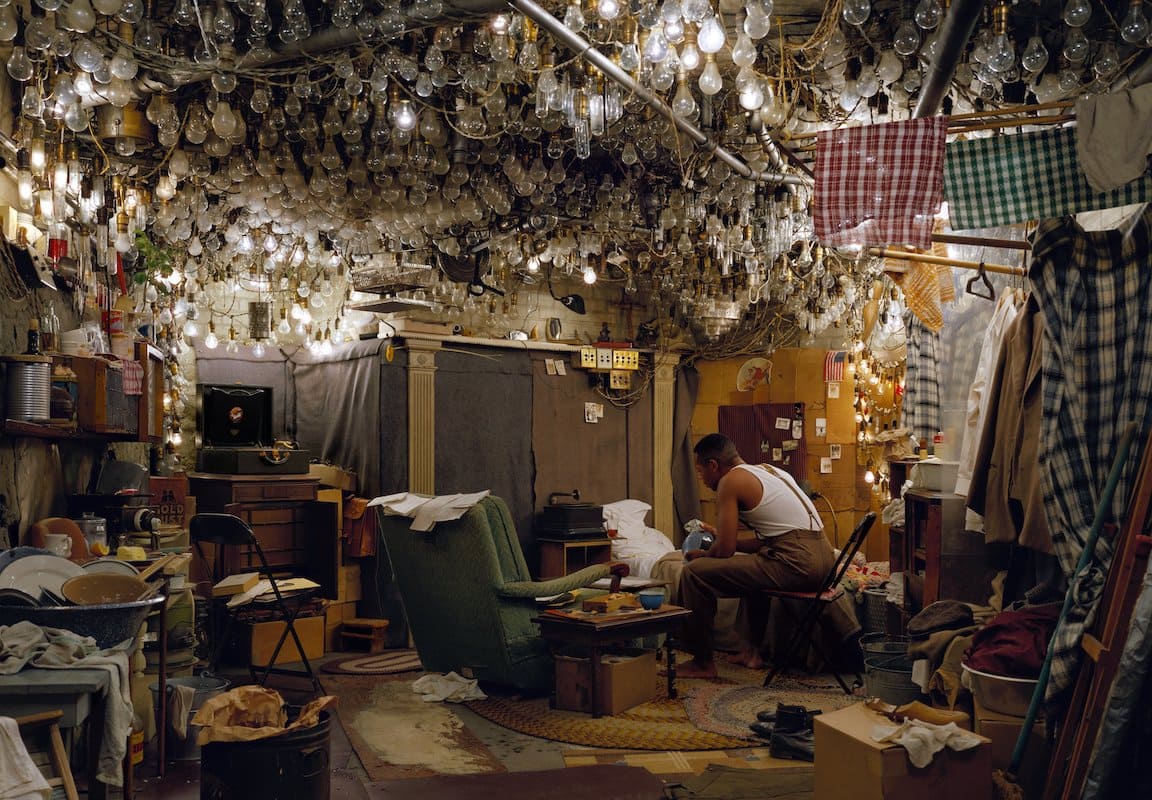
Odrarek, Taboritska 8, Prague, 18 July 1999 (1999) is based on a Kafka story, specifically, The Cares of a Family Man, constructing a hidden figure or shadow that leaves the mystery to the viewer's imagination. Unaware of this supernatural element, a young woman descends the stairs of an old Czechoslovakian house. Burrow (2004) starts from Ralph Ellison's novel Invisible Man to show us a refuge, a hole dug by man in the ground with clear references to Kafka, to survival, to disappearance, and to life and death and being buried.
Morning Cleaning is a large-format view of the 1983-86 replica of the 1929 Universal Exhibition Pavilion designed by Mies van de Rohe, and originally located in Montjuïc. In this piece, Wall emphasizes the act of cleaning, the relationship between clean and dirty, and his obsession with order, but also his attraction to dampness, liquids, puddles, swimming pools, and dirty sinks.
Men at the Mirror (2019) is an intrusion into the unreal with a kitsch aesthetic. A mirror with a message in a hotel room; the mirror as a great generator of ephemeral images. The mirror as a catalyst for fictions. A historically distorting and deforming element, it also functions as an omen of death, as a door to another dimension, or to a kind of augmented reality.
Another recurring theme in Jeff Wall's work is gravity and the attraction of bodies to the terrestrial. The ground is a nuclear element, a solid materiality, an irremediable constant. It is something fixed and unmovable. An example of this idea is Weightlifter (2015), where we find a weightlifter in black and white.
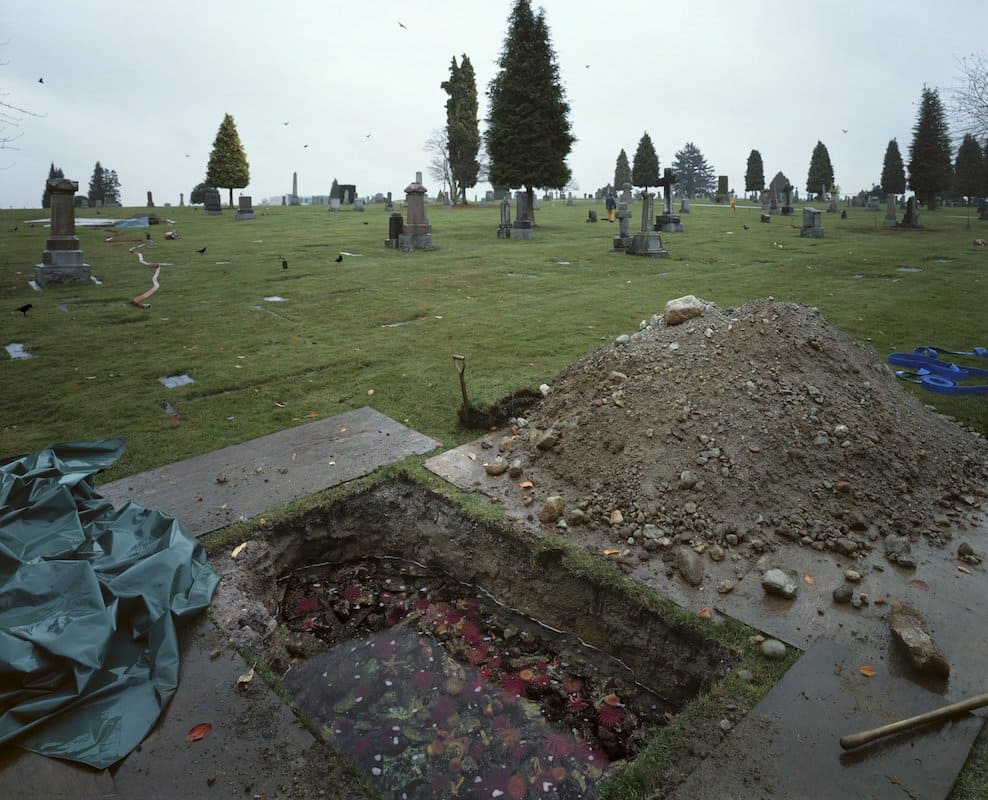
Finally, it is worth highlighting A woman with a necklace (2021), with an unreal light designed to generate an atmosphere of remembrance or daydreaming in a moment of great intimacy. The magnificent The Flooded Grave (1998-2000) functions as a final culmination with an evident allegory to death. A flooded grave that the spectator discovers and in which they discover themselves, in a play with the idea of returning to prenatal waters in the life cycle with water, beginning and end of a career, and the ocean (with an octopus included) as the architect of our world. Wall consulted an oceanographer to know what elements to put in that puddle.
The exhibition, completely free, is the fruit of the success reaped after the exhibitions of Pedro Costa and John Berger and has had the full participation of the artist in its financing. It is curated by art historian Jean-François Chevrier, one of the most important names in contemporary photography at a theoretical level and a specialist in the work of Jeff Wall. With this exhibition, La Virreina, located in the emblematic building on La Rambla, positions itself as one of the benchmarks of contemporary art, and especially, of the image. In parallel, the seventh issue of La Virreina's collection of essays on the exhibition will be published, titled Jeff Wall: Writings and Conversations, which includes 16 theoretical texts and interviews never before translated into Spanish.
Add The New Barcelona Post as your preferred Google source for free
Stay informed with the latest news.