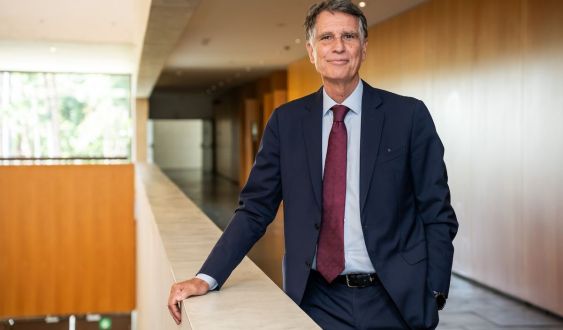
Jaume Guardiola (Barcelona, 1957) bids farewell to his last Cercle d'Economia meeting as president of an institution he joined when he was only 29 years old. After the whirlwind of these days, he will prepare a handover that is expected to be more controlled than on the last occasion, when the unusual event of having to vote between two candidates occurred. If there are no last-minute changes, the baton will be taken by Teresa García-Milá, an economist who will become the first female president of an entity with almost 70 years of history.
Jaume Guardiola has seen how BBVA's hostile takeover bid against Banco Sabadell has invaded the circles of the 40th edition of the meeting, now that the political situation in Catalonia is much calmer compared to other years. The surprise public consultation announced by the President of the Government, Pedro Sánchez, on the first day of the conference has become the main protagonist. The meeting closes its doors one more year in Barcelona, after bidding farewell to Sitges and not even remembering when it was held on the Costa Brava, despite the fact that this time it has moved forward in the calendar, taking into account the limited availability of its headquarters in recent years, the Palau de Congressos de Catalunya, another sign of an increasingly intense trade fair season in the city that leaves fewer available slots.
--- How have these three years at the helm of the Cercle d'Economia been?
--- We have lived through times of many changes, but current times are like that. We like to look up and reflect to try to see trends and be able to influence. We represent civil society, with very varied members since its origins, and we have a civic commitment to participate in public debate to seek the general interest. We are a totally atypical institution, I believe there is no other in the country that is comparable. This mix is unique and forces debate, confronting positions and sacrificing one's own for a higher good which is agreement.
--- Give an example.
--- When we took a stance on the amnesty, we had a lot of internal debate and, then, all kinds of reactions were generated, those who agreed and those who didn't. They read us a lot in Madrid and this always matters to us. We are an institution that is in Barcelona and who likes the centrality of debates to be here because we believe in a more federal and more peripheral Spain. We always say that they should listen to us in Madrid and that they should come. Our opinion on the amnesty opened eyes and, perhaps, without us it would not have happened. From a global point of view, the existential European reflection has been very important. Europe is a transcendental issue for the history of the Cercle. The arrival of the second Trump administration has made us look in the mirror and accelerate this need to get going if we want to be a global player.
--- In this Europe in transition, what role does Barcelona play?
--- If one takes Europe, Catalonia is quite representative of what it is. It is present in all economic sectors (primary, industrial and services). It is an open economy, probably one of the most open European regions. It has first-class science, with very well-positioned universities and business schools, also research centers, the supercomputer and the synchrotron. The President of the Council of Europe, António Costa, has not only participated in the Cercle meeting, but has also gone to Seat, the BSC and the Alba Synchrotron. He has been impressed by all the assets there are. Catalonia has always been a driving and leading region. As Costa has said, it is truly seen as a piece of Europe.
--- But...
--- We also have the same flaws as Europe. We share the housing problem with European capitals. The mayors of Rome and Paris have come. It is a very serious problem that affects everything: demography, social cohesion, productivity, competitiveness... It also costs us a lot to convert science into innovation. Perhaps the only sector that has achieved this is the health world. However, in the industrial world, it is difficult for us to make a strong commitment to innovation. With a fabric of companies like the Catalan ones, which are not very large, we must help them and encourage collaboration. There are companies that have the capacity to innovate using the science generated by research centers, but they find it difficult to assume all the risks alone. We have made a public effort very directed at research, which has been very successful and we must preserve it, but we must also make an effort directed at innovation.
--- Without a doubt, this year's meeting has been marked by BBVA's hostile takeover bid against Banco Sabadell. What does the Cercle think?
--- The Cercle has not commented on the takeover bid because it does not have business representation. I, personally, have. I believe that the competition resolution does not include a central element. It has been done with a retail banking methodology and remedies have been made to solve these concentration problems. But, in my opinion, the relevant risk lies in business financing. In fact, there are only four banks with a complete offer in business banking. Going from four to three... can end up stifling credit at a time of liquidity tension. And I believe this has not been properly valued.
--- Jaume Guardiola has worked in both entities, first at BBVA and, in the last stage, as CEO of Banco Sabadell (2007-2020). How is he experiencing it?
--- Evidently, now I have a greater bond with Sabadell because the executives who are at the helm were with me. On the other hand, at such a successful moment for the bank, after having suffered as much as it has and when such extraordinary results are being achieved, I feel very bad that this project could have this end. Having this bond with both institutions, when I talk about competition, I would say the same whether I was talking about a merger between BBVA and CaixaBank or between Santander and BBVA. I am concerned that this offer for corporate banking will disappear from the market.
--- With BBVA, you managed the former Bancomer in Mexico. This market, precisely, is pointed out as one of the weaknesses to convince Sabadell shareholders with the new Trump scenario.
--- When someone invests in Sabadell, it's because they like its portfolio, just as when they invest in BBVA, it's because they like its presence in Spain, Mexico, and Turkey. If mergers occur, you are changing the scenario a bit for the investor. The investor can say, "I'll decide, let me diversify, don't you do the diversification for me." However, I believe that, in the short term, Mexico will indeed suffer. But, in the long run, the correlation between Mexican GDP and the US industrial index is very high. A very important part of the competitiveness of American companies depends on having productive facilities in Mexico, and this is a very complex framework and it is very difficult to dismantle it. This will eventually return to normal because Mexico has many assets for things to go well.
--- Therefore?
--- In the short term, it could indeed be an element that puts a bit of pressure so that Sabadell shareholders are not interested in the operation. But, it seems a bit premature to talk about all this. We have to wait to see how the public consultation and the Government's position are resolved, and, then, if the takeover bid occurs, we will talk.
--- Jaume Guardiola: Will the Cercle participate in the public consultation opened by the Government?
--- We have to see how it works. They want to identify reasons around the concept of general interest. It's a slightly different reflection from what we've had until now, which focused more on competition. Indeed, now with this concept, it will force us to think.
--- After the conferences, your farewell from the presidency of the Cercle is approaching. What will you do next?
--- My stage at Cercle ends and, in a few months, my presidency of the Esade board of trustees will also end. My work as president is nothing comparable to being an executive as I was a few years ago. Therefore, my decrease in activity has already occurred.
Add The New Barcelona Post as your preferred Google source for free
Stay informed with the latest news.
