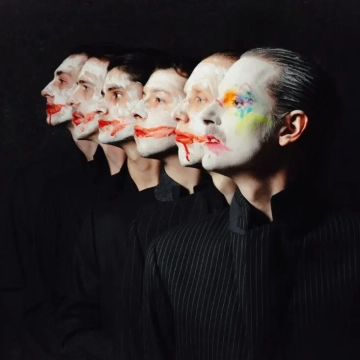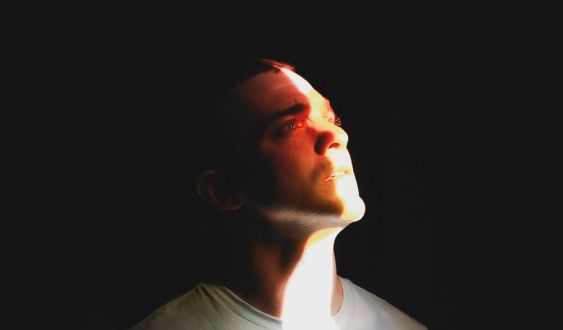
Eleven years after the premiere of Ricard de 3r at the old Sala Beckett in Gràcia, the company À Trois Teatre brings back the character from its history to show us what became of him and how he lives eleven years later in the prison where he remains incarcerated: this is Ricard 111. This proposal can be seen at the renovated Sala Beckett in Poblenou, an institution that has once again backed this company, recovering that first success from 2015 and giving it the possibility of creating a theatrical diptych in which the continuation of the story of that young Ricardo, who, at just 18 years old, protagonized a massacre, can be seen.
Both works can be seen together or separately, as they are independent pieces. However, it is advisable to see both proposals in order to appreciate the work the company has done and also to learn the history and evolution of the character that inspired their story. Because yes: the character played by Quim Àvila (in Ricard 111) and by Brandon Caritg (in Ricard de 3r) is inspired by real events. He is a person who existed, who murdered his parents, started shooting at his schoolmates, and was imprisoned with an exemplary sentence: 111 years in prison.
Prison is the setting for Ricard 111
Gerard Guix signs this production that presents us with the same character, but eleven years later. Ricard has already spent eleven years in prison, but he still has a century left to serve his sentence. Literally a century.
The reason why the company À Trois Teatre decided to bring back this character is because, last year, when ten years of incarceration were completed, the condemned man offered an interview. It was the first one he granted, and in it, he opened up completely, recounting his daily life in prison, the crime he committed, his mental illness, and his deepest reflections. With this basic material, the company decided to bring back its character and show him to the public already in his adulthood, a character nearing thirty years old, and with the enormous weight of his crime on his shoulders.

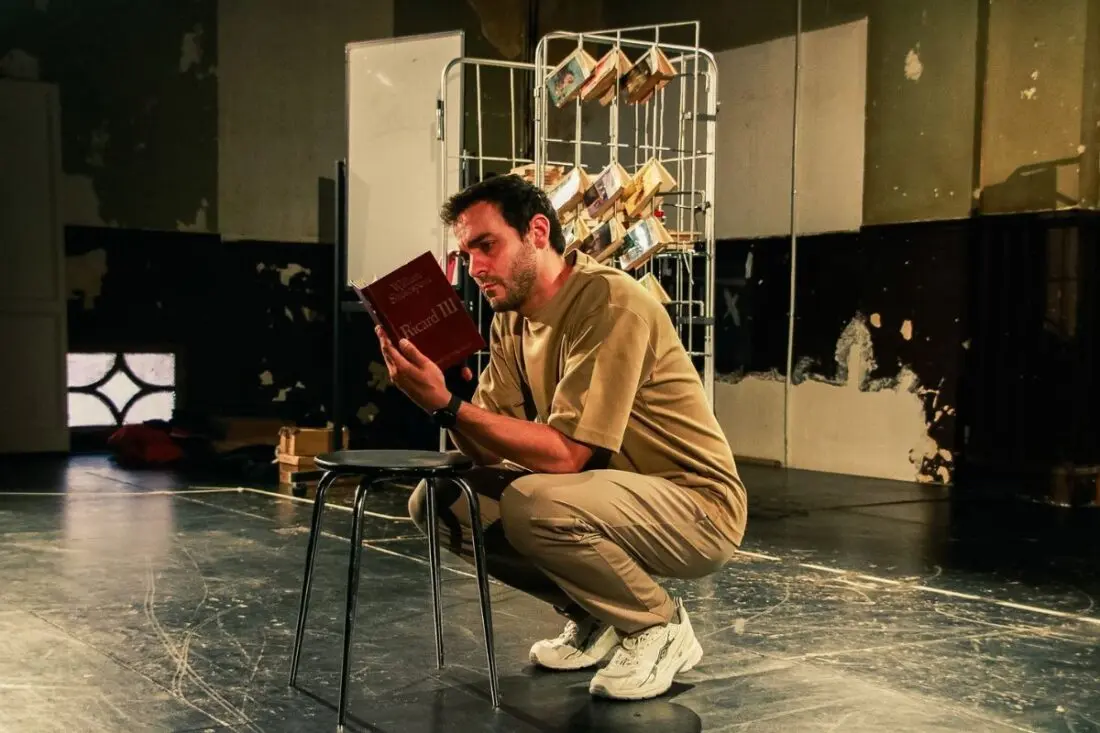
On the stage of the Sala de Dalt of the Beckett, we find ourselves with Ricard's daily life in prison. With the few elements of Anna Alcubierre's successful set design, we get to know his routine: welcoming younger prisoners, listening to music, reading books, doing laundry, repairing appliances, and playing basketball. That is his life; that is what his human existence is reduced to. These activities allow him to continue, not to give up, not to surrender, and, however little it may be, to try to be happy. But the sentence weighs on him, stones him, dynamites him. It is a condemnation that acts as a shadow of himself; no matter how much he tries to flee, distract himself, look away, the shadow remains there, unmovable.
Music plays a very important role in his daily life: it helps him not to fall apart, to lift his spirits when bad thoughts appear, when voices appear. It is his way of injecting positivity, energy, and not faltering. But the voices are there. He has learned to live with them, to limit them, to silence them, thanks to therapy and, above all, medication. So when his daily dose is reduced due to budget cuts, fear invades Ricard: will he be able to control his monster? Or will he commit another atrocious crime if his mind is unleashed? The symbol of the butterfly appears at this moment: his mind can fly free again, be untethered, and who knows where it might lead him.
Is forgiveness possible?
Ricard decides to grant an interview, the only one he has accepted in all these years. He doesn't want to be a role model for anyone; he has always hidden so that no one would recognize him, no one would turn him into a symbol of anything. But now he is ready to show his face and, who knows, perhaps become a role model, but of the opposite: a role model for change, for reinsertion, for the possibility of healing. Because, as he himself says, "I am possible because I exist." He wants to show that he is not that monster the media created; he was simply a sick and undiagnosed young man. But he killed his parents. He killed two of his companions. And he injured 25 more.
"I am possible because I exist."
It is in this duality that the work constantly moves: between compassion and guilt. We see a boy eager to live, with energy, with enthusiasm for small things; but he is a boy who will not escape his confinement, who will never go to a concert, who will never again have intimacy because his hands are stained with blood (an effect that, by the way, we see in a very subtle moment of the work and that reflects the barbarity he committed with his own hands, the same ones he now uses to repair appliances or read a book).
The debate about whether he deserves that condemnation or deserves forgiveness is what floats throughout the course of the work. A doubt that directly challenges the audience, since the text does not lean towards any option, it simply shows the dilemma and encourages each person to generate their own internal discourse. Can he be forgiven? Can such a person be rehabilitated? What weight does mental health really have in this type of crime? Does he deserve a second chance?

Quim Àvila in one of the best works of his career
The monologue starring Quim Àvila does not falter at any moment. And this is due, in part, to the impressive work Àvila does on stage. His interpretation is very restrained and reflects, at all times, those conflicting feelings between hope for second chances and resignation to live with guilt. The mental illness he supposedly has is not mentioned or labeled at any time, nor does he cling to it as an expiation of guilt; he only mentions it, uncovers it, to explain (and explain to himself) the reason for his crime.
The topic of mental health is touched upon in more depth in the letter his sister writes for the trial. In it, the girl explains in detail that her brother is not a monster nor has he ever been: her brother is sick and, when he committed the murders, it was because he was not treated. An allegation that also remains unclear whether it is real and truthful or if it is the way the sister has found to live with the trauma and forgive her brother. Because, if she doesn't cling to that idea, what is left for her? To live with the idea that her brother is a murderer? It is much simpler to accept that he is sick and, thus, not be absolutely alone in the world.
Àvila transits through all emotions: the positivity of the beginning, dejection, guilt, and with fear, above all, with fear. He has genuine terror of his own monster. When his dose is reduced, he is terrified of encountering that part of himself again that he has been fleeing for eleven years. The therapist helps him understand that, during all this time, he already has tools to control his impulses, but fear completely invades him.
The shadow of Richard III is felt throughout the play
Shakespeare's villain, Richard III, is present in the play all the time. His shadow accompanies the character of Ricard subtly and with overwhelming sentences. When some passages from Shakespeare's work are quoted, we feel the weight of the proposal we are seeing: they fit perfectly, they seem like tailor-made reflections and thoughts.
A reflection on the possibility of redemption, on mental health, and on guilt. Guilty or not guilty? That is the question.
The reading of book passages, with the musical selection, the moments of silence, and the therapy moments give a very agile rhythm to the production. It is a very dynamic proposal that, beyond the specific story of this Ricardo, wants to launch a reflection on the possibility of redemption, on mental health, and on guilt. Guilty or not guilty? That is the question.
Add The New Barcelona Post as your preferred Google source for free
Stay informed with the latest news.