
On February 23, the Colombian urban planner based in Paris, Carlos Moreno, presented in Barcelona the book The Proximity Revolution: From the "World-City" to the "Fifteen-Minute City", in which the author condenses the theses that support this city model that the mayor of the French capital, Anne Hidalgo, has helped to make fashionable worldwide by adopting it as one of the pillars of her political campaigns.
The fifteen minutes referred to define the maximum time one would have to travel on foot or by non-motorized means within an urban framework to access what Moreno considers the six essential urban social functions: housing, work, shopping, education, health, and leisure. Likewise, the urban planner advocates for the flexibility and diversity of uses of spaces, so that the possibilities of offering everything that the model demands within the perimeter marked by this quarter of an hour are multiplied.
Much has been said about this concept in recent years, especially following the situation created by the Covid-19 pandemic and city lockdowns, but above all, it is being discussed very intensely in this final stretch of the pre-campaign for the municipal elections in our country, at a time when the various city models that each political force will defend are being put on the table.
As a core idea, the conjunction of sustainability with the recovery of proximity ties in the face of an increasingly digitized and unequal society. In this sense, the fifteen-minute city, Moreno says in his book, encourages the mixing of the population to maintain the local anchoring of the middle classes and preserve social cohesion, while offering less favored people access to the services they need.
As often happens, however, every time a concept related to our way of life emerges strongly, controversy is served.
Firstly, the suspicion about whether Moreno has invented or discovered something new (in fact, there are even those who question his authorship of the concept) or if he has simply found a simple and "marketable" way to name what has existed for many years.
Indeed, is the fifteen-minute city an original idea? If we particularly consider the typical Mediterranean city, can't we conclude that it already intrinsically responds to this model? These questions are, at the very least, some of the most common reactions in our latitudes when the topic is discussed. And not without reason: traditional Mediterranean neighborhoods and towns are forged in proximity relationships and mixed uses.
But it is also undeniable that the prevailing urban development throughout the democratic era has largely gone to the detriment of these now-claimed characteristics. It is worth remembering that between the 70s and 90s of the last century, the population in the Barcelona metropolitan region practically did not vary, while the urbanized area in this territory doubled, with the consequent dispersion of settlement and the emergence of quite populated spaces without job or service provisions. One only has to observe the traffic jams and travel times during peak hours on our communication routes to understand that something is wrong, if we truly believe that our cities are already fifteen-minute cities.
It is worth remembering that between the 70s and 90s of the last century, the population in the Barcelona metropolitan region practically did not vary, while the urbanized area in this territory doubledThe debate on the urban model, then, is necessary, and even more so at a time when all cities are looking for formulas to face the energy transition and the fight against climate change. Therefore, beyond controversies about the originality or the greater or lesser depth of the concept coined by Moreno, he must be recognized for his ability to once again place this type of debate beyond the academic or professional sphere, where it has been raised for many years, bringing it to the political and citizen spheres, which is where this type of urban deliberation is most difficult to take root. Collective reflection on how we want the cities where we live to be is key to our future and, consequently, must be framed in terms that facilitate everyone's contribution to it.
Of course, this politicization and popularization is never without risks, especially in the era of social media and fake news. This is how the most varied conspiracy theories have emerged from various spaces, accusing Moreno of wanting to confine citizens to walled ghettos from which they could only leave by paying a toll or similar. The author recently denounced with perplexity the insults and threats he has received for his proposals, and even demonstrations have been organized against him in places like Oxford.
Collective reflection on what kind of cities we want to live in is key to our future and, consequently, must be framed in terms that facilitate everyone's contribution to it.In view of the popularization of the concept, another usual phenomenon has occurred: the appearance of multiple variations, which in this case have to do with the time assigned. In some places, such as Dubai, there is talk of the twenty-minute city; in Seoul, neighborhoods must be of ten minutes; a Copenhagen neighborhood has been designated to be "the five-minute city of the future" and in Sweden they go even further by proposing the one-minute city.
Now, if there is one concept that should cause concern from the point of view of urban vitality, it is that of the zero-minute city, that is, the city where everything, or almost everything, can be obtained without leaving home. A horizon we are not so far from: teleworking, e-commerce and deliveries, virtual training, telemedicine, entertainment platforms are already present to a greater or lesser extent in our homes.
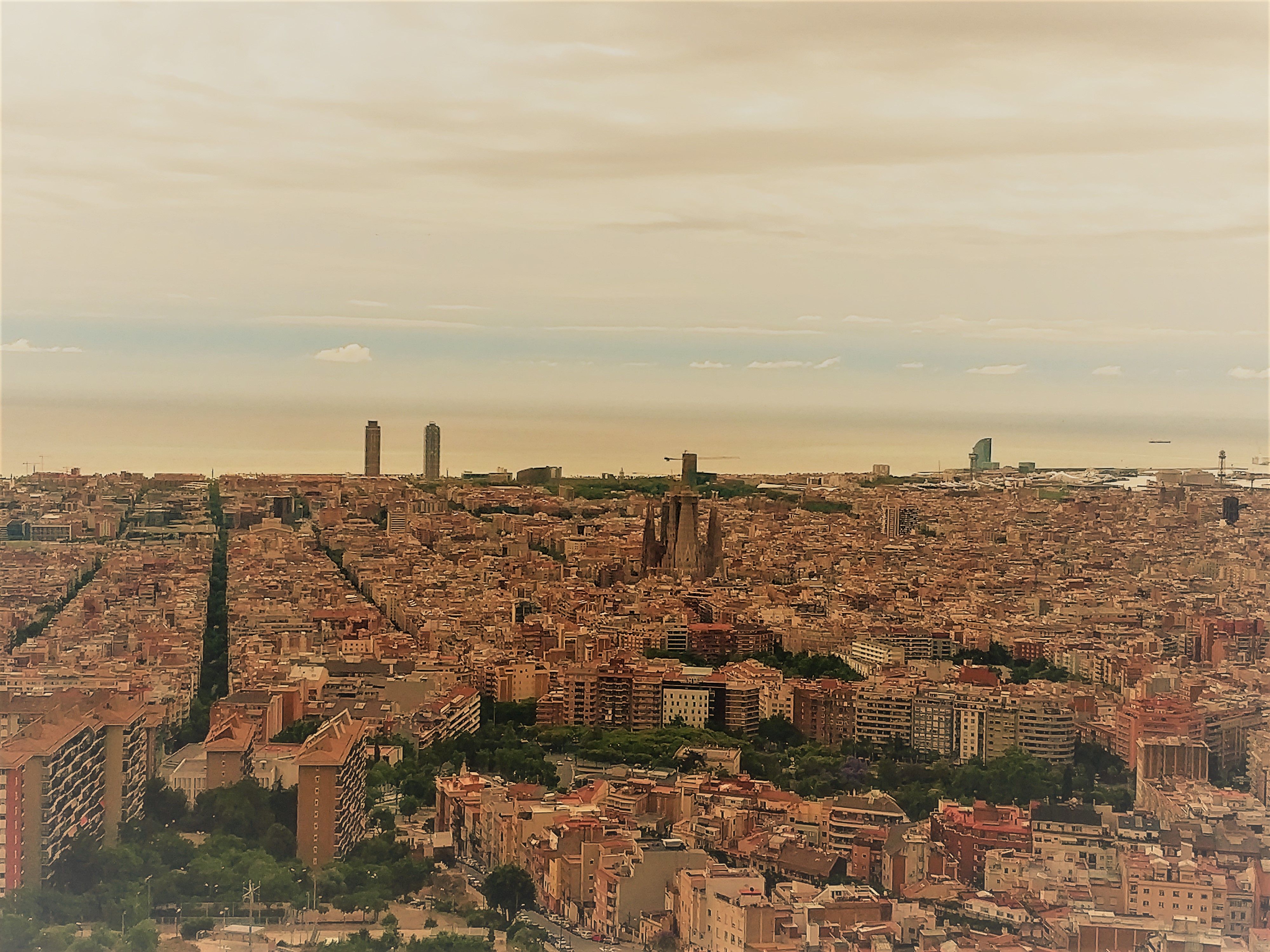
Returning to Moreno's proposal, like all urban theories and city models that have emerged over time, from Hippodamus of Miletus' grid to Ebenezer Howard's garden city, their implementation on the ground and the historical moment in which they are applied reveal the logical limitations that every model contains. The main one related to the fifteen-minute city is surely that, of all the essential functions assigned to it, work is the most difficult to reconcile generally with the model: that the entire population of a neighborhood can work in that same neighborhood seems a rather unattainable goal.
Taking into account, furthermore, that citizens must access other services and facilities that are not part of daily life, but that must also be accessible if needed, Moreno speaks of the thirty-minute city as a complement to the fifteen-minute city. In his model, no region can develop adequately if it does not build an urban structure that prioritizes the quality of life in its medium-sized cities.
Thus arises yet another concept, that of the fractal city, this time from the Catalan based at Harvard, Ramon Gras. Gras and his team have analyzed a great diversity of urban forms and have concluded that the most efficient is the one that offers harmonious polycentrism; that is, a network of similar nodes distributed evenly across the territory. Here, proposals have also been made about the Catalonia of forty-five minutes, to design a territory where all major towns are connected to Barcelona in three quarters of an hour by train.
Proposals have also been made about the Catalonia of forty-five minutes, to draw a territory in which all main towns are connected to Barcelona in three quarters of an hour by trainFrom the Barcelona Metropolitan Strategic Plan previous proposals have been collected and debated, and the "the fifteen-minute city and the forty-five-minute territory" to define what it should be the metropolitan region of Barcelona:a network of neighborhoods and cities with a good provision of basic services from which one can also access other daily needs (including work) in a maximum of forty-five minutes by public transport. It is essential, therefore, to break with the radial and Barcelona city-centered structure of communications, especially railways.
This proposal has been gathered and synthesized at the state level in a declaration and in a decalogue for political parties to incorporate it into their programs by the NESI Forum, and it is one of the key references of the Metropolitan Commitment 2030, the new metropolitan strategic plan that was presented last December, and which focuses on reducing social and territorial inequalities in the metropolitan region of Barcelona in the context of the climate emergency.
The fifteen-minute city and the forty-five-minute territory determine the model of metropolis that the set of organizations that have participated in this process, more than 400, have visualized as most convenient. Now, it must be territorial planning, in the hands of the Generalitat (and in the metropolitan area, also of the Barcelona Metropolitan Area), municipal urban planning, and investments from the different administrations that give it shape.
Add The New Barcelona Post as your preferred Google source for free
Stay informed with the latest news.