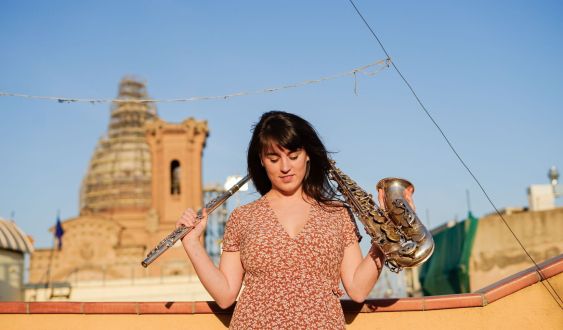
"With Joan Casares and Pau Sala we have been playing for a lot of years, but we had never recorded anything of our own. The idea had been in my head for a while and we finally did it. The truth is that I am quite happy," explains Irene Reig about Mira (The Changes) her brand new album recorded in a trio formation, which "we have released on vinyl, but not on coasters," as she specifies, alluding to the CD format, which she evidently does not like. And there's no need for it.
She leans against the bar and orders "an Alhambra 1925, the green one" and "since I can choose what to listen to, Kenny Garrett's Triology."
"I am a saxophonist and composer –she explains next--, although in the first stage of my musical training I played classical piano, I finally went over to the dark side and put my energy into the sax, Jazz and modern music. Thanks to that, I have been able to travel a lot, which has given me a lot as a person and as a musician. Yes, I use musician to define my profession, because I think it is correct to do so," explains this Barcelona native who is not yet thirty and who, in addition to her activity as a composer and performer, is part of The Changes, "a collective and record label with which we have released eleven references, and in the middle of a pandemic!".
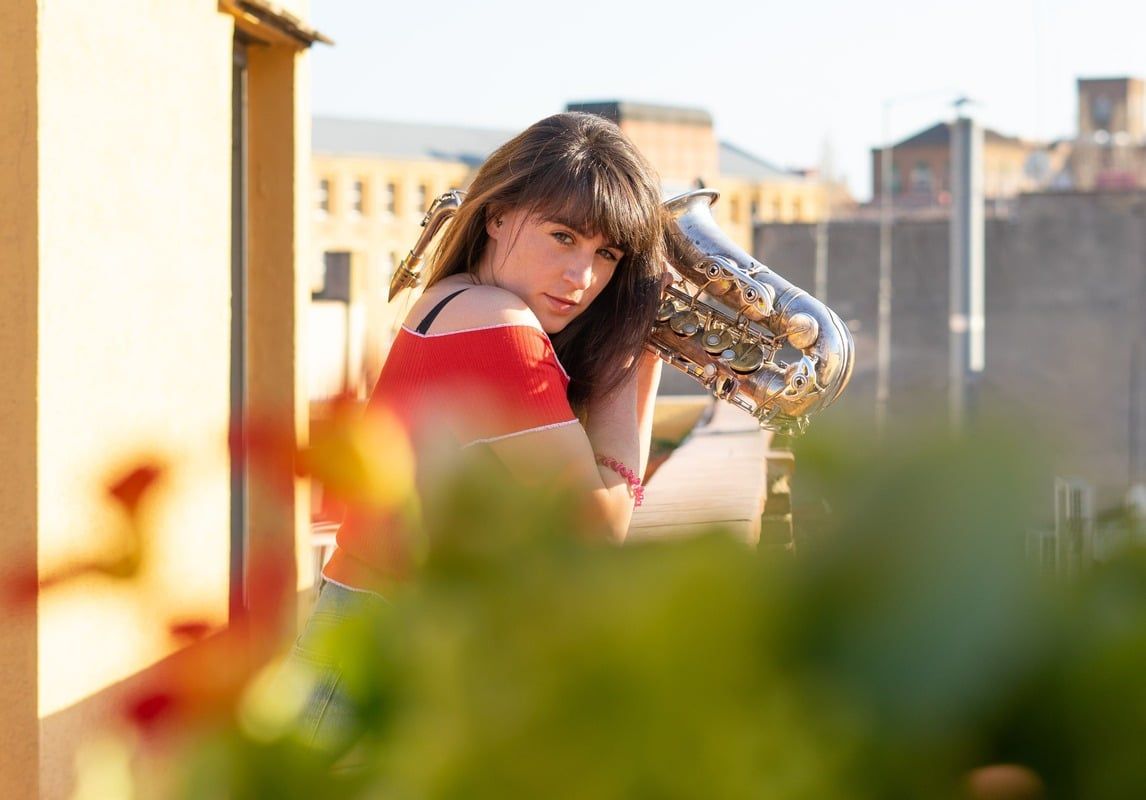
The lineup of The Changes includes some of the most notable new talents of Barcelona Jazz, millennials with a lot to say like the Casares brothers, Giuseppe Campisi, Pol Omedes, Héctor Floría, Oriol Vallès or Joan Mar Sauqué. And then, of course, there's Irene leading various projects.
"I am especially proud of the second album we recorded with The Bop Collective, Iaspis, which sounds spectacular. We recorded it at Wisseloord Studios in Hilversum, Netherlands, with Attie Bauw on the buttons. The place, the microphones they put on us and the great work Attie did is nameless."
--I suppose you don't have time for much else.
--Not at all! Right now I'm in Almería a lot, playing in the Clasijazz Big Band Pro, a local project that is a kind of self-managed Big Band, conceived by Pablo Mazuecos and which is really cool. Musicians like Voro García or Perico Sambeat have visited us. Now we are putting together the repertoire of the Bernard van Rossum Flamenco Big Band. We don't stop!
A modern school
For Irene, it is very important to have studied at Oriol Martorell, "a school that has music and dance integrated into its curriculum. That is, you would leave in the afternoon having had mathematics, solfège, chamber music, and literature, for example. Everything was mixed, and you would take what is usually considered extracurricular activities within school hours. It's true that we did more hours than other high schools, but it was worth it."
That was her first contact with the world of music until she and her classmate, Sara, heard about a center in their neighborhood: the Escola de Músics del Raval. "We decided to take the tough entrance exams to study there. The level was very high, and I had a pretty hard time the first few months because I entered from secondary school, and the classmates who had been there since primary school had an amazing level; they could sight-read sheet music perfectly, and they could get all the ear dictations in two or three tries. It was incredible. But well, that really motivated me and made me see that I really wanted to dedicate myself to music."
--And the Jazz thing, where does that come from?
--At that time, I also met Joan Casares, who started playing Jazz records for me and introduced me to his father, who has given me the foundation for everything I play now. That was a before and after in my career.
The city that could be
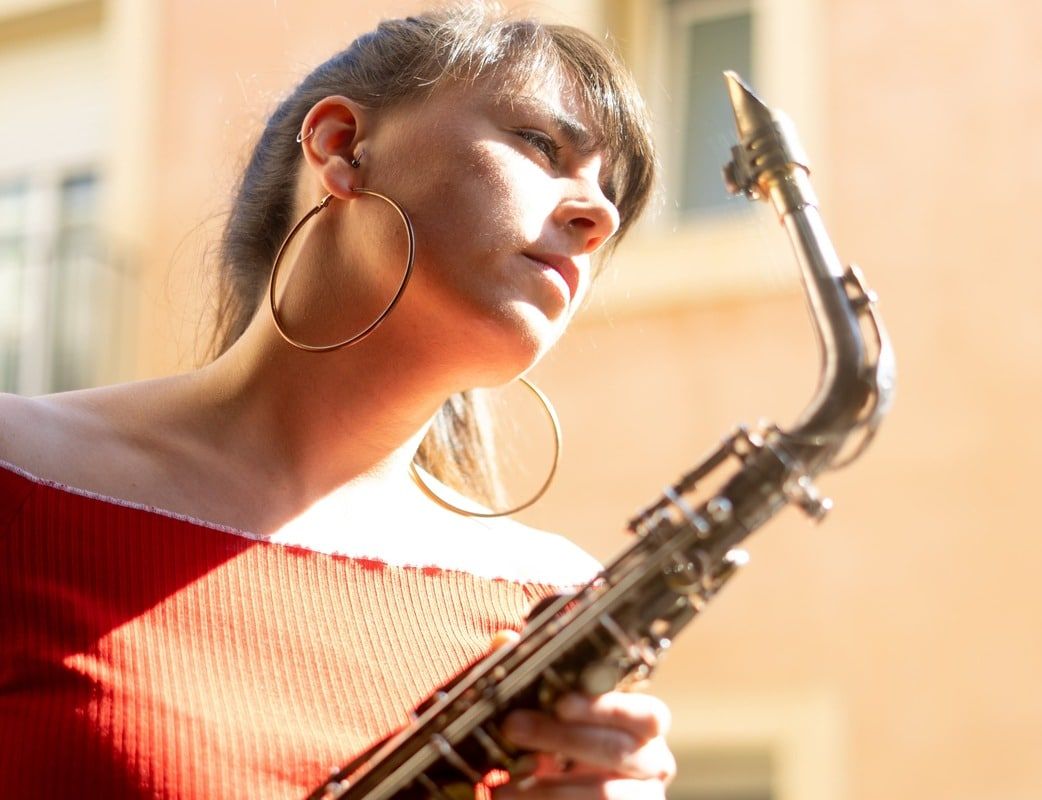
"I am from Barcelona, from Raval specifically. I adore Barcelona for many reasons. I think it's a beautiful city and has a lot to offer," explains Irene, who cannot comprehend that "the lifelong local shops like grocery stores have been disappearing, and souvenir shops with bull sculptures and 'I love Spain' t-shirts have been appearing, as an example of the type of tourism the city attracts and how they have sold it. For me, that is something horrible, given how beautiful Barcelona is and the cultural offerings it has."
--Or could have.
In this love-hate relationship with the city, so typical of many Barcelona residents, urban history is among the aspects that make one fall in love: "I love the origin of the Fossar de les Moreres. They say that, in the 12th century, the parish priest of Santa María del Mar needed a larger cemetery to bury his faithful. He asked the owner of the plot that is now the Fossar if he could cede that space. He said yes, on condition that it be used within fifteen days, that is, that some dead person had been buried to prove its necessity as a cemetery. After fifteen days without any death, the owner was on his way to Santa María del Mar to reclaim his land, but when he arrived under the mulberry trees in the square, he had a heart attack and it was he himself who inaugurated the cemetery."
--And when you're not in Barcelona, playing, or traveling around, what do you like to do?
--Well, I like to swim in the sea and I love to go to my favorite mountain, which is Montserrat, and see it from my town, Piera, which is where it looks best. Also, I like chess.
And Irene Reig, smiling, with big eyes that oscillate between blue and green, a thousand ideas swirling in her head, looking for the note with which to express them, asks for another beer and to take a look at today's menu.
Add The New Barcelona Post as your preferred Google source for free
Stay informed with the latest news.
