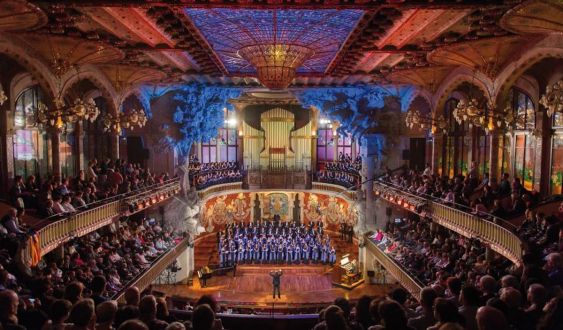
In a musical season, the motto is not usually a simple communication resource. It functions more as a reading framework: a way of organizing repertoires, anniversaries, and artistic presences that would otherwise appear as a heterogeneous succession of concerts. The major cycles of the 2026-2027 season at the Palau de la Música Catalana are articulated around a word charged with historical and moral resonances: peace. More than an epidermal slogan, it points to the need for rootedness; to the return to a primary foundation, which allows humanity to flourish in the human being.
The tribute to Pau Casals on the 150th anniversary of his birth and the remembrance of Ludwig van Beethoven on the bicentennial of his death structure the program to give music a power that far transcends the noble task of entertaining, pleasing, or even comforting: we delve into a tradition in which artistic creation, moral conscience, and historical memory intertwine to show the enriching feedback between aesthetic experience and ethical commitment. Something that is already perceived on the occasion of the inaugural concert ---on September 28--- dedicated precisely to the figure of Casals.
More than a commemorative celebration, the project is conceived as a musical reflection on the legacy of someone who made the defense of peace an inseparable dimension of his public life. The tribute will bring together cellist Pablo Ferrández, the Quartet Casals, the Escolania de Montserrat, the Orfeó Català and the Orquestra Simfònica del Vallès conducted by Xavier Puig. Among the most significant moments of the program, in addition to the interpretation of his beloved Schubert Quintet, will be the fourth movement of Beethoven's Ninth Symphony, with Schiller's text ---the famous Ode to Joy--- in the Catalan version that Joan Maragall elaborated in his day. In fact, Pau Casals was preparing the interpretation of that version when the civil war cut short the project. Recovering it today means reactivating a cultural tradition in which Beethoven's music was understood as an affirmation of fraternity. One of the most influential formulations of the modern humanist ideal: the existence of a community founded on the possibility of feeling joy, "divine spark," and on the horizontal consideration of all human beings. This aspiration, which runs through much of European culture since the Enlightenment, also had a philosophical background in Immanuel Kant's reflection on dignity and on the need to cultivate humanity through aesthetic experience, which Schiller obviously had in mind.
Music, from this perspective, no longer appears as mere entertainment: it opens a symbolic space in which a different form of coexistence can be rehearsed, emotional exploration becomes a path to a transcendent experience. This starting point gives meaning to the entire season, traversed by a presence ---that of Beethoven--- which culminates with the integral interpretation of his nine symphonies by the Staatskapelle Dresden under the direction of Daniele Gatti, in four concerts.
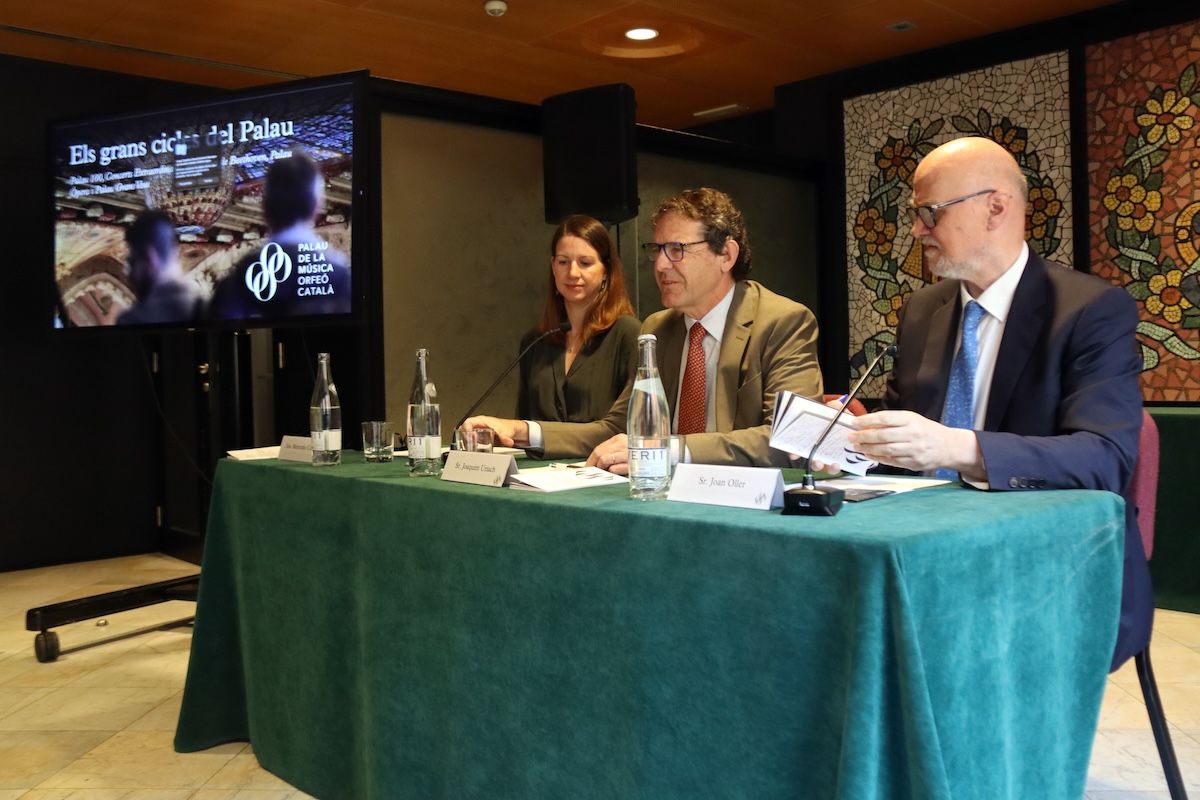
Other dates to mark in red ---singular moments of the season--- include Brahms' Double Concerto, performed by Julia Fischer and Daniel Müller-Schott, with Edward Gardner conducting the London Philharmonic Orchestra. A program that will open the Palau 100 cycle and incorporates Sibelius' Fifth Symphony. That same cycle will host the prodigious Klaus Mäkelä, who returns to the Palau conducting what for some ---as the general director of the Palau, Joan Oller, recalled in the presentation--- is the best orchestra in the world, the Royal Concertgebouw Orchestra, in a concert that will feature Lisa Batiashvili as soloist in Sibelius' Violin Concerto. The Accademia Nazionale di Santa Cecilia will return to the modernist hall with Daniel Harding and pianist Kirill Gerstein, and the Nederlands Philharmonic will debut with Lorenzo Viotti and Gautier Capuçon in Dvořák's wonderful Cello Concerto, while Esa-Pekka Salonen will conduct the Philharmonia Orchestra with Leif Ove Andsnes in Beethoven's Third Piano Concerto.
Music no longer appears as mere entertainment; it opens a symbolic space in which another form of coexistence can be rehearsed: emotional exploration becomes a path to a transcendent experience.No less essential will be the new intervention by John Eliot Gardiner, who will bring together a star cast in Beethoven's Triple Concerto: Isabelle Faust, Jean-Guien Queyras, and András Schiff. The program, which will be performed by The Constellation Choir and Orchestra, also includes two other works by the genius from Bonn, such as the Choral Fantasy ---which anticipates the finale of his Ninth Symphony by two decades--- and the Mass in C major. In this sense, the season incorporates large-format symphonic-choral projects that connect with the historical tradition of the Palau itself. Noteworthy is the performance of the oratorio Elijah by Felix Mendelssohn, by the Orquestra Simfònica del Gran Teatre del Liceu and the Orfeó Català under the direction of Xavier Puig. From a not-too-distant aesthetic framework, Jordi Savall will conduct Beethoven's visionary and unclassifiable Missa solemnis, leading Le Concert des Nations and La Capella Reial de Catalunya.
The Palau Grans Veus cycle, for its part, will bring together some of the most recognized figures on the international scene. Mythical artists will parade in collaborations to remember: this is the case of the charismatic Cecilia Bartoli alongside pianist Lang Lang, or Lea Desandre alongside lutenist Thomas Dunford. Attention Liceu fans: Nadine Sierra ---the most revered and sought-after singer today--- will debut in the modernist temple, singing arias by Mozart and Donizetti, in a cycle that will also feature Juan Diego Flórez and René Pape.

The operatic field finds its space in the Palau Òpera cycle, mainly dedicated to the baroque repertoire. This edition will feature three operas by George Frideric Handel —Riccardo Primo, Alessandro and Agrippina—, two of which are premieres in Spain. These will be joined by Beethoven's imposing Fidelio, directed by none other than Pablo Heras-Casado at the helm of the Orchestre Révolutionnaire et Romantique and the Monteverdi Choir. In Beethoven's only operatic title, the defense of freedom against injustice takes the form of a drama in which music appears as an affirmation of human dignity.
The relationship between art and collective memory also appears in one of the season's most significant international projects. The Orfeó Català will participate in Gustavo Dudamel's first European tour leading the New York Philharmonic to visit several European musical capitals, including the Philharmonie de Paris, the Elbphilharmonie, and the Musikverein. The concerts will include the performance of John Adams' On the Transmigration of Souls, a work written in memory of the victims of the September 11 attacks.
Musical feeling brings us closer to the privilege of connecting with the idea of humanity within us, and realizing what for Kant constituted the highest moral aspiration: to make ourselves worthy of being happy
Coda
Viewed as a whole, the season of the Palau's great cycles suggests a broader reflection on the place of music in cultural life. Art has often been spoken of as something "useless," insofar as ---it would seem--- it produces no immediate benefits nor responds to a practical purpose. But perhaps that very uselessness is precisely what grants it ---or safeguards--- its true value. Music does not resolve the world's conflicts, but it allows us to recognize something that conflicts often conceal: the shared experience of the human, which springs from the most intimate sphere.With the emotion of the subject who recognizes himself as sentient, the meaning of a common experience opens up ---from specular projection. In this sense, when it is stated that music is a universal language, it does not mean that we all interpret it in the same way. Rather, it means that we can all recognize ourselves in it from our own experience. Because each listener, as Beethoven intended with his Ninth ---and as Mercedes Conde, artistic director, recalled in the presentation of the cycles--- can make it their own, alive. In that intimate, personal, and collective gesture, perhaps resides the clearest form of fraternity that Schiller also conveyed in his Letters on the Aesthetic Education of Man.
In times of often arbitrary tensions and conflicts ---but with very serious consequences--- this reminder is not minor. Music does not replace politics or history, but it can open a space in which the experience of listening together ---of collaborating, producing, or living the same sound fabric--- acquires a meaning that goes beyond. In this sense, peace is not just a programmatic slogan: it is also a way of understanding the musical experience as an exercise in humanity, from the recognition of what is most one's own also in the gaze of the other. Although they seem separate and watertight issues, aesthetic experience helps to enable ethical reciprocity from the connection with oneself and the intuition of a transcendent experience. Along with the vindication of the dignity of all human life, as Pau Casals had wanted, musical feeling brings us closer to the privilege of connecting with the idea of humanity within us, and realizing what for Kant constituted the highest moral aspiration: to make ourselves worthy of being happy.
Add The New Barcelona Post as your preferred Google source for free
Stay informed with the latest news.
