
The impulse of green and digital technologies in Europe and Spain will be through interregional collaboration, or it will not be. Spain has the necessary potential to become a leading country in the technologies of the dual digital and sustainable transition, and can achieve this if it intensifies its cooperation with the most advanced regions of Europe. Collaboration must overcome state barriers and promote joint work between the leading and less advanced regions of the continent.
This is indicated by the macro-study Technological capabilities and the twin transition in Europe. Opportunities for Regional Collaboration, which compares 288 European regions in 42 technological capabilities linked to sustainability and digitalization. The study, by the Bertelsmann Foundation in Germany, was presented this Tuesday in Barcelona and concludes that Europe has great technological potential, but that it is unevenly distributed. This imbalance between regions can aggravate economic disparities and affect social cohesion.
The Internet of Things (IoT), solar energy, drones, biofertilizers, electric mobility, virtual reality, artificial intelligence and big data are some of the elements taken into account by the exhaustive report. By comparatively analyzing their development in the 288 regions, it concludes that interregional cooperation is key.
All regions would benefit from this collaboration, both the leading ones and the lagging ones. By cooperating, the former could diversify their economic activities and explore new sectors, while the latter would also gain diversification and promote innovation. A win-win for sustainable and digital development.
Madrid and Catalonia, leaders in Spain
The study emphasizes the challenge posed by the imbalance between regions. And, given this risk, what can Europe and its regions, including the Spanish ones, do? Promote this technological cooperation between more and less advanced areas.
This collaboration would accelerate the dual green and digital transition, and strengthen European social cohesion, according to the report, carried out by a research consortium from Utrecht University and the Austrian Institute of Economic Research. This was explained by the co-director of the Europe's Future Programme of the Bertelsmann Foundation in Germany, Malte Tim Zabel, and the project manager of Europe's Economy of the entity, Nathan Crist, in the presentation of the study at the Ciutadella Campus of Pompeu Fabra University (UPF).
The most developed regions of Europe account for 80% of patents in green and digital technologies. This figure stands at 60% in Spain, with the industry concentrated in Catalonia and Madrid. Specifically, Catalonia stands out in technologies such as nanomaterials, 3D printing, and greenhouse gas capture.
The report highlights the strength of Madrid and Catalonia and identifies untapped potential in regions such as the Valencian Community and AndalusiaThe report not only highlights the capabilities of these areas but also identifies untapped potential in regions such as the Valencian Community and Andalusia. The Basque Country completes the top 5 of the most developed regions in Spain in the double transition.
Potential of Andalusia and the Valencian Community
The report, a pioneer in addressing this topic and analyzing a territory of this magnitude, points to Andalusia as a region with great potential in technologies linked to virtual and augmented reality. It currently has a high specialization in green technologies such as biofertilizers, marine energy, and fuel from waste.
This obtaining of fuels through waste is also one of the capacities highlighted in the Valencian Community, which also stands out for its specialization in the production of sustainable packaging and nanomaterials. To develop this potential, collaborative ties should be forged with pioneering regions, not only Spanish but also from the rest of the continent.

At a European scale, the opportunities for developing dual transition technologies are highly concentrated. Digital technologies are especially located in the regions of Upper Bavaria, in Germany, and the Parisian Île-de-France. In the case of green technologies, certain areas of Germany and northern Italy stand out. In contrast, various areas of Eastern and Northern Europe have less potential for the deployment of technologies linked to sustainability, according to the report.
Transition from Europeanism
The conclusions of the report were presented this Tuesday at an event co-organized by the Bertelsmann Foundation, the Institut Barcelona d'Estudis Internacionals (IBEI), and the European Commission (EC). The event brought together representatives of Europeanism, as well as economic, technological, and social institutions, in the Catalan capital, around this transition in Europe and the snapshot prepared by the Bertelsmann Foundation.
As a standard-bearer of this Europeanism, the director of the Representation of the European Commission (EC) in Barcelona, Manuel Szapiro, participated in the event. He applauded the report for mapping the technological capabilities of the regions and for launching cooperation proposals, and highlighted Catalonia's potential in this area. In the same vein, the Minister of Foreign Action and EU of the Generalitat, Meritxell Serret, intervened, emphasizing the value of the report being presented in Catalonia. "We want to be an agent and an engine that drives both transitions," highlighting areas such as 3D printing, proclaimed the minister.
The director of the Bertelsmann Foundation links the development of green and digital technologies with the importance of trainingThe director of the Institut Barcelona d'Estudis Internacionals (IBEI), Jacint Jordana, opened the presentation by praising the role of regions in Europe. The director of the Bertelsmann Foundation, Clara Bassols, linked the development of green and digital technologies with the importance of training: without trained professionals in these fields, they cannot be developed. In this sense, she advocated for promoting dual Vocational Training (FP) and boosting career guidance that shows young people the full range of new professions available. In the same vein, the foundation's project director, Vicent Climent, expressed himself, warning of the need to combat this lack of professionals in these areas.
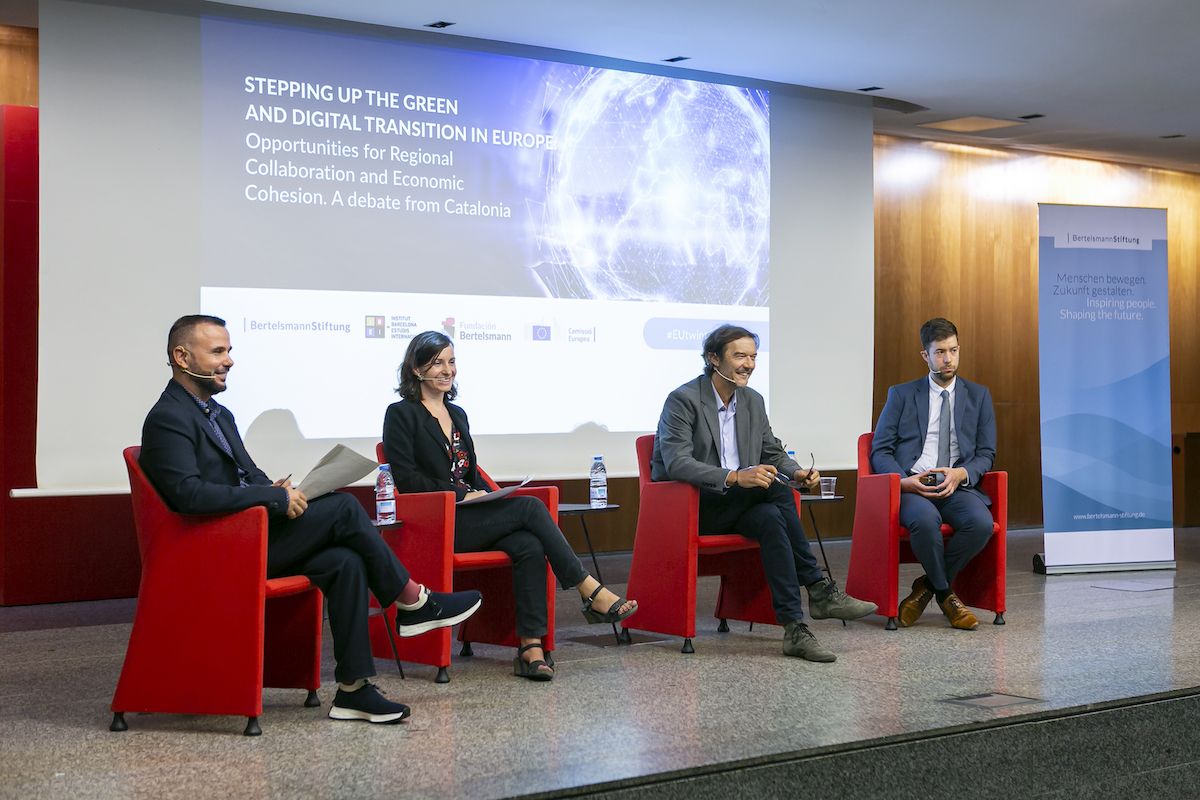
The presentation culminated in a debate with the associate professor of the University of Barcelona (UB) and associate researcher at IBEI, Aina Gallego, and the associate professor of the Pompeu Fabra University (UPF) and IBEI affiliate Andrea Noferini, who set out the challenges and opportunities of this digital and sustainable transition. They agreed on highlighting the importance of promoting public policies to advance in the development of future technologies guaranteeing cohesion and combating imbalances between European regions.
Add The New Barcelona Post as your preferred Google source for free
Stay informed with the latest news.
