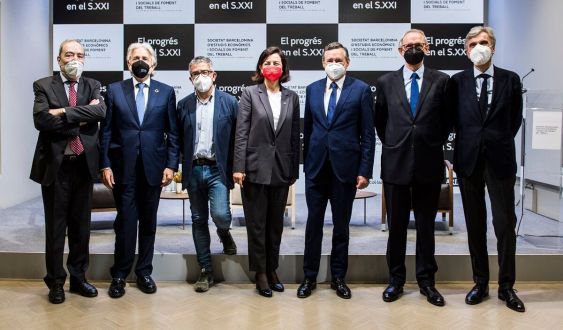
"Inequality is a powerful solvent of the social contract," economist Antón Costas defended in a dialogue with socialist leader and second vice-president of the Parliament, Eva Granados, within the framework of the conference series El progrés en el segle XXI, promoted by the Barcelona Society of Economic and Social Studies of Foment del Treball. Costas and Granados addressed the dangers that the polarization between rich and poor causes for social coexistence and the economic structure itself, which the professor sees as a termite that slowly and from within destroys the system in which it lives.
"It's a bad business," added Granados, who presented data that confirms this, such as that in more unequal societies people participate less in politics or suffer more anxiety and school bullying. A curious fact also pointed out by the socialist leader ---both this and the previous ones were extracted from the essay Igualdad (Capitan Swing) by Richard Wilkinson and Kate Pickett--- was that the children of working families know fewer words than those of families with a higher socioeconomic position.
For Granados, the increasingly smaller weight of wages compared to other types of income, residential exclusion, lack of training, and difficulties in accessing social benefits are some of the causes of this inequality. Costas added another, territorial inequality, and, in this sense, maintained that one of the challenges Spain faces is to create better jobs for more people and in more places.
Both agreed on the need to re-edit the existing social contract, which Costas defined as the distribution of the risks of living in a capitalist economy made by individuals, companies, and the State. After the "disaster" of distribution made over the last 40 years, transferring risks to citizens, the economist advocated for rebalancing the weights and taking advantage of the opportunity presented by the COVID-19 crisis to generate new consensuses. Granados assured that they must be woven with an intergenerational, gender, income distribution, and territorial perspective, and being aware of the social interdependence that exists, evidenced by the pandemic, where individual behavior was not useful without the collective.
The dialogue, under the title Per un nou contracte social contra la desigualtat, was moderated by the writer Jordi Amat and introduced by the president of the board of sponsors of the Barcelona Society of Economic and Social Studies and president of Agbar, Àngel Simon, who defended the need for a new social contract that lays the foundations for how companies and society should relate. For this new guideline, Simon indicated that the Sustainable Development Goals (SDGs) can serve as a path to follow, but that they must be translated for each of the communities.
The Welfare State, one of the parts of the social contract
Costas emphasized that the Welfare State or the redistribution of wealth in a society is one of the parts of the social contract, but not the only one. The pre-distribution of wealth and the distribution of capital surpluses must also be taken into account to be able to attack the roots of modern inequality.
For this reason, the economist has advocated for "equipping ourselves with new ways of thinking," for example, by ceasing to see social benefits as an expense and starting to conceive them as an investment, or by defending competition as a progressive policy. On this last point, Granados clarified that liberalization must be fitted into the respect for consumer and worker rights, and recalled that the companies that perform best are those that take workers most into account and train them.
Add The New Barcelona Post as your preferred Google source for free
Stay informed with the latest news.
