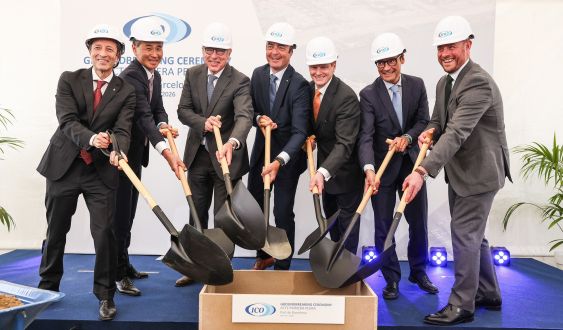
ICO has started the construction of a new vehicle terminal in the Port of Barcelona that will be fully operational by early 2028. The project, located on the Príncep d'Espanya dock, will have an area of more than 100,000 m² and an initial annual capacity of 180,000 vehicles, with the aim of consolidating the city as a logistics hub for the automotive sector in Southern Europe.
The new terminal, developed by ICO —a subsidiary of the Japanese shipping company Nippon Yusen Kaisha (NYK)—, will be integrated into the company's European RoRo network and will mark its expansion into the Spanish market. The facility will be able to house up to 11,000 vehicles simultaneously, of which 8,160 will be located in a multi-story storage structure that will optimize space usage and reduce internal movements.
The project has been conceived as a new-generation logistics infrastructure, based on four main pillars: capacity, digitalization, sustainability, and connectivity. In this regard, the terminal will incorporate automatic vehicle scanning systems at access points, charging infrastructure for electric vehicles, and its own digital platform that will allow real-time tracking of each unit, improving operational efficiency and traceability. In addition, the facility will be prepared to operate with standard trucks and megatrucks, optimizing entry and exit flows and reducing transit times within the enclosure.
The choice of Barcelona responds to its positioning as one of the main logistics nodes in the western Mediterranean. The terminal will be located next to the port's railway infrastructure and will have triple-gauge tracks, allowing for seamless integration between maritime, rail, and road transport. This intermodal approach will facilitate the movement of vehicles between Southern and Northern Europe, reinforcing the role of the Port of Barcelona as an international distribution platform.
In the words of Jurgen Vanhove, CEO of ICO NV, "we are expanding beyond our Belgian base to better serve the Southern European market, adding capacity where it is needed and creating jobs in the process." He also emphasizes that "automation helps us work more safely and intelligently, but people remain essential in our way of operating."
The development of this infrastructure will have a direct impact on the entire port ecosystem. The activity generated will not only affect logistics operations but also auxiliary services such as transport, maintenance, security, and technical support. The creation of both direct and indirect employment is foreseen, strengthening the economic fabric linked to the port and contributing to the growth of industrial and logistics activity in the Barcelona metropolitan area.
The new terminal will allow the Port of Barcelona to strengthen its role as an international automotive hub and improve its logistical connection with Europe
From the Port of Barcelona, its president, José Alberto Carbonell, has highlighted that this new terminal will allow increasing operational capacity and advancing towards the goal of exceeding one million vehicles annually. Currently, the port moves more than 700,000 vehicles a year, a figure that could progressively grow with the incorporation of new infrastructures. "The port must act as a bridge between Asia and Europe", Carbonell pointed out, focusing on the growth of international traffic and the increasingly relevant role of vehicles from Asian markets, especially China.Sustainability has been integrated as one of the key pillars of the terminal's design. The project includes the optimization of internal traffic flows, the reduction of unnecessary travel, and adaptation to the growing presence of electric vehicles in the market. The infrastructure will include electric charging points and will be designed to respond to the new needs of the automotive sector, which is in full transition towards more sustainable mobility models.

In this context, Carbonell emphasized the importance of moving towards more resilient infrastructures in an environment marked by global uncertainty: "zero-emission vehicles are no longer an exception but are becoming an increasingly majority option."
The concession, with a duration of 27 years, will be the third terminal dedicated to automotive within the port and is part of an approximate investment of 75 million euros. The project also includes the construction of a high-rise storage structure up to 45 meters, designed to maximize operational capacity in a limited space.
With this new infrastructure, ICO continues to expand its presence in Europe and strengthens its position as one of the main global operators in the RoRo transport sector, responding to the growing demand from manufacturers and logistics operators seeking efficient, scalable, and sustainable solutions in the south of the continent.
Add The New Barcelona Post as your preferred Google source for free
Stay informed with the latest news.