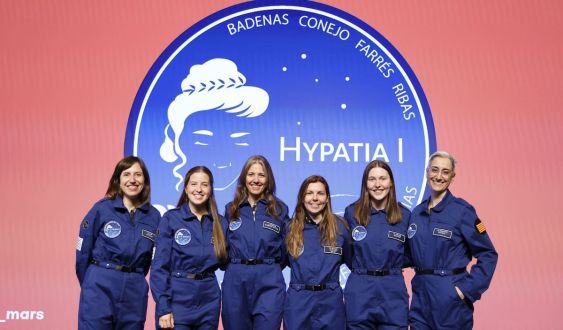
Nine Catalan scientists are finalizing the details for a space mission at the Mars Research Desert Station (MDRS), a facility in the Utah desert that recreates living conditions on Mars. This shouldn't be a surprising start at this point, but it still is, with the gender gap taking its toll in many sectors, including the scientific one. The members of Hypatia I are the first local researchers, from different disciplines and ages, who have been selected to undertake a mission at this simulation station located in the United States. With a budget of 50,000 euros, it has been financed by the Generalitat, the Fundació Catalunya La Pedrera, and the Fundació Banc Sabadell, among others.
"Undoubtedly, we have progressed a lot since women were excluded from the scientific community, but the road is long and there is still much to do," says astrophysicist Mariona Badenas-Agustí, commander of the Hypatia I mission. The data speaks for itself. 62 years ago, the Russian Yuri Gagarin was the first astronaut to make a manned space trip, and since then, only one in ten people who have gone to space have been women, most of them also white. And, of the 12 astronauts who have walked on the Moon, all were men, white, and American.
"With this project, we want to contribute to a more inclusive and diverse science, where women have the recognition and visibility they deserve," remarks the commander of Hypatia I. The nine scientists who make up this mission want to inspire girls and adolescents, encouraging them to be interested in vocations historically dominated by men and in which only men have been made visible. NASA is working along the same lines with the recent announcement that the Artemis II mission will include a woman on the team, engineer Christina Koch, who will be the first in history to step on the moon.
The Hypatia I mission will begin this Sunday in the Utah desert and will last 13 days, until Saturday, April 29. Badenas-Agustí will be accompanied by human biologist and science communicator Carla Conejo González; researcher at NASA's Goddard Space Flight Center Ariadna Farrés Basiana; researcher Laia Ribas; journalist Núria Jar; researcher Neus Sabaté; aerospace engineer at Airbus Cesca Cufí Prat; artist Anna Bach, and Physics and Mechanical and Electronic Engineering student Helena Arias.
The Catalan scientists will live under the same conditions they would have if they were leading a manned mission to Mars, completely isolated and measuring each of their actions, forgetting the facilities that Earth provides. They will have to eat dehydrated products and potable water will be limited. They will not be able to communicate immediately with Earth and will only have specific hours of connection with mission control. And, of course, they will all dress as astronauts, even on outdoor excursions, which will also be limited. Just in case, the mission members have received training in health emergencies.
Beyond changing the narrative and putting women as space protagonists, the mission will dedicate the two weeks it will spend at the Mars Research Desert Station to investigating the viability of a real mission to the red planet, which today still carries too many risks. The experiments they will conduct will take advantage of the fact that the orography and geology of the Utah desert resemble that of Mars, with a landscape rich in ferrous material, with large temperature fluctuations and low humidity, which will allow for more precise results.
For two weeks, the mission crew members will live completely isolated and measuring each of their actions, forgetting the facilities that Earth providesThe Hypatia I scientists will analyze questions such as aquaculture on Mars, bearing in mind that it is a hostile planet, not only to live on, but also to grow food; ornew navigation systems, since those used until now fail. A very important issue in future missions to the red planet will bethe batteries, bearing in mind that the ship cannot be loaded with too much weight if fuel is to be saved, so batteries based on iron chemistry, a material abundant on the Martian planet, and which will be activated with urine, will be tested.
This first experience will not be the only one. The promoters hope to give it continuity by looking for new members in future missions. For those who want to start thinking about it, Hypatia II will travel to Mars in 2025.
Add The New Barcelona Post as your preferred Google source for free
Stay informed with the latest news.
