On the founder's path, it's easy to get lost. From the ideation phase of a project to product development, market launch, the search —or not— for investors, each stage is full of twists and sudden changes of direction in which it's difficult not to get disoriented. To smooth this path for founders and give them clues about the route to follow, a sea of hubs, accelerators, incubators, clusters, and other institutions has emerged in the city, dynamizing the ecosystem, facilitating the growth of companies, and stimulating interactions among its various actors.
Thus, this network of institutions and entities acts as an innovation engine for the ecosystem. They generate strategic nodes that connect entrepreneurs with mentors, investors, knowledge, and opportunities, thereby contributing to articulating the ecosystem, giving it more density and contributing to its maturity and, therefore, impact. Aware of its importance, Catalonia has experienced —and continues to experience— a continuous emergence of such actors, often promoted by an alliance between the public and private sectors.
Within this work of structuring the ecosystem, hubs play a crucial role. A hub is originally a network device that connects connection nodes, and this is also its role within the startup world: to connect, to be a point of confluence for actors from the various legs of the ecosystem. To connect founders with investors, with training, with talent… and with other founders, which is also essential for a founder to expand their network and to have access to other points of view when facing challenges similar to those they may be confronting.
These innovation nodes constitute small-scale entrepreneurial ecosystems in themselves, in which synergies and meeting points between entrepreneurs, investors, and companies are fostered. In the Catalan capital, Tech Barcelona was one of the precursors in this field. With Pier01, which will soon celebrate a decade, as its emblem, the association has been opening spaces for startups, such as Pier03, initially focused on blockchain and which has ended up becoming a transversal space; and Pier07, which focuses on the health sector.
But the network of hubs now goes much further in Barcelona. In fact, they are spreading in such a way in the city that hubs are emerging from all kinds of sectors, whether with or without physical space. The Barcelona Finance Hub to turn the city into an epicenter of financial innovation; the future Catalunya Media City at the Tres Xemeneies in Sant Adrià; a node for sport at the Barcelona Sports Hub; the powerful Barcelona Health Hub; the Advanced Therapies Hub coordinated by Biocat; the Global Legaltech Hub; an ecosystem of innovative companies in the field of major sports and music events at the Olympic Stadium with The Venue; a space to rethink tourism at the Barcelona Travel Hub, promoted with the Gremi d’Hotels, and a long etcetera, which also includes hubs that go beyond a sectoral scope, such as Impact Hub or Norrsken, which focus on the impact that their ecosystem generates in society.
The list is extensive, and private companies have contributed to enlarging it in recent years. Due to its impact and size, the AstraZeneca Global Hub Barcelona stands out, which will contribute to innovation and research globally from the renovated Edifici Estel. But these actors go much further, and include dozens of projects, such as the AI hub recently opened by Sanofi and Cisco's Innovation Center, among many others. The rise of these hubs has led to reaching 160 in Catalonia, 20 more than the previous year. Of these, 75% are located in Barcelona city, as detailed in the study Tech Hubs Overview 2025, promoted by Mobile World Capital Barcelona. According to the report, prepared with the collaboration of the City Council and Acció, the number of these hubs has quadrupled in the last seven years, and generates more than 34,000 jobs and an impact of nearly 2,900 million euros annually, with an average of 18 million per hub.

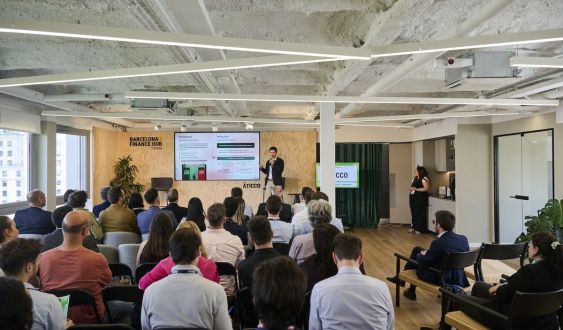
The contribution of hubs to entrepreneurship, however, goes beyond this quantifiable impact. "They are essential for energizing the ecosystem, and they generate interactions and synergies, in addition to connection with investors," highlights Acció's Senior Startup Manager, Oriol Sans. At the same time, they are "a very broad concept, with a common thread: they have the mission of aggregating and energizing ecosystems," adds Quino Fernández, director of the Barcelona Finance Hub (BFH). In their case, the hub aims to energize financial innovation in Catalonia. The center, which has completed its first year of activity in the Barcelona Stock Exchange building with more than 100 active members and a hundred events, aspires to "turn Barcelona into a financial innovation center," as a meeting point and activity hub for the community, which it has brought together in events such as Finance Day, which will be replicated annually every May with the aim of "consolidating it as a benchmark meeting for financial innovation." And events are another key element of all this revitalization.
Barcelona as a hub of hubs
Although a hub like the BFH focuses on a specific sector, it often interacts with hubs from other areas. "We relate but we structure little, and sooner or later the hubs of Barcelona will have to start working together," highlights Fernández. The objective? "To promote the concept of Barcelona as a hub of hubs."
The same is advocated by the managing director of Norrsken Barcelona, Rocío Alcocer, who is promoting a first meeting with leaders of other hubs to try to articulate this hub of hubs that Barcelona can be. "We all see that we are trying to build the same thing in different ways, which are very complementary; by uniting, we can make Barcelona's ecosystem advance even further," highlights Alcocer: "Each one has its own plot, but there are several that overlap and, if we work together to make these areas bigger, we will all benefit."
In addition, the hubs have common interests in areas such as regulation and talent attraction. “If we have a more unified voice representing many of the ecosystem's actors, we will have much more strength at all levels,” adds the director of the center that the Swedish foundation opened at the end of 2023 in Barceloneta to delve into the city's impact economy ecosystem and boost it: “The role we want to play is that of a link between the different actors already operating in Barcelona,” with its coworking, social club, and events. More than 270 startups currently operate from the hub, with a “wide range” that goes from one-person emerging companies to companies with more than 50 employees. To these are added the 600 members of the social club and 70 investors: “Barcelona is being able to attract many investors, and it is an opportunity that must be seized now that multiple funds are centralizing their operations in Europe.”

In the impact economy ecosystem, Impact Hub also stands out in Barcelona, integrated into an international network of 120 hubs with 20 years of experience, as explained by the director of the Barcelona center, Irene Tarradellas. With a presence in 70 countries and a community of 25,000 people, Impact Hub works to find solutions that drive social and environmental transformation. To do this, it identifies challenges in society and specific sectors, and challenges the entrepreneurial and research ecosystem to devise and launch creative proposals to respond to needs in areas ranging from education to water saving.
Precisely water is the protagonist of another of the sectors in which Barcelona has set out to become a benchmark: the blue economy. This area, partly propelled by the America's Cup, has joined the strategic sectors that the city wants to promote, with initiatives such as the blue economy pole in the reformed Port Olímpic and the Blue Tech Port, which the Port of Barcelona promotes in the old Sant Bertran sheds with the aim of making it a benchmark in this field. The hub is already partly operational in the space, but it needs to be completely remodeled. The works, which are expected to begin in the autumn, will last until 2027, with an investment of 49 million euros.
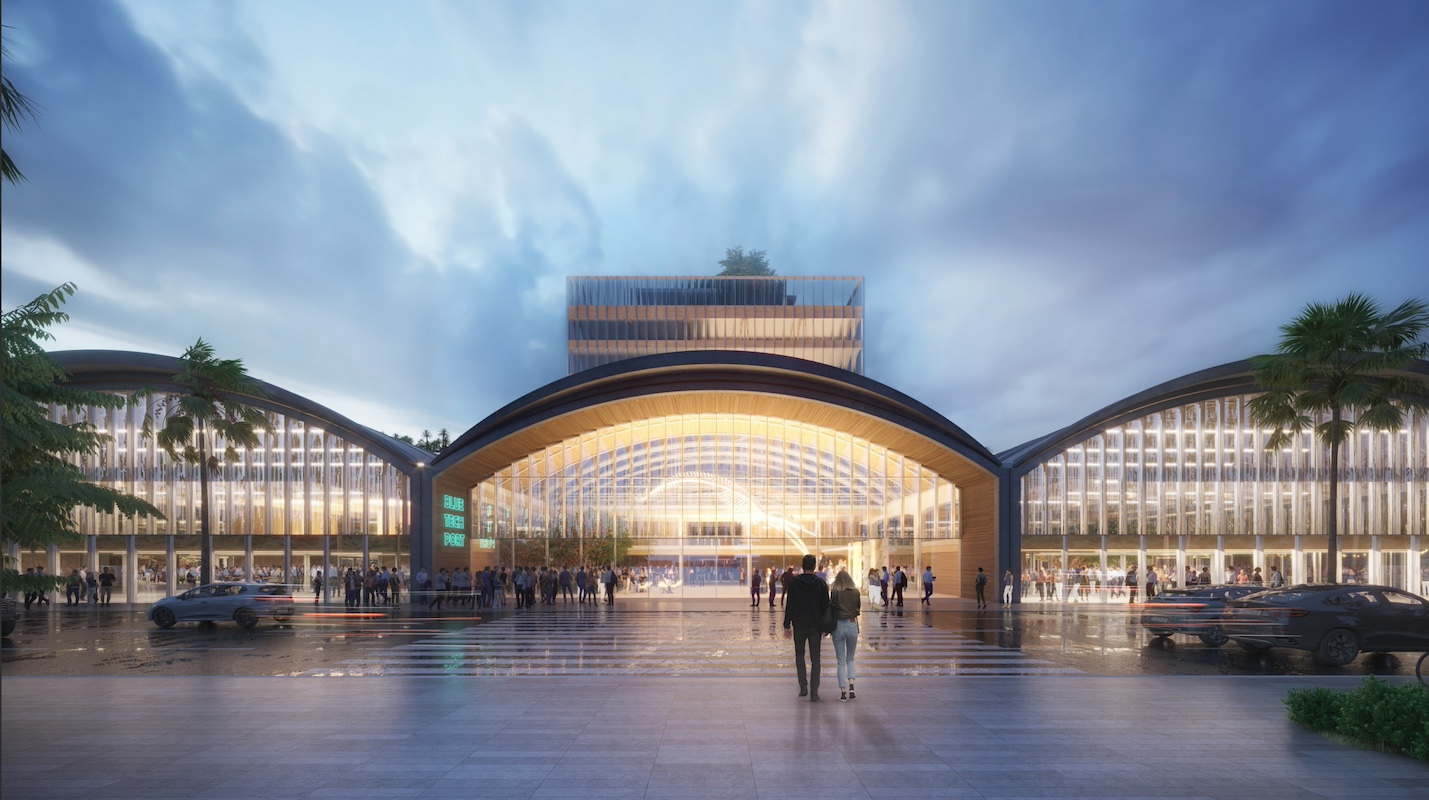
The Blue Tech Port will join the constellation of hubs operating from Barcelona. However, they are not alone in structuring the entrepreneurial ecosystem. Sometimes intertwining in their functions, incubators and accelerators are key to giving wings to startups in both initial and growth phases. While incubators create the environment to cradle new ideas, accelerators turbocharge these ideas so they can take off and materialize. Barcelona offers tools for both phases, in a city that has actors such as Barcelona Activa, Seedrocket, Bcombinator, Itnig and Lanzadera, and also with sectoral initiatives, such as the Logistics 4.0 Incubator of the Consorci de la Zona Franca de Barcelona. In addition, these gestation and take-off platforms are adding new agents who often come from companies or even sectoral hubs that aim to accompany startups in their creation and growth. To do this, entrepreneurs immerse themselves in often intensive programs, which provide mentorship, training and networking.
“We carry out programs throughout the year focused on entrepreneurs,” highlights Kasia Adamowicz, global manager of Seedrocket, which was born as a non-profit association in 2008 by Jesús Monleón and Vicente Arias, as the first accelerator founded at a national level. Seedrocket's emblem is its Entrepreneurs Campus, a bootcamp that takes place during an intense week in which about fifteen selected startups receive mentorship and training and access a wide network of investors, totaling about 190: “On the last day, the startups present their projects to investors, and many of them end up closing funding rounds.” Since its launch in 2008, the association has facilitated the investment of 140 million euros by its external network of investors.

Part of these startups that go through the bootcamps can then continue operating from Seedrocket's facilities, where they delve into the acceleration process with workshops, activities, events, and training. And it is that, for any entrepreneur, it is essential to train, since they can hardly master all the areas they have to touch in the development of the startup, where they often act as a one-man or one-woman band. To also contribute in this area, the Barcelona ecosystem has seen new training options emerge, such as Founderz. Founded in 2020 as an online business school focused mainly on AI, it has trained more than 200,000 people in more than 50 countries, and accompanies 350 companies in these processes, as explained by its founder and CEO, Anna Cejudio.
And accelerators, incubators, and hubs do not row alone in the structuring of the entrepreneurial ecosystem. Actors such as clusters also acquire great relevance. Although from a distance they may seem similar to hubs, they have nothing to do with each other: “They are very different; hubs want to energize an ecosystem, while clusters are associations of sectoral companies that aim to generate synergies among themselves and boost their business. A hub energizes; a cluster is a lobby,” highlights the director of the BFH.
Clusters to strengthen sectors
And clusters are not few in Catalonia in general, and in Barcelona in particular. Globally, Catalonia has about thirty clusters, which operate as a concentration of companies, institutions, and related agents that, despite being able to be competitors, in the cluster share visions and strategies to grow together and defend common interests. These organizations group more than 3,000 companies and associated agents in Catalonia, with an aggregated turnover of 80,000 million euros —36% of Catalan industrial turnover—.
These companies include large companies and also SMEs and startups, which can see their growth facilitated by being in contact with large companies in their sector. And these sectors are found in all areas: from technology linked to education, with the Edtech Cluster to CataloniaBio & HealthTech, passing through the tourist innovation of the Tech Tourism Cluster, and even perfumery. As Adrià Martínez, strategic projects manager at the Beauty Cluster, highlights, the cluster aims to propel the sector, which it does in several ways: “From the cluster, we participate in global fairs and events, often with grouped pavilions, and we also conduct market studies and commercial missions to discover new potential markets.” And now the cluster is taking another step, with the consolidation of the Barcelona Perfumery Congress as an international reference event in the sector.

With this objective of strengthening the network of companies in a given sector, clusters have been emerging in Catalonia until they are found in sectors as disparate as lighting, bioenergy, logistics, mental health, wine and viticulture, and meat and alternative protein, totaling these thirty groupings that give consistency to the business ecosystem, including the most emerging companies.
Through this extensive interconnected network, which goes further and touches multiple local and multinational institutions and companies, the ecosystem continues to strengthen, also driven by major events, such as Mobile, 4YFN, Tech Spirit Barcelona, and Smart City Expo World Congress, through which local startups come into contact with the global scene. With all of them, Barcelona is consolidating itself as a laboratory-city that, with adequate coordination of all these actors, can itself act as an accelerator.
Add The New Barcelona Post as your preferred Google source for free
Stay informed with the latest news.