
Children play a prominent role in the fulfillment of the Sustainable Development Goals (SDGs) that were approved by all United Nations Member States in 2015, with the aim of eradicating poverty, reducing inequality, and achieving more peaceful and prosperous societies by 2030. According to Unicef, in each of the 17 goals of the 2030 agenda, programs can be promoted that defend and strengthen children's rights, especially those related to the eradication of poverty and hunger, the right to health or education, gender equality, or the reduction of inequalities.
SDG number 11 also has a direct impact on children and on cities like Barcelona, as it advocates for making cities more inclusive, safe, resilient, and sustainable. "Half of the world's children live in urban areas, and this figure is expected to reach 70% by mid-century," highlights Unicef, which has been promoting the Child-Friendly Cities Initiative since 1996. "In collaboration with partners, we support governments in creating urban spaces where children have access to basic services, where they enjoy clean air and water, and where they can play, learn, and grow feeling safe. We also help ensure that children's voices are heard and that their needs are integrated into public policies and budgets," explains this United Nations agency.
In this context, the Industrial Design Association of FAD (ADI-FAD) has organized next Thursday, May 11, at CASA SEAT, a new edition of ADI Making Of in which different projects will be presented whose purpose is to make Barcelona a more livable city, especially focusing on the quality of life of children, that is, a "more playable" city. To get a ticket click here.
The objective of ADI-FAD is to publicize intervention projects in urban spaces to make them more playable, fostering a more cohesive and healthy urban context. As in all ADI Making Of sessions, these are three micro-conferences, united by a common thematic axis. In this case, the projects El pulpo del parque de la Pegaso, by Jordi Queralt; Landskate Parks, by Sergi Carulla and Oscar Blasco; and El Parque de les Glòries, by Ana Coello and Pilar Llop, will be explored in depth.
The meeting at CASA SEAT will be led by Enric Pericas, architect, landscape architect and industrial designer from Escofet, and will be complemented, before the conference session, with a guided visit to the exhibition Dream the City at the Palau Robert in Barcelona, with curator Roger Subirà, architect and vice-president of Arquin-FAD.
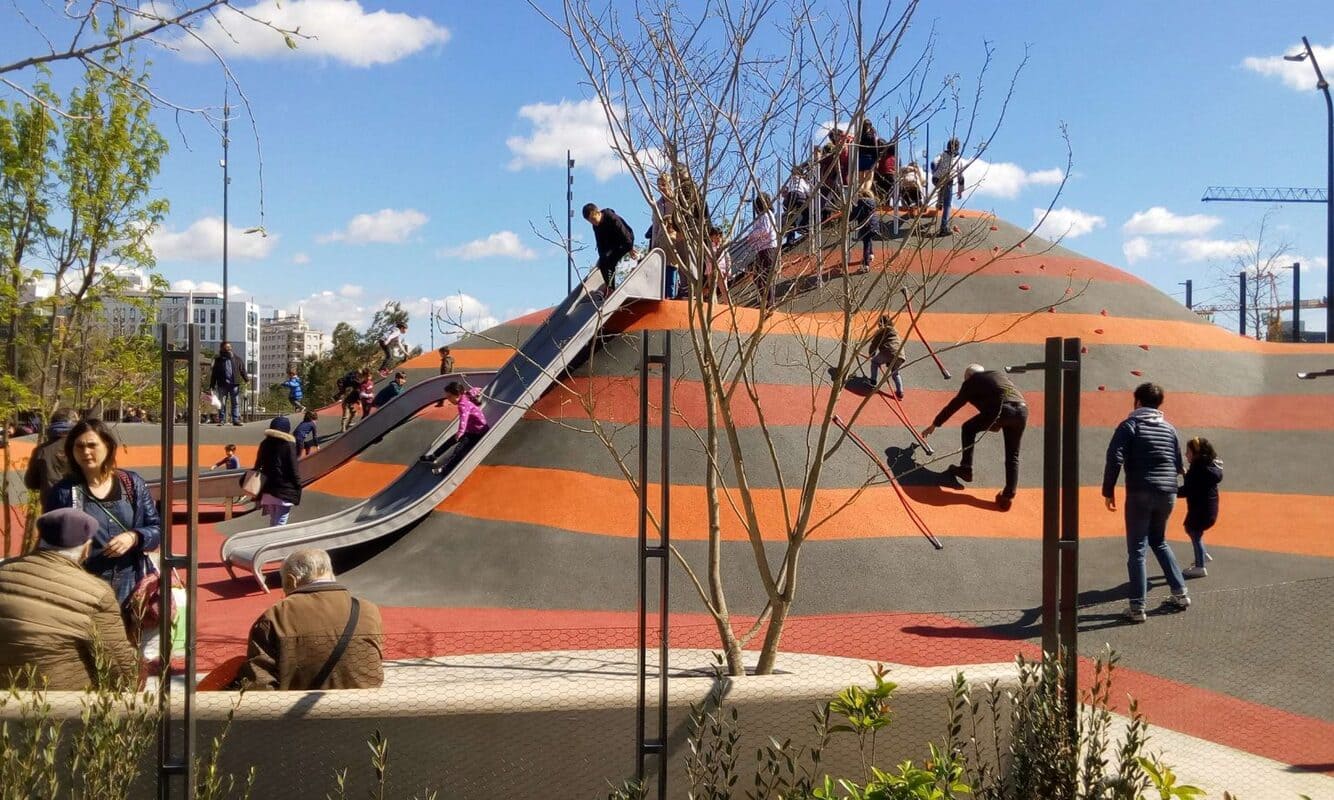
The Octopus of Pegaso Park
To learn about this project, the guests will be Jordi Queralt, from Queralt Suau, and Carmen Sabaté, from BDU, Espacios de Valor. Queralt Suau is an architecture studio that explores transversal formats based on the interaction between space, time and narrative. According to ADI-FAD, "they are defined by their interest in crossing disciplines, techniques and content, intervening in the city with permanent and temporary installations, through play and critical thinking." For its part, BDU defines itself as creators of valuable spaces. And they do so with the collaboration of architects, landscape architects, athletes and educators with whom they create spaces that inspire, endure and are sustainable.
Landskate parks
In the second block, Sergi Carulla and Oscar Blasco, from SCOB Arquitectura, a studio responsible for some of the city's most emblematic skate parks, including the one at Mar Bella Beach, those in the Àurea Cuadrado gardens, in the Les Corts neighborhood, in Nou Barris or in Trinitat. "These urban sports parks represent a new paradigm for the city's public space; and often, a refuge for teenagers," highlights ADI-FAD.
Glòries Park and the Sensory Worm
Finally, Ana Coello and Anna Mallen, from the temporary joint venture Agence Ter and Ana Coello, will explain their work as those responsible for the transformation of Plaça de les Glòries and the Sensory Worm project designed in the Vil·la Amèlia Gardens. Agence Ter, with offices in Paris, Karlsruhe and Shanghai, received the French National Urban Planning Grand Prize in 2018. Ana Coello Paisaje y Arquitectura was founded in Barcelona in 2007 and carries out landscape and architecture projects in a wide range of scenarios, from territorial planning to gardens.
Add The New Barcelona Post as your preferred Google source for free
Stay informed with the latest news.
