[dropcap letter="D"]
uring the sixties, in Poblenou there were few corners with more life than the Pau i Justícia cooperative. The ground floor of the building, erected in 1927, was a hive of people entering and leaving the consumer cooperative, the grocery store where workers found all kinds of products at good prices, from crates full of fruits and vegetables to hams hanging on the walls or canned goods that someone patiently stacked to form gigantic pyramids. There was also space for a shoe store, brooms and crockery were sold, and, of course, bulk wines and the small Coca-Cola fridge were not missing, as can be seen in these period images. The cooperative also had a bar with billiards and a theater, where popular classics such as La criada nueva or Déjame la mujer, Cisquet were premiered, and the upper floor housed a chess club, a hiking group, a women's group, a library, and the school (where the sculptor Subirats, born next door, studied).
In that glorious era, the more than 1250 members of the cooperative were not satisfied with all this hustle and bustle and decided to promote a housing development: the Civit block, located where Diagonal avenue would later be, is a good example of those self-managed promotions, which provided housing for 300 families in the neighborhood. In fact, the Pau i Justícia building had already been built with the effort of fifty members, who for months dedicated Sundays and holidays to working as laborers, in an unparalleled demonstration of the cooperative spirit of the time.
Already in the hands of the City Council, in 2011 it was decided that the Pau i Justícia would house the Sala Beckett, forced to leave Gràcia, where its theater and dramaturgy school achieved international prestige.Unfortunately, the appearance of supermarkets and changes in habits forced the cooperative to close. In the nineties, the building at numbers 228 to 232 of Pere IV only housed a gym and a sauna, and later the doors had to be bricked up to prevent occupations. Already in the hands of the City Council, in 2011 it was decided that the Peace and Justice the Sala Beckett will be installed, forced to leave Gràcia, where its theater and dramaturgy school achieved international prestige. And an architectural competition is organized to make it possible, which receives completely divergent proposals: some architects, like Jordi Badia, wanted to keep the space intact, with just a coat of paint, while Carme Pinós's studio opted to demolish the cooperative's building and erect the umpteenth emblematic building, considering that the obsession with preserving and maintaining memory was falling into "political correctness" (in this video a heated debate among the various contestants can be recovered).
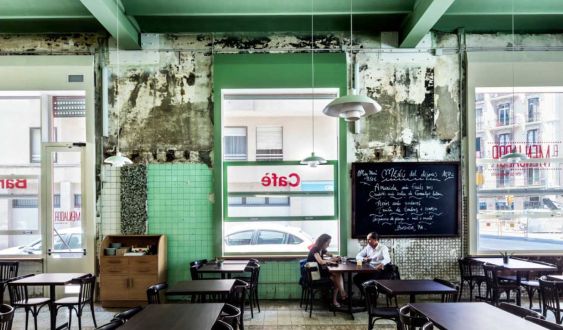
Luckily, the winners were the studio Flores i Prats, with a craftsmanship proposal that maintained the essence of the building to unsuspected limits: without giving up on sanitizing the structure and opening spaces, the new Beckett has preserved most of the doors, windows, and hydraulic mosaics from the 1920s, often relocated to new spaces. In this way, the old and the new coexist at the same time, and memory is combined with theatricality: as the director of the Beckett, Toni Casares, explains, "when the spectator sits down, looks at the walls and is already imagining."
Currently, the cooperative Pau i Justícia, with its brand new theatrical attire, not only lives a second youth in Poblenou, where it is once again a reference space for the neighborhood, but also, at least for a few months, will have a second life at the Venice Biennale. The curators of this year's architecture exhibition fell in love with the project, and to explain all the details of the rehabilitation, Flores i Prats have reproduced a piece of the new Beckett in the middle of the Venetian Arsenale, replicating the sinuous oak benches and the fantastic modernist rose window that so proud the cooperativists.
Add The New Barcelona Post as your preferred Google source for free
Stay informed with the latest news.