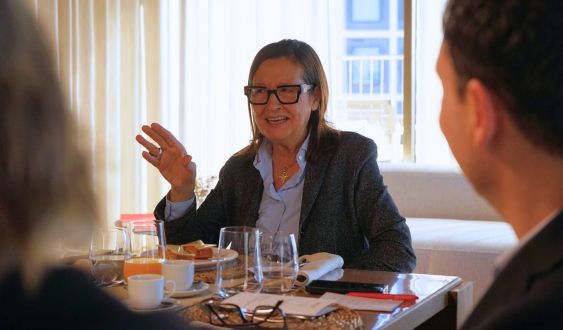
Barcelona has not always known how to explain itself. But there are trajectories that, more than explaining the city, practice it. They build it. Or they build cathedrals within it. And Helena Guardans is one of them: a global businesswoman, builder of teams of thousands of people and, today, from the Liceu, a defender of an idea that goes beyond culture: the city as a collective work. She explains it to us, behind closed doors, to a group of people invited to the latest Esmorzar de Forquilla, a series of meetings organized by the Cambra de Comerç de Barcelona, sponsored by Indra and with The New Barcelona Post as a collaborating media.
Guardans founded Singular in 1994, a pioneering company in customer service, at a time when call centers were little more than switchboards. She introduced a differential idea: it was not about managing calls, but about solving problems: "We didn't sell hours, we sold peace of mind," she recalls. A way of understanding service —and leadership— that could be synthesized in a metaphor she herself uses: the difference between breaking rocks and building a cathedral.
In fact, in this trajectory between the stone and the cathedral, the company was acquired by Sellbytel in 2001 and, subsequently, by Webhelp in 2018. In both processes, Guardans not only remained linked, but also assumed executive responsibilities, including the presidency. From Barcelona, she came to lead teams of up to 5,000 people, in a highly internationalized environment.
And now? Since 2024, she has been president of the Patronage Council of the Gran Teatre del Liceu Foundation. She is also a member of the Board of Directors of Fira de Barcelona, of the board of trustees of the UOC and of the Sifu Foundation, as well as of the board of Perk, one of the most relevant scale-ups born in Barcelona. A new chapter from which she continues to do what she has always done: build.
—In a sector, that of call centers, where everything tends to become a commodity, how can one differentiate oneself when, apparently, everyone does the same thing?
— For me, the key was to understand that we didn't sell hours, we sold peace of mind. That is, when a person calls, what they want is not for someone to answer the phone, but to be able to forget about the problem. And that means that you assume that responsibility: that you understand the problem and that, even if you don't know how to solve it, you will help find someone who does. And that was already a radical change compared to other existing services.

— The business was not about managing calls, but about solving problems.
— That's right. And of all kinds! I remember, for example, La Vanguardia's obituaries. They had to come in at any time and be sent immediately to print. There you are no longer managing a call, you are managing a delicate situation, with real responsibility. And like that case, many others: we worked for Henkel, for Apple, for HP... and the key was the same: understanding what happens on the other side, understanding that we were part of something much bigger than answering a call.
Guardans: "It's not about saying what people have to do, but where they have to get to"
There is a big difference between toiling away or building a cathedral.
— What is the difference?
The difference is in understanding the why. And when you give a person visibility of an entire project, you empower them. It's about not saying what they have to do, but where they have to get to. And that's a big difference. It is, in fact, the best way to delegate: because if you know you are building something important, you get involved in a different way.
— How is this philosophy transmitted to teams of thousands of people?
First, by explaining things to the end. And if you transmit it to your most direct team, they will also work that way with their teams. And also by example: if you do it well, that will scale to the rest of the company.
 Helena Guardans © Cambra de Comerç de Barcelona
— A philosophy, in fact, extrapolable to cities.
— Absolutely. And Barcelona is a very good example. Because Barcelona has something that sometimes we don't value enough: it is an extraordinary city. When you ask people from outside why they come to Barcelona, no one talks only about the climate or the sea. They talk about culture, cosmopolitanism, quality of life.
We don't have to invent that. We already have it. What we have to do is take care of it. And transmit it. I tell the executives of Perk or companies with international talent: "listen, you have come to Barcelona for a reason, and you are as responsible as the rest for continuing to take care of this asset." We have to take care of it together!
— And do you think we are doing it?
— Yes, although not always.
In politics there is a tendency to think in the short term, in what will be seen quickly. And cities are not built that way. Important things need time, vision and a certain courage. When you walk through 22@ today, you see a consolidated reality of a city that someone imagined, but that did not yet exist.
Helena Guardans: "Quality tourism is not the one that goes to a five-star hotel. It is the one that comes looking for culture"
— In this city, what role does culture play?
— A central role. And not only from an identity point of view, but also economic.
I remember when they explained to us in London that culture generated more income than the City. That makes you change your perspective. Here we often understand culture as a complement, and it is not. It has great relevance in our city.
In fact, culture defines the type of tourism you want. For me, quality tourism is not the one that goes to a five-star hotel. It is the one that comes looking for culture. The one that comes for a concert, for an exhibition, for an opera. That is the one that adds value to the city.
 Helena Guardans © Cambra de Comerç de Barcelona
— That connects with your current role at the Liceu.
— Yes, because the Liceu is much more than a theater. It is one of the most important opera houses in Europe and it is also an ecosystem: with talent, with training and with an industry around it.
And what we want is precisely that: for that ecosystem to grow and, above all, for people to feel it as their own. For companies, the economic fabric, but also the citizens, to feel that the Liceu is part of them.
— Open the Liceu to the citizens… and to the sea!
— The Liceu Mar project allows us to reformulate a space in the city, yes, but for us it responds, above all, to a very specific need: the need for more space. Currently we do not have enough space-time to do everything we would like to do. When we are doing an opera, for example, we cannot be doing something else at the same time. So with this new space we will be able to do more dance, new creation, more projects… And also have a different space, more open, more flexible.
In addition, for Barcelona it allows to reformulate an entire area and provide a new cultural space. A new cultural hub.
— A new way, and a new space, to experience the city.
— That's right, because culture is what makes us live. If there is no culture, we lose everything. It is, in fact, what differentiates us from machines. And to maintain that culture, we have to take responsibility.
— Through patronage.
— I would like people to feel uncomfortable, very uncomfortable, when asked if they donate money to culture or to a project in Barcelona and they say no. Like when someone smokes, there is already a certain point of discomfort. I would like it to be almost a social norm.
— Would the patronage law help with that?
— Yes and no. Because the law helps, but it is not the problem. What we have to change is the mentality, the concept. It is to understand that when you give money, to the Liceu for example, you are investing in the city where you live or where you operate, and in its culture. That you are part of something bigger.
— That you are not breaking rocks, but building a cathedral.

Add The New Barcelona Post as your preferred Google source for free
Stay informed with the latest news.