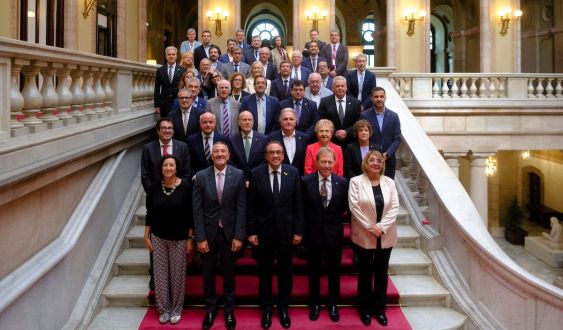
The Llei de Cambres is now a reality after a decade of negotiations. This Wednesday, after the Council of Statutory Guarantees (CGE) endorsed its adequacy to the Constitution and the Statute last August, the Parliament plenary has given the green light to the norm proposed by PSC-Units, Junts, ERC and the PPC. This decision has put an end to the internal front opened between chambers and has updated the law within the state legal framework of 2014. The new regulation establishes a dual financing system, both public and private. It also regulates the Consell General de Cambres as a consultative body and for "collaboration" with institutions. In other words, the 13 Catalan chambers will have more say in general economic matters, direct interlocution with the public administration, and specific funding.
The Parliament plenary has approved the new Llei de Cambres with 114 votes in favor (PSC-Units, Junts, ERC, Popular Party (PP) and Aliança Catalana), 9 against (Comuns and CUP) and 11 abstentions from Vox. Thus, the regulation, which had not been changed since 2002 and had been stalled for 10 years, has been recognized by a substantial majority despite the turbulent political moment, with state elections at the end of November. In fact, in the press conference after the approval, Josep Santacreu, president of the Cambra de Comerç de Barcelona, thanked "the great support from political parties". On the other hand, he lamented the waiting and negotiation time for the law: "We have to look at ourselves for taking so long to approve such a regulation."
Josep Santacreu (Cambra de Comerç de Barcelona): "We have to look at ourselves for taking so long to approve such a regulation"
Without a doubt, the most notorious change with this new law is the funding model. Within six months after the approval of the law this Wednesday, the Government and the chambers must sign a multi-year agreement for three years and the Generalitat must annually foresee a specific allocation for the entities. It has been agreed that this funding will be progressively implemented over the three years: 3 million euros the first year, 5 million the second year, and 7 million the third year. This issue generates some concern within the chambers, as Santacreu has assured in subsequent statements to the media that he would like it to be a "more stable" allocation. In fact, the Junts deputy himself, Joan Canadell, who also presided over the Barcelona chamber between 2019 and 2021, specified that since it is public funding that "is linked to budgetary availabilities," it could be a "dangerous clause."
Beyond funding, the new law organizes four major areas where the Cambra de Comerç operate: the representation of the general interests of commerce, industry, services, and navigation; collaboration with administrations; the provision of services to companies and the promotion of Catalan. In this way, it seeks to strengthen the function of representing general interests and "consolidate a governance model based on plurality," according to the Barcelona chamber in a statement. Thus, a regulation has been approved that aims to place the chambers within social dialogue, without turning them "into social actors," in Santacreu's words, but giving them a space for communication and debate on issues affecting the general interests of the economy.
More public-private collaboration
Another of the great novelties introduced by the law is the new configuration of the Plans Camerals, an instrument that will allow for more coordinated collaboration between the Chambers and public administrations. For the chambers, dialogue with public administration must be constant and they see themselves as capable of identifying and putting on the table "the priority needs of the economy of each territory of Catalonia," confirmed the Cambra de Comerç de Barcelona. Through these plans, then, the entities will be able to propose economic development objectives and propose specific actions to achieve them. All, however, in negotiation with the competent public administrations. The norm also defines with greater precision the participation of the chambers in areas such as economic studies, business surveys, economic promotion, or the development of vocational training.
In addition, a clearer framework is established for the relations between the General Council of Chambers of Catalonia and the territorial Chambers, both in terms of governance and the financing of shared projects. Also at the press conference after the agreement, the president of Cambra de Comerç de Manresa, Sílvia Gratacòs, and the president of Cambra de Comerç de Girona and vice-president of the Consell General de Cambres de Catalunya, Jaume Fàbrega, thanked that it is a law that focuses on improving and streamlining the work of the people who are part of these entities, distributed throughout the territory: "It is recognizing the work of 400 people," said Gratacòs.
The shadow of the silver chairs
The vote against the law by Comuns and the CUP is tied to an issue that has been controversial throughout the negotiations: the increase in the number of "silver chairs." These are the seats on the plenary of the Cambra de Comerç assigned to large companies or entities that make a higher voluntary financial contribution to the body, rather than being chosen by direct vote of the productive sectors. The new law does not set the number of these seats: it provides for the figure, but the increase from two to ten is an agreement of the plenary of the Cambra de Comerç de Barcelona, which approved the proposal of the executive committee chaired by Santacreu. This decision stirred up considerable controversy and opened a debate on the sector's representativeness within the chambers. In fact, the two parties that have now opposed the law took the matter to the CGE, which ultimately found no irregularity and considered that the new composition of the chamber's plenary "has weighed objectively and reasonably the diversity that exists within the business fabric."
Comuns and CUP's amendments on this issue have been rejected in the Parliament's plenary session and, as a result, Santacreu has a free hand to apply the increase from two to ten seats. For this reason, both groups have maintained their vote against. Vox also abstained without speaking on this point, although it has made clear that, for them, the law is "too interventionist." Santacreu commented on these positions after the vote and acknowledged that they do not particularly affect him: "If one extreme and the other hold contradictory opinions, we must be doing something right," he declared.
Add The New Barcelona Post as your preferred Google source for free
Stay informed with the latest news.