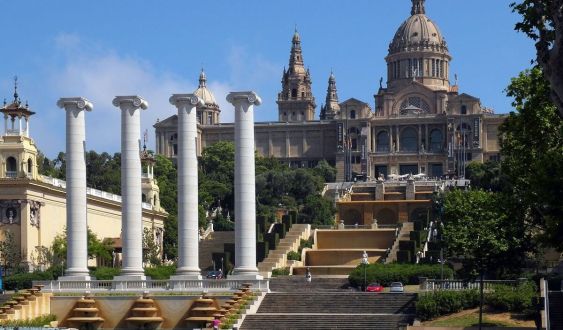
The awaited expansion of the MNAC is underway. The museum's board of trustees, comprising the Government, the Generalitat, the City Council, and representatives of civil society, has unanimously agreed to initiate the tender process for the expansion project and the services for drafting the basic and executive projects.
The planned extension in the Victòria Eugènia Pavilion will allow for a reformulation of the cultural facility, fostering "a global rethinking of the museum, its spaces, narratives, and scope." It will coincide with the planned transformation of the Montjuïc complex, which will reduce the space dedicated to fair activity, with the incorporation of 500 apartments and six public facilities, as well as allowing for the expansion of the MNAC.
Once this validation is overcome, the timeline being worked on foresees developing the feasibility and museography plans and the architectural projects during 2022 and 2023. In this way, the public tender for the definitive project would be faced at the end of 2023 or beginning of 2024. The museum sets 2029 as the horizon for the completion of the works, the centenary of the International Exhibition, the urbanization of Montjuïc, and the construction of the National Palace.
The board of trustees has also decided to renew its director, Pepe Serra, for a period of five years. In office since 2012, the work carried out during all these years has been "very positively" valued. In this regard, the social and cultural positioning that the MNAC has achieved in the last decade has been taken into account, increasing the number of visitors, which reached about 900,000 in 2019, compared to 400,000 in 2012.
Under Serra's mandate, the museum has organized more than 70 exhibition projects, renewed the presentation of the modern art and Renaissance and Baroque collections, worked on the formation of the post-war and second avant-garde collection, and on a hundred projects in collaboration with other museums and entities. Another point that the board of trustees has highlighted is the growth of the collection, with numerous acquisitions and donations, and the creation of the Xarxa de Museus d'Art, which has gone from having only three sections in Catalonia to being integrated by 22 museums, deploying a policy of itinerancy throughout the rest of Spain, and increasing its international presence.
Add The New Barcelona Post as your preferred Google source for free
Stay informed with the latest news.
