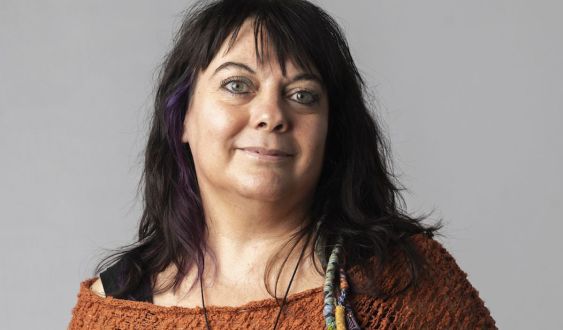
She smiles, her large, expressive emerald green eyes wide open. "Since I was little, I have understood myself and tried to understand the world through my writings." Glòria Sabaté sips the first mouthful of the steaming green tea with lemon, freshly served. "I am a person who seeks to be happy, and luckily I have found what helps me to be close to this goal: literature," she continues, filling the quiet morning atmosphere of the Bar with her words and all this passion for letters.
When she earned her doctorate in Catalan philology in 2016, Glòria Sabaté already demonstrated a deep enthusiasm for that magical relationship established between people and what we read. Her thesis, Aquells qui ho voldran saber, lligen...: Llibres i lectors a la Barcelona del segle XV, explored this relationship from a historical perspective and very much linked to the city. Something that is present in her new work, Mort al palau (Rosa dels Vents), an intelligently structured enigma novel that draws on the passion for Arthur Conan Doyle's legacy to transport the reader to a nineteenth-century thriller, where the key lies in the connection between the work of the brilliant British writer and Barcelona readers of the time. "I am very excited and eager to explain to the world how, in 1908, this city fell in love with Sherlock Holmes!"
This new title, which sees the light of day these days, adds to a brilliant track record that began nine years ago with La filla de Lilith, where she immersed the reader in the dark meanders of 14th-century Barcelona. This was followed by El vel de la deessa, a story of women in the context of the Tragic Week "with which I won the Néstor Luján Historical Novel Award in 2020." This same year, she published, with fellow philologist Núria Pradas, La marca del lleó, which mixes history and fantasy in 15th-century Valencia. To these works, the writer adds two volumes of short stories, Bruixes and Fades, and the informative essay Medicina en femení: de les remeieres medievals a les trementinaires, which highlights the legacy of generations of women who accumulated ancestral knowledge with which they healed and connected people with nature.
She lives for this, for writing. "I can't complain, can I? The contact with readers is pure magic," she reflects. She sips some tea. She closes her eyes. She sighs, satisfied. "I live on a cloud," she adds. Yes, pure magic.
A liberating balance
Professor at the Faculty of Philology and Communication of the University of Barcelona (UB) and a researcher specialized in the Middle Ages, with several academic studies on medieval literature to her credit, Glòria Sabaté is passionate about teaching: "sharing universal works with students, learning from their readings and opening windows to new landscapes."
--- And how do you manage to combine your career as an author with your academic one?
A sideways smile lights up the parishioner's face. "There is a key moment in my life, professionally, and it is relatively recent, which has been precisely that of giving up an academic career so as not to jeopardize the balance I have managed to weave between my facets as a university lecturer and a writer." She sighs again, always satisfied: "realizing that I already have what fulfills me from the university, contact with students, and that I don't need anything else, has been liberating."
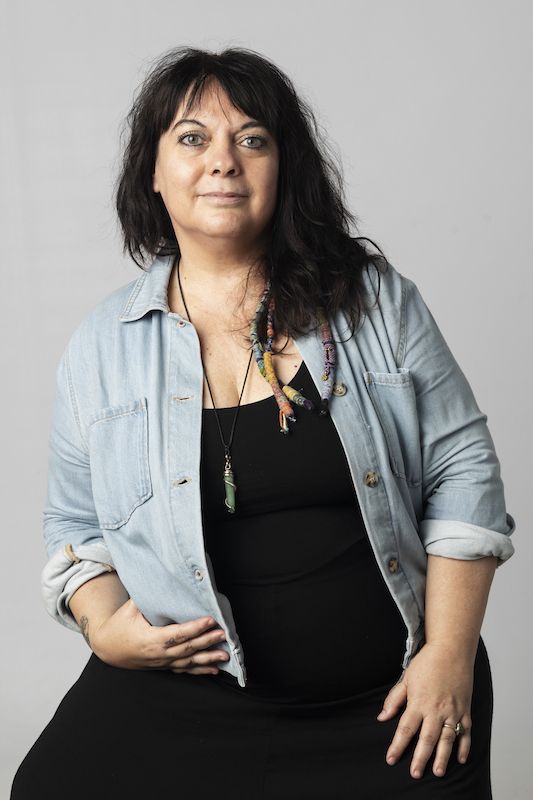
It has not been an easy journey, in any case. "It has cost me a lot to get where I am, nothing has been given to me, and the path has been hard, full of shadows, but also of lights and wonderful people who are now part of me." At the same time, by that magic alluded to before, she is already part of thousands of readers.
One more character
An unconditional lover of the city where she was born in 1985, and despite the current scourge of real estate speculation "which turns a right like access to housing into a privilege," the writer never tires of delving into Barcelona's past. Of turning its streets, its corners, its landscapes and people, into one more character "that beats between the pages of my stories."
And of all those possible, infinite stories within History, she feels a special fascination "for the awakening of women through spiritualism that seduced Barcelona at the end of the 19th century and beginning of the 20th: that liberating path of the search for an alternative spirituality to Catholicism." And who knows if, with this reflection, she is revealing the setting of her next work.
Suddenly, the parishioner stops the flow of her words. She finishes her tea and looks towards some place that is probably not here or now. "Heterodoxy has always seduced me," she adds after a long few seconds of silence.
--- Well, if heterodoxy seduces you, you cannot miss trying some of our varied, diverse, and succulent gastronomic offer, as lunchtime is almost upon us.
Glòria Sabaté opens her eyes wider, if possible, letting herself be enveloped by the sounds and aromas of the Bar: conversations, confidences, laughter; the radio playing in the background, the last coffees of the morning intermingling with vermouths and lunches freshly out of the kitchen. A symphony of urban costumbrismo that makes her feel good, as if this too were, in its own way, pure magic.
--- Perhaps a combo plate might tempt me, but make it vegetarian! –she finally replies.
Add The New Barcelona Post as your preferred Google source for free
Stay informed with the latest news.
