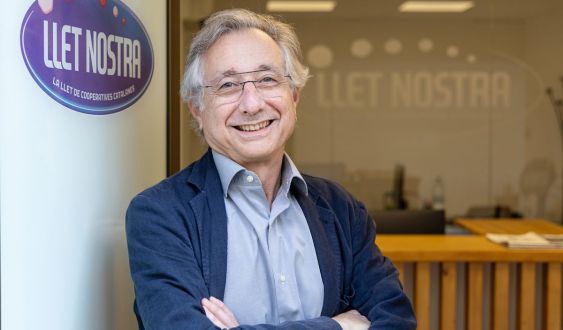
More than two decades ago, Llet Nostra was born with a clear mission: to preserve the Catalan primary sector, at a time when the dairy industry was in decline and there were hardly any packaging plants left in Catalonia. However, they soon realized that defending farmers and ranchers also meant defending the territory, as well as the language and customs. In short, boosting the primary sector also meant boosting Catalan culture.
This is how, very naturally, Llet Nostra became a company committed to cultural patronage, with activities such as the organization of El Nostre Festival, a family artistic event that raises funds for the Fundació Catalunya Cultura. The general director of Llet Nostra, Gabriel de Mariscal, is a strong defender of the positive impact of patronage on society, but also on the companies themselves. De Mariscal urges public administrations to support, instead of penalizing, these companies in their mission to "create a freer and fairer society and, therefore, more cultured."
— How did Llet Nostra come about?
— In 2003, several small and medium-sized farms decided to unite to ensure their subsistence and viability at a time of uncertainty and crisis in the food and dairy sector. Thus, the Federation of Agrarian Cooperatives of Catalonia decided to create a second-degree cooperative, called Lleters de Catalunya, to jointly produce and package under the same brand. The objective was to favor all economic activity in Catalonia with a product made from the territory itself.
— After more than two decades, how has it evolved?
— Since the creation of Llet Nostra, we have never stopped growing. In fact, since 2011 we have remained leaders in the basic brick milk market. We currently produce between 32 and 35 million liters of milk per year, and 95% of our activity is based on the commercialization of liquid milk, although we have also been incorporating other products such as yogurts.
— A company dedicated to the production and distribution of milk, why does it decide to organize a cultural event like El Nostre Festival?
— The idea was to promote an activity aimed at our consumers as a token of gratitude for their loyalty, but where we could also elevate our mission and founding values. In the end, with small actions such as keeping product labeling in Catalan or favoring the subsistence of the primary sector, what we were doing, deep down, was preserving Catalan culture. In addition, we began collaborating with the Fundació Catalunya Cultura, which was just being constituted in 2014, the year we began to consider the idea of the festival.

— And so it ended up becoming an annual itinerant festival aimed at a family audience that brings together everything from performing arts to music or magic. Why this commitment?
— It is with children that we must teach and promote the customs that make us unique, but also where we must influence to transmit the dairy tradition. That is why we decided to focus on the family audience and offer them a wide variety of activities: from educational workshops on how to milk a cow to a Lildami concert. In addition to betting on culture, with the festival we also defend another of our founding values: proximity. For this reason, we decided that the festival would be itinerant, and we have already celebrated it in Barcelona, Vic, Girona and, this year, also in Igualada, on Saturday, November 8.
— A solidarity festival, moreover, since the profits obtained from ticket sales are destined for the Fundació Catalunya Cultura. Why this commitment?
— Llet Nostra was born with the mission of being much more than a dairy company. It also wants to promote a more just and healthy society. And for that reason, we consider it essential to bet on culture. Donating the profits obtained from El Nostre Festival is almost a symbolic act, since it does not represent a large sum, but it is an impulse for these cultural projects. In addition, for the festival we also use the Impulsa Catalog promoted by the foundation, managing to give a voice to emerging Catalan cultural projects. On the other hand, for each attendee to the festival, we will also donate six liters of milk to the Igualada Food Bank.
"From public administrations, not only is patronage not favored, but, in a certain way, it is penalized"
— For all this involvement in the defense and promotion of Catalan culture, the Fundació Catalunya Cultura has also distinguished Llet Nostra with the Segell Impulsa Cultura, which recognizes companies that want to generate social and cultural value. Is it increasingly difficult to find this type of committed companies?
— We are not alone, there are many companies, and even large organizations, that share this commitment. But it is true that there is a lack of pedagogy and role models for companies to understand that investing in culture and society also ends up becoming a benefit for the company. Because, in the end, a free society with criteria is an educated and cultured society. It is a mutual interest: the more cultured society is, the more capacity it will have to distinguish what is good and what is bad and buy with criteria, thus valuing our commercial commitment and the values we defend.
— Is it easy, as a company, to bet on patronage?
— It is not easy, neither for small nor for large corporations. From public administrations and from the law, patronage is not only not favored but, in a certain way, it is even penalized.

— How does the current law penalize patronage?
— Fiscally, this activity does not seem to be favored, but rather the opposite, and that makes companies think twice before investing in culture. Even so, there are companies in Catalonia that choose to invest in culture, social or scientific projects. Therefore, if we had a good patronage law, at a Catalan or Spanish level, as they have in France, these companies could multiply exponentially.
— Why should Catalonia look at France and its patronage law?
— In France, on the one hand, companies, but even individuals, have many more tax deductions for all those activities considered positive for society or the territory, such as patronage. But, on the other hand, it is also the general framework and the perception of patronage. It seems that in France the message is: entrepreneur, promote culture, and the State will reward you. While here, on the other hand, patronage even seems to be fiscally punished.
"One must distinguish between patronage and advertising"
— Is there, then, a lack of institutional commitment to patronage?
— As a society, we are not used to talking about patronage, nor do we perceive it as something positive. Catalonia has a very important tradition of patronage: large buildings in the city of Barcelona would not have been built without sponsors or patrons, such as the Palau de la Música or the Liceu. In recent years, however, it seems that this spirit has been lost, mainly due to the lack of aid and cooperation from the administration.

— Would it also be necessary for more and more companies to believe in it and stop considering patronage as an expense?
— Patronage is not an expense, but a responsibility. Patronage must become one of the indispensable objectives of the company. Basically, because if from the company you promote and awaken the critical spirit of society, there will be more probabilities that they will value the products and values that, as a company, you offer. Whether larger or smaller, any contribution will help build a better society. It is also important, however, to distinguish between patronage and advertising. That is to say, patronage should not be done with the idea of obtaining an economic benefit or projecting a good image before society.
"We will get wherever we need to, but we will do it our way, with our language and customs"
— Does current society value autochthonous culture and customs?
— Culture seems not to be one of the priorities of modern society. But, in reality, this is not new: when Llet Nostra was founded in 2003, we already decided to bet on the Catalan language as the only vehicle to address the consumer, because we detected that the use of Catalan was receding and that, therefore, there was a lack of companies —as there still are now— that address the consumer entirely in Catalan. I remember a consumer who, in the beginning, told me: finally I find a package that, however I place it in the fridge, I can always read it entirely in Catalan. And this is a risky bet, because there will be consumers who will not agree, but it is also necessary.

— Do you still maintain this commitment to the language today?
— Language was the first commitment we made when we started our activity, and we want to keep it that way. We will go wherever it takes, but we will do it our way, with our language and customs. Language is one of our basic bets and, around it, all other company policies and values unfold. Because the Catalan language is associated with traditions, with customs, but also with a population and sectors that we must preserve, such as the primary sector.
— In addition to the defense of culture and language, what are the other values you defend at Llet Nostra?
— Our mission is to establish ourselves as a responsible company that promotes the Catalan primary sector, in addition to healthy eating. A company that also generates value for society, and that means being a culturally sustainable company —defending the language and customs that make us unique—, but also socially, collaborating with different food banks, and environmentally.
"Our commitment to language, culture, and proximity is non-negotiable"
— How do you work on this commitment to the environment and sustainability?
— It is undeniable that any human activity has a direct impact on the environment. But since Llet Nostra is made up of a hundred small and medium-sized farms (with a maximum of 250 cows), this impact is more controlled than in large farms. In addition, in collaboration with the Institute of Agrifood Research and Technology (IRTA), we are studying how to reduce the carbon footprint or the water footprint of farms. Now, we are also developing a long-term project to introduce a labeling system that allows total traceability of the product, so that the consumer is aware of the origin of the milk they drink. And all this, without forgetting the other great aspect of sustainability, which is social and economic, that is, being able to guarantee that these small and medium-sized farms can be economically sustainable.

— How?
— Llet Nostra's mission is to ensure that livestock farming is an economically viable and socially valued activity. Another of our great missions is to ensure the preservation and continuity of these businesses, to curb the progressive abandonment of the countryside by current society. We want to promote that livestock farming, despite being hard, has its value and attractiveness. We do this, for example, through the Experiència Aprop, through which students of all ages, from primary school to vocational training, visit and learn first-hand about the work of the farmer at the IRTA's EVAM farm in Monells.
— How do you envision the future of Llet Nostra?
— Our commitment to language, culture, and proximity is non-negotiable. We want to continue growing, but to do so in Catalonia and, therefore, we do not have the ambition to become a large multinational. It would not be coherent to defend proximity and products made here and then intend to export massively. Nor do we want, for example, to give up the Catalan language as our communication vehicle. Our mission has been and continues to be the same: to remain market leaders to ensure that consumers have good products manufactured in our territory.
Add The New Barcelona Post as your preferred Google source for free
Stay informed with the latest news.
