
Some restaurants have the ability to project themselves beyond their walls. They are spaces where each visit offers the opportunity to discover something new or to evoke forgotten memories. An example is the combination of Xerta and Kintsugi restaurants, both located in the Ohla Eixample. These two establishments recover flavors from two dialoguing perspectives, those of the Terres de l'Ebre and Japan, establishing a conversation that fuses ingredients and techniques with a shared philosophy.
The reflection of this double project led by chef Fran López emerges from the observation of the environment, from the ability to surprise with the reinterpretation of traditional ingredients and from the exploration of fusions that develop gradually, enriching flavors without hiding them. It is not about clinging to the past but about remembering it, accepting that a blue crab is already part of our heritage.
Thus, in Xerta, we find mussel farms that celebrate traditional festivals, from the Renaissance to the capture of bluefin tuna, as well as elaborations that are nourished by the Levante wind. Its fusion is manifested in a subtle way, as in the case of a fish from the Sant Carles de la Ràpita fish market stuffed with duxelles and nori seaweed (Bocuse peeking out), a kombu broth, eggs matured in miso or oysters with soy and ginger.
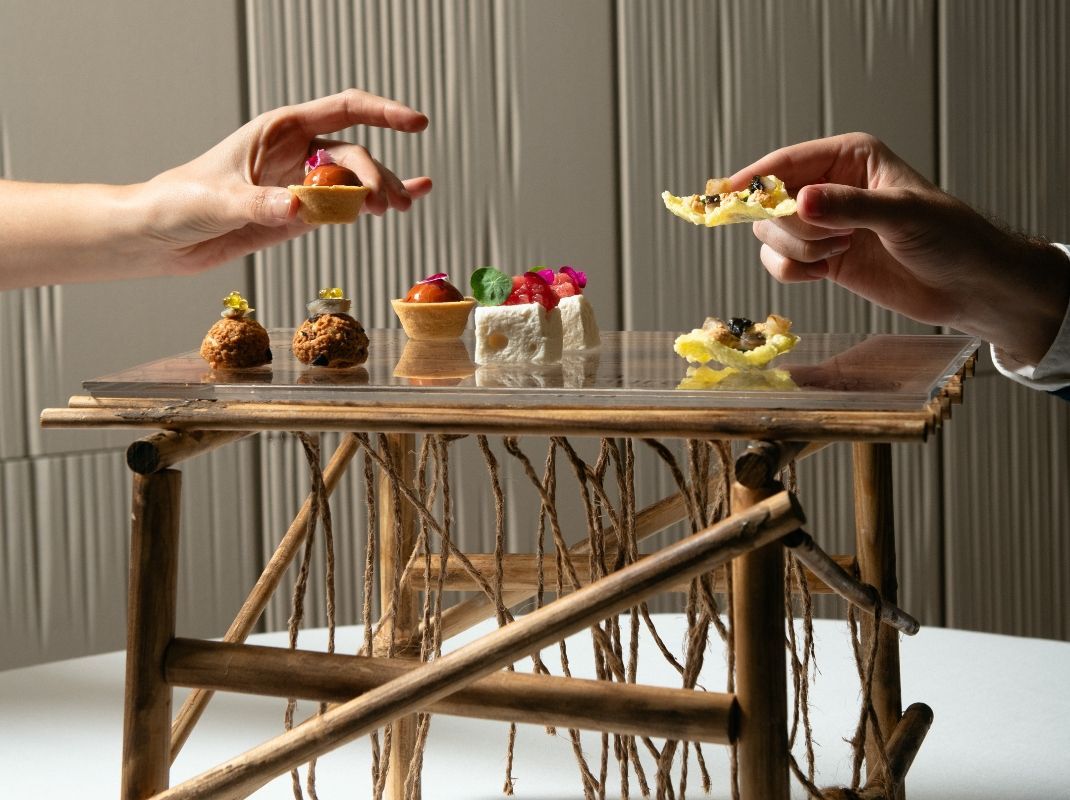
A few meters away, the Kintsugi restaurant reverses this concept by offering technically Japanese cuisine but with ingredients from the Delta. Bomba rice gives way to minori rice, of Japanese constitution but cultivated in the Ebro. Natural ferments such as sake, miso and koji are also incorporated, which are already growing in Catalan lands thanks to the Kenshô artisanal project.
The itamae Héctor Ribeiro, someone from whom one always learns a lot, once told me a great phrase: "In many places, more than fusion, what there is is confusion." He, however, does not confuse at all, but rather creates signature elaborations such as Balfegó tuna aburi, kobayashi-style braised eel hosomaki, oyster with marine umami or eel and razor clam xapadillo. The future, here, is in Catalan crops that look towards the east.
Recently, in addition, it has incorporated a kaiseki menu, one of Barcelona's upcoming gastronomic trends. It is one of the most refined expressions of Japanese cuisine, a style created in the 16th century and linked to ryokans, which some theorists define as the origin of the tasting menu we know today. Precisely this July, a new restaurant inspired by Kyoto and Ginza-style kaiseki, Scapar, is opening, led by chef Kouichi Kuwabara.
The itamae Héctor Ribeiro once told me a great phrase: "In many places, more than fusion, what there is is confusion"On my last visit to Ohla Eixample, however, I not only learned about the Ebro and the rising sun, but also about the culture of Yucatán. José Guadalupe Couoh, the group's head chef and with Maya as his mother tongue, is a world reference in this cuisine with intoxicating sonorities.Dishes like thepapadzules, thetikin-xic, themucbipolloor thepoc chucshow that there are still many gastronomic sensitivities to discover.
In the coming weeks, we will also discover the new project proposed by Fran López at Time Out Market Barcelona, where he continues his legacy of Delta cuisine with a namesake restaurant open 364 days a year. For now, he has announced that it will feature dishes such as oysters with black garlic or Sant Carles de la Ràpita prawns, in addition to his famous cannelloni with truffle. Product and technique that create discourse without confusing.
Add The New Barcelona Post as your preferred Google source for free
Stay informed with the latest news.