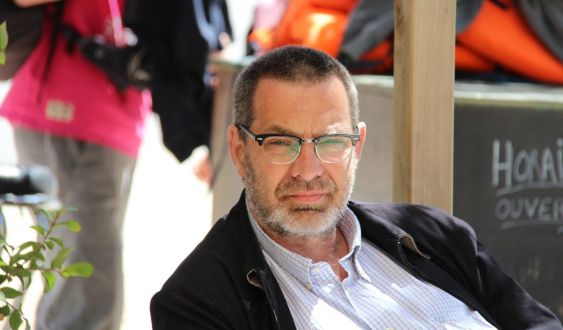
"I am the second to last of seven siblings, each of whom was able to dedicate themselves to what they liked most. I opted for History, although at first I didn't know whether to dedicate myself to that or to be a journalist. Then, when I was in third year of BUP, a teacher came who made us read Pierre Vilar and Jaume Vicens Vives and then I had it clear. That teacher swayed me." The historian and researcher Francesc Vilanova, one of the leading authorities on the Catalan exile of 1939 and the first post-war period in Catalonia, has arrived just in time for lunch at the Bar and, while choosing his food, leans against the bar.
Full professor of Contemporary History at the UAB, director of the Carles Pi i Sunyer Archive, of the homonymous Foundation, and member of the Research Group on the Francoist Era, Francesc is a member of the Scientific Council of the Memorial Museum of Exile of La Jonquera and is, above all, passionate about history. About studying it, living it, understanding it, teaching it.
Author of a multitude of works such as Exiliats, proscrits, deportats; Una burgesia sense ànima. El franquisme i la traïció catalana, Fer-se franquista. Guerra civil i postguerra del periodista Carles Sentís (1936-1946) or the spectacular Nazis a Barcelona. L'esplendor feixista de postguerra (1939-1945), written with Mireia Capdevila, the historian returns to bookstores with Barcelona, gener de 1939. La caiguda (Ajuntament de Barcelona), "which portrays life in Barcelona from March 3, 1938, when Lleida falls, until the first weekend when the city is already Francoist, in January 1939."
With this volume, the author confesses his desire to close his work "of specialization in the first stage of the post-war period, which covers from '39 to '51, and to be able to address the second stage, which goes from '51 to '59, when the regime approves the Stabilization Plan."
It's not just luck
"I am the son of the city's Catholic and Catalanist bourgeoisie. I have been lucky, because I have never lacked anything, but I have also worked hard to achieve what I have. On the other hand, I don't have the feeling of toiling away. I like my job and I am also proud of my family. Of my wife and my son. Of an environment that has accompanied and supported me in all crucial moments: the good, the bad and the terrible," he explains while, in the background, the transistor speaker unfolds in the air the notes of Albinoni's Violin Concerto No. 4 in A major.
His professional career began in 1986, upon returning from military service, "working first for L'Avenç, then for the Martínez Roca publishing house, and then, already at the Fundació Carles Pi i Sunyer." In the 92-93 academic year, Francesc Vilanova began teaching at the UAB as an associate professor of Contemporary History in the Political Science degree. Ten years later, and after his time at the faculties of Journalism and Humanities, he became a Full Professor, alternating this work with research "of which, with the exception of two or three books, I am very satisfied," confesses this devotee of the figure of the medievalist historian and politician, Ramon de Badal.
City lived vertically
"I am from Barcelona and I have always lived here. My wife and I could not live anywhere else. We suffer and enjoy this city equally. And we travel it a lot." But there is something in that sum of journeys that is, to say the least, singular.
"We always go down in a straight line, from Can Caralleu and Bonanova to Ciutat Vella, from west to east, but we don't usually walk through north and south, neighborhoods like Sants or Poblenou escape us, we know them little," explains the local before looking back, and smiling with all the strength of preserved memory, recalling a childhood "walking to school, at the top of Iradier street, in that neighborhood that then consisted only of towers and schools, and from which later, on weekends, we would go down to the center with the family. To see the museums, and to buy clothes and see antique shops near Santa María del Mar."
"Many of those businesses and the families that breathed life into them have been expelled by the real estate market, which is a criminal problem in Barcelona." Angered by a "savage uniformization of the city," the local blames equally "all those who have been in charge here."
---What is far from uniform is our culinary offer. Have you already decided what you'd like to eat?
Francesc Vilanova then smiles, remembering what he had come to the Bar for in the first place. He takes a last look at the offer and decides.
---Well, look, a veal Milanese and a sparkling water.
---Nothing else? Just that?
---Man, it's just that I'd better not eat too much--, he replies without losing either his smile or his appetite.
Add The New Barcelona Post as your preferred Google source for free
Stay informed with the latest news.
