[dropcap letter="L"]
he years of the revolution were a good time to be a woman in France. Everything changed rapidly and favorably for them since the storming of the Bastille on July 14, 1789, where the scenario for the revolutionary process was conceived. Seen from the perspective of the artistic effect of this key historical event, what was done then was as it should be: an abandonment of the pose, gestures, and clothing of the Rococo, which was soon identified, with good reason, as the style of Versailles, the style that had the hated Queen Marie Antoinette as a reference; an abandonment that was accompanied by a distancing from the falseness of courtly rituals for an aura of authenticity, which is why Shakespeare was liked and not Racine: authentic problems —unemployment, famine, misery—, authentic violence that had to lead the perpetrators of calamities to the guillotine and, from time to time, authentic victims of the repression of the Swiss Guard.
But, on the other hand, everything had to be a spectacle, something that sometimes did not seem serious, with masses shamelessly obsessed with the execution of nobles amidst large demonstrations. There was a lot of nervousness. Also a lot of anger. That anger that is the fuel of complaint. On October 5, the people went to Versailles to shout at the king to his face about the hardship they were experiencing and demand redress. The novelty of the day, what distinguishes it from July 14, is that the leadership is now carried by women.
THE NEW HELOISES
There were about six thousand, perhaps more, who had the support of two of the heroes of the Bastille, Hulin and Maillard, men who did not show their alpha spirit, but rather were close to the feminine sensibility that since Rousseau had been linked to La nouvelle Héloïse. Two engravings by Janinet reflect the fact; they are part of the series of 54 engravings on the revolution. The idea that women could, at the end of the 18th century, exorcise the ills of a society made by men by making decisions, overcoming inhibitions, is a fact that gave rise to a true mystification of the revolutionary behavior of women, as Elisabeth Liris says. An example determines it. On September 7, 1789, a group of eleven women appeared before members of the National Assembly to donate a chest with jewels to the Nation. All are artists or relatives of artists. A spontaneous gesture that led, however, to the opening of two offices for this purpose: one directed by Madame Pajou, the other by Madame Rigal; a gesture that serves to visualize how the moorings are metaphorically loosened from the symbols of the previous era. Thinking about that gesture of some Parisian women, it is easy to see how women, whose political universe was delimited by opinion leaders such as Marat, Danton or Robespierre, had convinced themselves of the need to carry out purgative strategies of the objects that linked them with the past.
Looking back at the art that reflected the world of women in the years of the revolution, one cannot avoid thinking that it is an effort to situate the iconography of a certain way of being and acting, even painters of the talent of Élisabeth Vigée Le Brun were called upon to change their style to adapt to the times. Revolutionary women? So, what distinguished them from the screaming women in the streets —those who were represented as seamstresses— who screamed every time a cart full of women left the Conciergerie heading for the Place de la Concorde where the Guillotine was installed? Rebels? Of what cause? At what price? Did they even know the courage it took to endure weeks of police interrogations, followed by death sentences by guillotine or several years in prison? And this feeling was not only had by women of the aristocracy, but also by those who refused to participate in the Jacobin game of purification.
TENSIONS OF THE REVOLUTION
Despite the great debates about the meaning of the revolution, women found themselves caught up in the entanglement of party politics. Girondins against the Mountain: diverse, and opposing, sensibilities in the conception of the revolutionary event. Don't some of the most recognized women of these years emerge from this small world of ideological conflicts? Let's think of four of them, Théroigne de Méricourt, Charlotte Goday, Olympe de Gouges, Madame Tallien: four revolutionaries who were able to realize that they were in one of humanity's crucial moments, and acted, wrote, and positioned themselves with the same intensity and social effect as men. It was in Paris, in the months following July 1789, where the spirit of the revolution nested in the souls of all of them.

I don't think Théroigne de Méricourt should feel guilty for having been born in the right place at the right time. Let's look at a small ivory medallion by the miniaturist François Hippolyte Desbuissons, where she appears with a Girondin cap and a low-cut dress in the fashion of the moment. At twenty-seven years old—she was born near Liège in 1762 into a peasant family—she represents a generation fortunate to grow up at the pace of history, which was that of the ideals of the revolution. With that determined spirit, she settled in Versailles in August 1789 to closely follow the work of the National Assembly; she did so from a politically inspired literary salon. She liked to dress as an Amazon to have a masculine appearance, and she didn't mind being called the Belle Liégeoise because that sustained the popularity she needed. From January 1790, she was seen in Paris near Gilbert Romme, where she founded the Club of the Friends of the Law. But fame has a price. She was taken prisoner in Belgium and taken to Austria, where she remained nine months in the gloomy prison of Kufstein Castle. After nine months, she returned to Paris, where she received a triumphant welcome. It was then that she invited citizen women to organize themselves into an armed body through a harangue that perfectly summarizes her thought: "Let us break our irons, it is finally time for women to emerge from their shameful nullity where the ignorance, pride, and injustice of men have enslaved them for so long." From then on, her political life intensified with her participation in the assault on the Tuileries on August 10, '92, although little by little she sided with the wrong side of the revolution: she became a fervent Girondin, and that motivated her downfall, and ultimately her arrest, torture, and loss of reason. She was institutionalized in 1795 and remained oblivious to the world until her death.
MARAT'S BATHTUB
For Charlotte Corday, everything seemed possible: unlike other young women with a revolutionary spirit, she was never thought capable of carrying out the plan she set out to do.

In 1793, she is represented by Tony Robert-Fleury as a peaceful woman with a book in her hands in a bucolic landscape of the city of Caen; this portrait better reflects her personality as a restless woman than that by Paul Badry, where she is seen as a romantic heroine. In any case, she was always seen as a woman who never felt the need to waste her time on something degrading like routine life guided by provincial customs. History lent her a hand so that this would not happen to her. It happened in the spring of 1793, when many Girondins took refuge in Caen fleeing the reprisals of the Jacobins led by Jean-Paul Marat. Their revolutionary ideals, contrary to war and a federal solution for France, captivated a twenty-five-year-old Charlotte Corday: she had been born in 1768 into the d'Armont family, descendants of the playwright Pierre Corneille.
She often attended meetings that spring where they talked about what was not working in the revolution and how to change it. The proposal of a federalist insurrection activated the inner world of this woman, who in July of that year went to Paris with the intention of reaching Marat and stabbing him; which she did on July 13 when she finally found herself in front of the Jacobin leader who was working, as was usual for him, in a bathtub. At least from her point of view, she took the step forward that many young people of her generation did not want, or could not, take. Immediately arrested, she was tried by the Revolutionary Tribunal and executed by guillotine on July 17.
THE JACOBIN SCAFFOLD
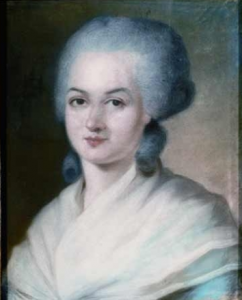 Another of the revolution's most renowned heroines, Olympe de Gouges, born Marie Gouze into a bourgeois family in Montauban, was fully captured by Alexander Kucharski. Due to her tenacity and intelligence, she was the heiress to the long list of women writers influenced by Madame de Valmont's Mémoire and whose Declaration of the Rights of Woman and of the Female Citizen constitutes a milestone in French literature of the revolutionary period, according to Michel Faucheux. The seductive attraction of this woman's life and work is undeniable. During the revolutionary years, she sought to place herself in the reality of her time by thoroughly studying ideals; as she was forceful in her statements, everything she said acquired the value of a slogan, like the famous phrase "if a woman can mount the scaffold, she should also be recognized the right to mount the Tribune." Her involvement with the Girondin cause led her to the guillotine in 1793; she who had been the soul of the revolution ended her life as counter-revolutionaries are said to end theirs. There was an excess of Jacobin zeal in those years; an excess of criminal sentiment.
'NOTRE DAME THERMIDOR'
The expression dedicated to Olympe today, of being a "feminist," would surely have amused Madame Tallien, born Teresa Cabarrús, a woman from Madrid who, through her own merits, became the epitome of an illustrious Parisian. From the very beginning, she became a relevant figure in the Marais district, where she set up a literary salon attended by the cream of French liberal society; General Lafayette or Count Mirabeau or the Lameth brothers were regulars. Invoking the special authority of her prestige, she opted for the Convention, abandoning her husband, her jewels, and her gallant life. The revolutionary ideal of Girondin persuasion led her to prison where she would meet the man who was to guard her, who first became her lover, then her husband, and from whom she would receive the name by which she went down in history: Jean-Albert Tallien.
 To understand the mystery of Teresa Tallien, transformed in the imaginary of the revolution into Notre Dame Thermidor, one must begin by placing the portrait Jean-Louis Laneuville made of her, where she appears with her cut hair in her hands and on the cell wall the portrait of her lover. She was the promoter of neo-Hellenic fashion, which is how she appears in François Gérard's portrait, to which the women who frequented her salon quickly adhered. Her ascent is evident when she witnessed Napoleon's wedding to Josephine, another female icon of the revolution. But what the group surrounding Napoleon had gained in position often lacked in imagination. The rejection of Madame Tallien in Napoleon's circle after 18 Brumaire is quite instructive in this regard. In a note to Josephine, the First Consul himself wrote: "I forbid you to see Madame Tallien, under any pretext. I will not admit any excuse. If you hold me in esteem, you will never transgress the present order." After this forceful Cartesian signature, Madame Tallien left the Bonapartist circle, which after all was fragile and surprisingly provincial, and learned a cardinal axiom of social life born of the revolution: friends are commitments. Her luck was that Napoleon's repudiation opened wide the doors of Madame Staël's circle, daughter of Minister Necker, one of the most refined minds of the era, a writer, a woman of the world, who introduced her to the Prince of Chimay, after all, the man of her life.
In times of revolution, women placed themselves at the intellectual center of France. The light emitted by their testimonies and the accounts they tried to explain in retrospect, based on memoirs, what happened, still reach us as the radiant sun of a plenteous moment of humanity that had a markedly feminine tone.
Add The New Barcelona Post as your preferred Google source for free
Stay informed with the latest news.