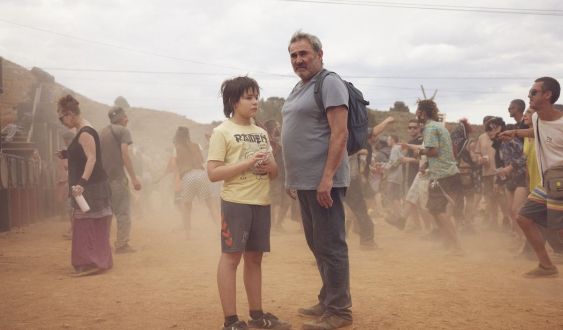
Before referring to the images, let's focus on the sound. There is, in the film Sirât, an eagerness to return us to the beat of percussion. First, it imposes itself on us with a delicious vomit of cloying images from a desert rave (as with minimalism, the thump-thump first causes much laziness or fear, until it ends up generating calm; it's like the music of drums, which reconnects the modern with the most archaic vital tribalism) and then it goes out of sync thanks to the clicks of the bombs that fall again on the crippled people of the desert. I reread the previous words and see that the initial sentence turned out too long; because Óliver Laxe has given me back the pleasure of exercising syntax. Given that the film is preceded by a certain fuss, let's get to the point; despite its excesses (also certain self-sabotages, like an ending where the filmmaker shakes off the film), Sirât returns the screen to the lush world of ideas.
Let's continue; I was saying that this film imposes itself in its sonority. Indeed, the pulsations of the party in the desert (and trance music, clap or whatever the hell it's called now) is the continuum that gives meaning to the existence of the last adventure seekers, utopians who end up mired again in geopolitics, as always happens, through blows. It is normal for the viewer to pay special attention to this fauna that travels and dances compulsively, but the grace of Laxe's creation is that the adventure of these little animals is equated to that of a brave father looking for his disappeared daughter to try a redemption that smells of the middle class of the Eixample. Here lies the great idea of this film, which beyond the search for a certain ataraxia with which the filmmaker himself has sold it, is a deeper ethical essay, which dynamites the ridiculous heroism of fathers and ends up making them pay for their hubris, leaving them almost alone on the train of lost immigration.
Blessed be the filmmaker who, in a present where films seem like Netflix episodes concocted based on a couple of occurrences (oh yes, the Pope of Rome is a woman, oh yes what a beastly thing and blah blah blah!), has had the temerity to make us think a little and, as the corny would say, to take us out of our comfort zone. In an interview with Agus Izquierdo (an unveiled and hardworking communist), Laxe claims that lately he is obsessed with raves and the Quran. Bullshit, my son, because the delicious final scenes in the desert ---where the survival of the species is forced to encounter war and in which even the Rousseau of the moment ends up embracing the law of the strongest--- owe a great deal to the book of Exodus. The final meaning of this beautiful creation, which could be sold as an attack on Western reason, turns out to be profoundly 18th century; you thought your struggle was to save your daughter, when the problem lay within yourself.
I am very much in favor of Óliver Laxe having sold his creature disguised as a Galician spiritualist, lover of witches, the mysterious... and all that nonsense. But Sirât is also good news because it shows that independent cinema in our country, despite rather regionalist cultural appeals, is profoundly American in spirit. You don't have to be a genius to see the debt of the film's initial sculpture to the monolith of our beloved genius Stanley, just as the desert crossings ---however arid they may seem--- maintain the expansive joy of Easy Rider and the father-child scenes are more Spielbergian than a shark's teeth. At home we celebrate it, because if they continue with that creative pulse, the filmmakers of this land will sooner or later receive an offer from Hollywood, they will become rich, and thus we will be able to abandon the usual poverty of the tribe.
Some critics will say that many images in Sirât (like the eternal transit of vans flying over the stones or the last dance on the burnt sand) revel in aesthetics, sacrificing coherence, discourse, and thought. Perhaps they are right, but it must be said that if any of the fine arts often sacrifices coherence for artifice, it is cinema, without a doubt. But I would say that all these are perepunyetes' amendments, because, after months of gorging ourselves on dreadful duds in movie theaters, being able to shout that there is an artist who excites our prose is much more important than appeals to formal perfection. Rush to the cinema, this movement is worth it. I hope the American Jews hire you very soon, Mr. Laxe; don't pretend to be proud and call them back, because these people work wonderfully and, if the script calls for it, they are capable of filling an entire city with sand and tears.
Add The New Barcelona Post as your preferred Google source for free
Stay informed with the latest news.
