Although today some winds blow against the ideal of a more united Europe, the current impasse of European politics demands a decisive step forward from all those countries that have already made great efforts sharing a common currency and an internal space of free circulation. This step forward is necessary if we do not want to end up losing what has been achieved to date, since the current instability drives discontent and disaffection towards the idea of Europe. Furthermore, the rewards of this final stage of integration are enormous and can constitute an essential factor to drastically change the attitude of the European population regarding the Union. They can mean that the European population assumes a reality that is questioned today, that the European Union, far from being the problem, is in fact the solution.
The results of the European elections last May highlighted once again the growing lack of harmony between the European integration process in its current format and the aspirations and expectations of a large part of the citizenry.
One explanation, I believe circumstantial, for the increase in this Euroscepticism is the effect of the economic crisis that the continent has suffered. It is true that its harshness and prolongation are, in part, a consequence of the errors made by the member countries in the introduction of the single currency. However, the adverse reaction of important segments of the European population is due more to dissatisfaction with the management of the consequences of the crisis than to an assessment of the causes. Beyond the perception associated with the economic crisis, I believe there are also very important structural reasons behind the increase in disaffection among European citizens. If the European Union does not respond to the expectations that the population places in it, it is for various reasons that should be examined carefully.
The first is that economic growth on the continent has been very scarce in the last fifteen or twenty years and, in any case, is insufficient to maintain the welfare state at the levels of benefits with which it has been operating in most member countries. The causes of this low growth are controversial, but there are two components that usually receive little attention and play a decisive role. One of them is the dominance that national elites continue to exert over the power apparatuses of the member states. These elites resist ceding sovereignty to Brussels in key areas such as fiscal and regulatory policy. This implies that both the economic and monetary union and internal market policies in regulated sectors, such as energy and telecommunications, function in a very unsatisfactory way. The other component is the corporatism that still dominates in many member states: from the private sector, too much support is often given to national governments to preserve protected markets and sectors where competition and free entry are insufficient.
A second structural explanation for the citizens' distancing from the European construction process has to do with the complexity of the Union's institutional structure. The problem is not only that it is difficult for the European citizen to understand the role of the different community bodies. The fundamental issue is that there is no clear correspondence between the exercise of power at the European scale –who decides what and with what effects– and the perception of the democratic legitimacy of that power by the citizenry. European institutions are legitimate thanks to the democratic representativeness of the national leaders who make up the European Council and also thanks to the direct election of popular representatives in the European Parliament. But the complexity of the decision-making process and the role of the European Commission often leads national leaders to internally promote unpopular policies, with the excuse that these are community measures of inevitable adoption. It should be remembered, in this sense, that although it is true that the European Commission has its own legislative initiative, it is also true that it is a body appointed by national leaders.
But perhaps the deepest cause of the current political crisis is that the European Union, following a tradition that dates back to the beginnings of the European Economic Community, has continued to advance through economic integration without parallel steps of political integration. It has continued to be believed that the latter would be an inevitable consequence of the former. When political progress has not accompanied economic integration, the institutional system has suffered, sometimes very acutely, as happened in the 1990s with the breakdown of the European monetary system. Today there are two areas of European policy in which the imbalance between the progress of economic agreements and the delay in political integration is causing a very accentuated conflict. So serious that it can even make the current institutional configuration unsustainable.
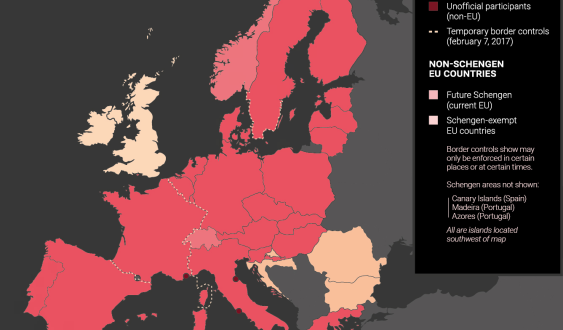
The first conflicting policy is the free movement of people within the Union. That is, the policy that allows any European citizen to reside and work in all member countries. Some countries have even gone further with what is known as the Schengen agreement, which allows crossing the internal borders of the Union without border controls.
The principle of free mobility of people is a political principle of the Union that has important positive repercussions in terms of economic efficiency for the entire continent. Under normal conditions, it would already be difficult to implement given the great diversity of living standards within the European Union in the 28 countries we have today. But it is practically impossible to guarantee if, to this great internal diversity, we add a set of immigration policies of the Member States that are neither coordinated nor respond to common guidelines. Most likely, the free movement of people within the Union will not be a viable long-term policy if it is not accompanied by a common immigration policy. And it is obvious that agreeing on this type of policy entails, for each of the member countries, a significant loss of sovereignty.
The second major policy source of institutional conflict is, naturally, the economic and monetary union: the euro. Sharing a currency is very difficult in the long term if this monetary union is not accompanied by very substantial integration in the political sphere. To put it in a nutshell, common political institutions are necessary to deal with chronic competitiveness imbalances that almost always end up arising within a monetary union. Through political union, either the deficits of the less developed parts of the Union are structurally financed, or the legal and institutional reforms necessary to prevent imbalances from becoming chronic are centrally imposed. Alternatively, legal reforms can also encourage the mobility of people as an alternative adjustment mechanism. Either way, the degree of political union required is considerable, even greater than what is needed for a monetary union to function harmoniously when its member countries have different economic cycles. In the latter case, the necessary steps have to do with fiscal union and banking union, areas in which the eurozone has already made progress recently as a result of the crisis experienced in recent years.
It is important to remember that both the free movement policy and monetary policy are areas of action that are no longer shared by all member countries today. The eurozone currently includes 18 of the 28 countries of the Union, while Schengen has been adopted by 22 countries of the European Union and by four that do not belong to it.
Deepening political integration to achieve more coherent and effective Union immigration and monetary policies does not, therefore, require a political decision from all member countries, but rather progress from the subset of countries that have already decided to be part of these areas of collaboration that entail a greater renunciation of their own sovereign spaces. Is it possible today to advance in this design of the Union in which some countries decide to unite more to guarantee the achievements made in monetary integration and the free movement of people? Is a two-speed European Union politically feasible?
In procedural terms, the Union already has instruments to advance collaboration among groups of countries, without the less developed ones slowing down the pace of those who decide to integrate more deeply. These are the so-called "enhanced cooperations." The issue is not, therefore, procedural, but essentially political. Countries that do not participate in this enhanced integration may fear that the advancement of the Schengen-euro countries will constitute an integrated bloc that will come to dominate the European Union's agenda and, therefore, negatively affect the rest of the countries. The United Kingdom's reservations in this regard are well known, especially regarding the impact that this entire process may have on London's interests as a financial center.
However, greater political integration of the Schengen-euro countries would improve the democratic legitimacy of macroeconomic and immigration policies, with a very positive impact in terms of citizens' perception of the European Union. Furthermore, greater coherence of community policies in these areas and the central political support they would receive would make their implementation in the Member States much more effective. In this way, better results would be achieved both in terms of economic growth and in the social effects of the free mobility of people. Again, these are two key areas to improve citizens' perception of the practical effect of European policy on their well-being.
In the relationship with countries that do not participate in the "first speed," the hard core must fundamentally respect two principles inherent to the process of European construction from its beginnings: the first is that the first speed must be open to all countries that wish to participate in it. And, the second, that the countries participating in the first speed may not under any circumstances discriminate against the rest, as they would then be questioning some of the main achievements obtained by the European Union in its almost sixty years of existence.
This is the state of the matter, and the difficult political question to answer is: are the countries of the Union's hard core prepared to take that step and move at two speeds?
* Article written before Brexit.
Add The New Barcelona Post as your preferred Google source for free
Stay informed with the latest news.