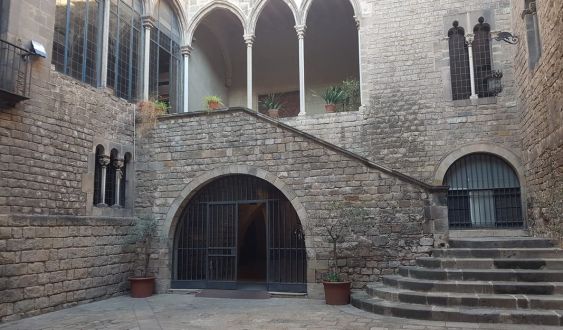
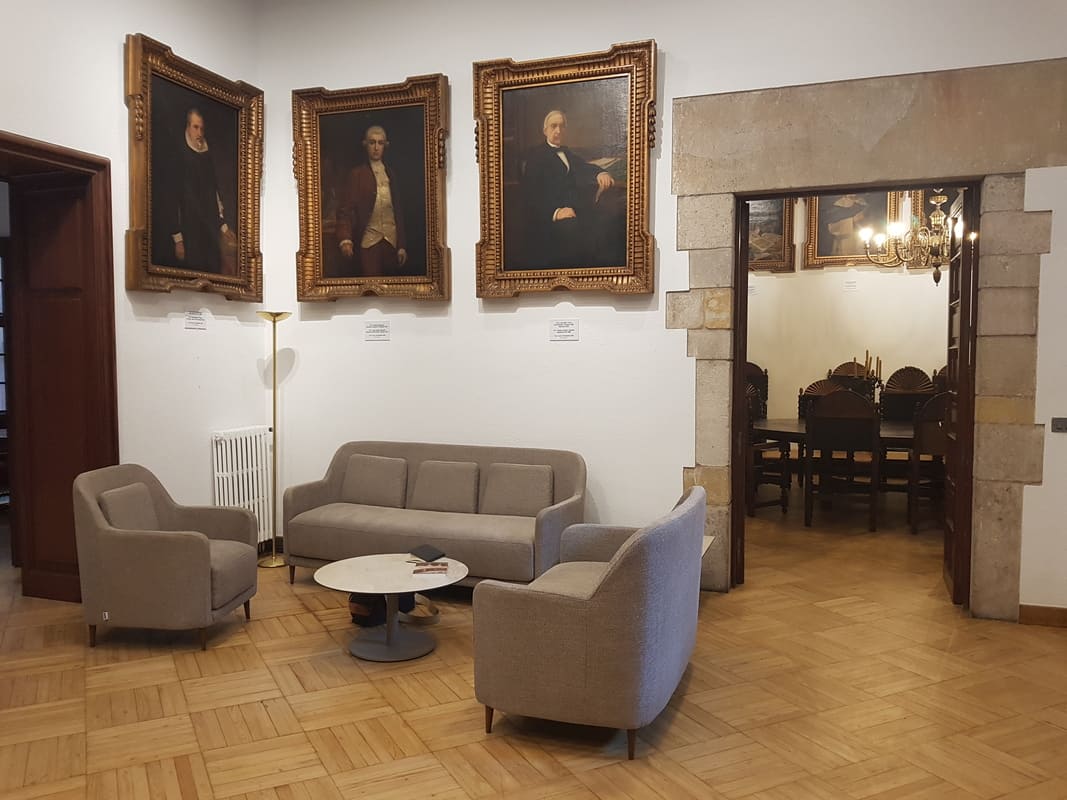
The Galeria de Catalans Il·lustres is an artistic collection that began with enthusiasm in 1871 and now celebrates 150 years. It consists of a set of pictorial portraits of 48 personalities from all times and currently, after years of moving from one building to another, it can be contemplated in the extraordinary and unknown Palau Requesens, headquarters of the Reial Acadèmia de Bones Lletres.
The certain lack of knowledge about this building and the treasures it houses is due to its secluded location. To get there, one must enter the dead-end street of Bisbe Caçador which, at first glance, does not invite one to do so. But if one persists, behind a discreet grated door, one will find a noble courtyard that welcomes the visitor into a building with a lot of history that contains Roman, Gothic, and later architectural elements.
The headquarters of the Acadèmia de Bones Lletres stands on part of the 3rd-century Roman wall and includes one of its defense towers. The main Gothic structure, however, dates back to the 13th and 14th centuries. Since then, various reforms have been undertaken for the uses it has had throughout these centuries, from residence, warehouse, and headquarters of the academy.
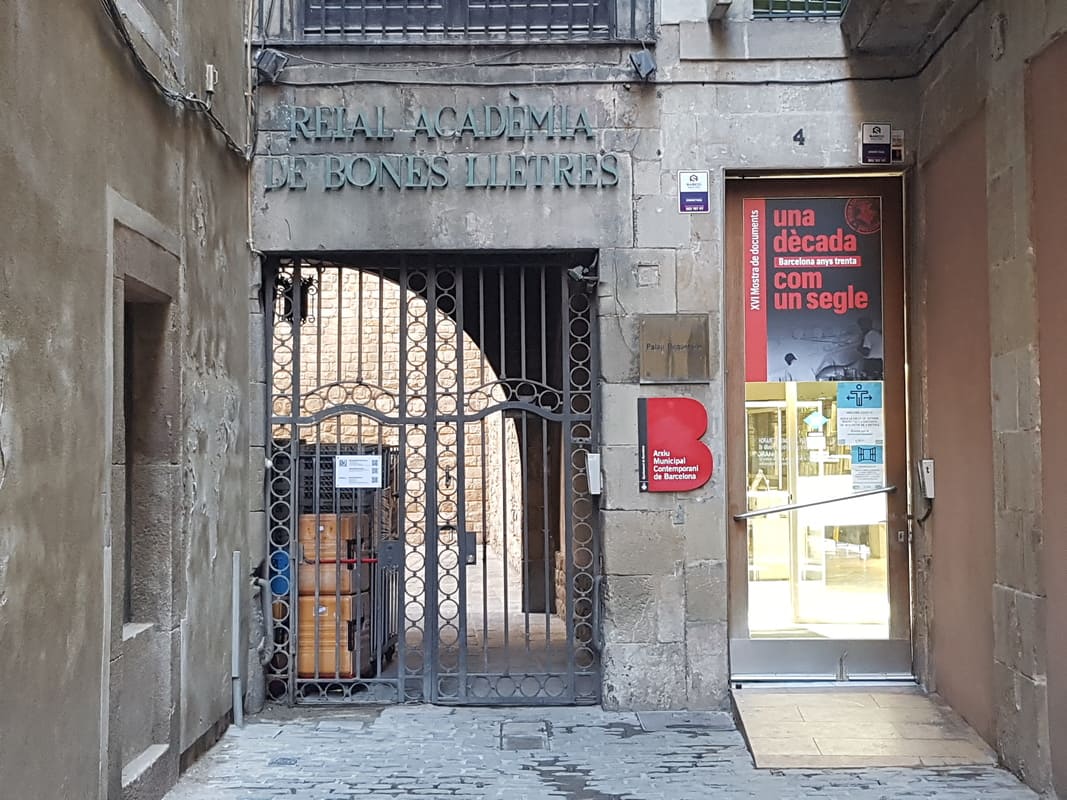
The Acadèmia de Bones Lletres is a cultural institution whose activity focuses on philological and literary studies. It was founded in 1729 by a group of intellectuals after the Universitat de Barcelona was moved to Cervera, as part of the repressive measures dictated by Philip V after the defeat of 1714. The academy was in fact the heir of the so-called Acadèmia dels Desconfiats, founded in 1700 to promote the study of history, language, and poetry and which was also closed by Philip V.
The area currently occupied by the Palau Requesens is believed to have been used for residential purposes since Roman times. Since the Middle Ages, it has hosted noble families of Barcelona. In the 19th century, the property passed to the State, which initially converted it into a warehouse, until in 1917 King Alfonso XIII donated it to the academy to establish its headquarters.
In addition to what it means for Barcelona's architectural heritage, the academy preserves an important archive and library with more than 70,000 volumes. In the mid-19th century, the entity led the recovery of historical and archaeological heritage that came to light in the various urban reforms. All these holdings became the property of the Barcelona City Council in 1905.
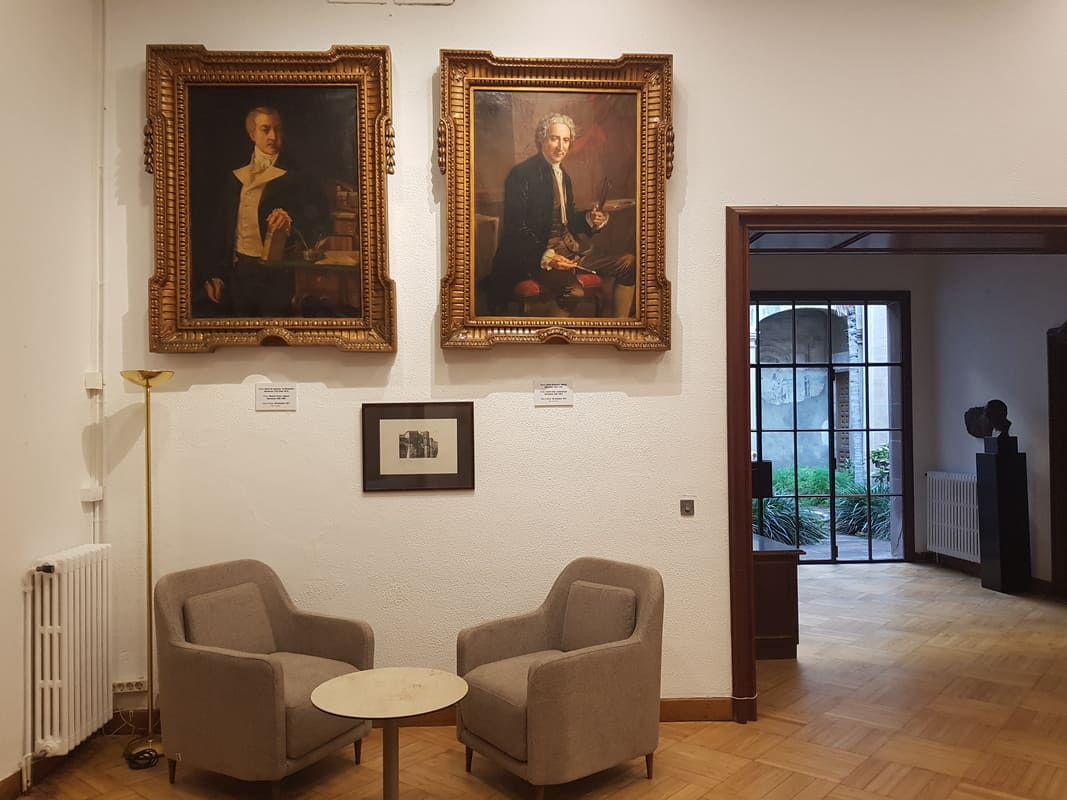
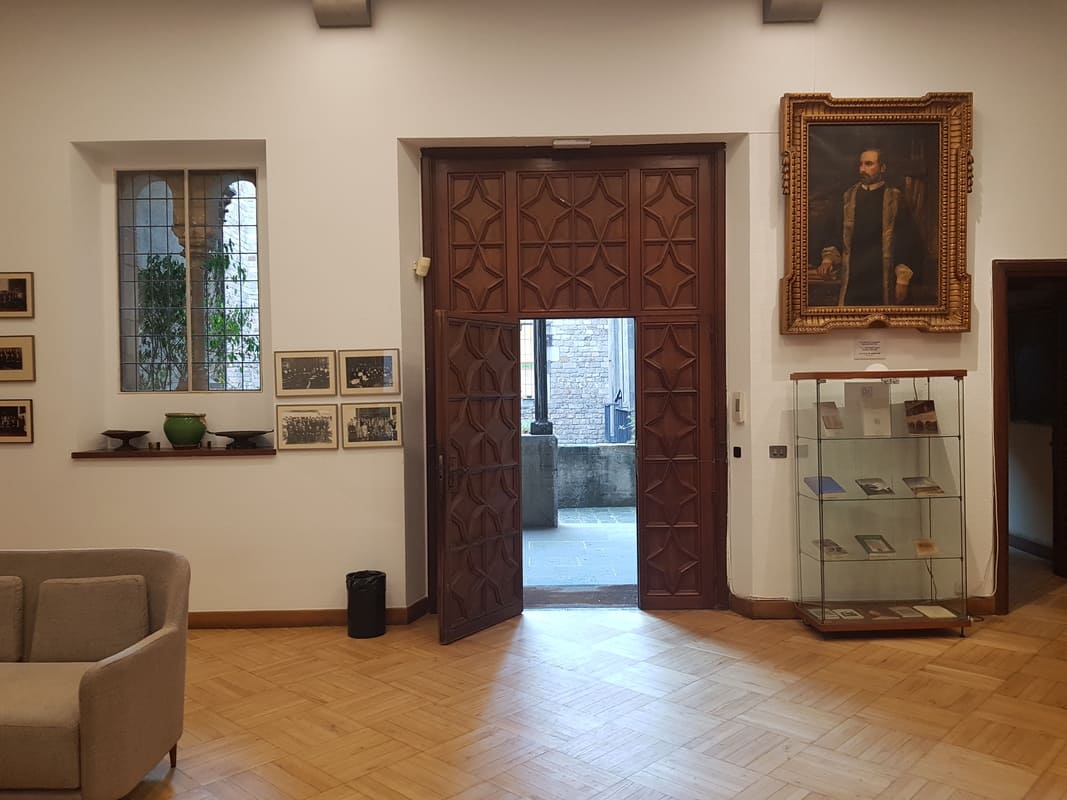
Currently, the academy houses the aforementioned Galeria de Catalans Il·lustres, which is now celebrating its sesquicentennial. To mark this commemoration, the Palau Requesens has undergone a significant renovation to improve the exhibition of portraits in various rooms. The book Construint la memoria. La Galeria de Catalans Il·lustres de l'Ajuntament de Barcelona, by Laia Alsina, Pere Molas, Borja de Riquer, and Margalida Tomàs, has also been published.
Presence of only two women
The collection is actually owned by the city council, which decided to promote this initiative in 1871. The gallery was inaugurated by the historian Antoni de Capmany, and over the years, figures such as Jaume Balmes, Pau Claris, Anselm Clavé, the presidents of the First Republic Estanislau Figueras and Francesc Pi i Margall, Antoni Gaudí, Eusebi Güell, Miquel Biada (promoter of the first Barcelona-Mataró railway), Narcís Monturiol, Juan Prim, and Jacint Verdaguer, among others, were incorporated, completing the list of 48.
Among the peculiarities of the collection, the sole presence of two women in the gallery stands out, Elisenda Montcada and the poetess Maria Josepa Massanés. Likewise, the controversial inclusion of Francesc de Paula Rius i Taulet in 1892. The former mayor of Barcelona during the 1888 Universal Exposition ended up on the list, contravening the collection's own regulations, which stipulated that at least 25 years had to pass since the death of an illustrious person to be part of the gallery. In the case of Rius i Taulet, this condition was ignored. The last to be incorporated was Joan Maragall, in 1971.
Initially, the gallery was installed in the Saló de Cent, until it grew and had to be distributed in other municipal offices and departments, losing its exhibition unity. For this reason, it was moved to the disappeared Palau de Belles Arts, near the Arc de Triomf. In 1947, it was decided to relocate it to the current Parliament of Catalonia building, the old Ciutadella arsenal which was converted into an art museum after the war. Finally, in 1970 it became part of the heritage of the Museu d'Història de la Ciutat, which in turn ceded the collection to the academy.
Contemplating the gallery and getting to know this interesting hidden building and the institution's activity are more than enough reasons for a visit to the academy even though at the moment one of the illustrious is missing from the gallery. This is the writer Lluís Cutchet, who for incomprehensible reasons remains stored in the MNAC's reserve collection. However, he already has his reserved space in one of the rooms of the Palau Requesens.
Add The New Barcelona Post as your preferred Google source for free
Stay informed with the latest news.
