
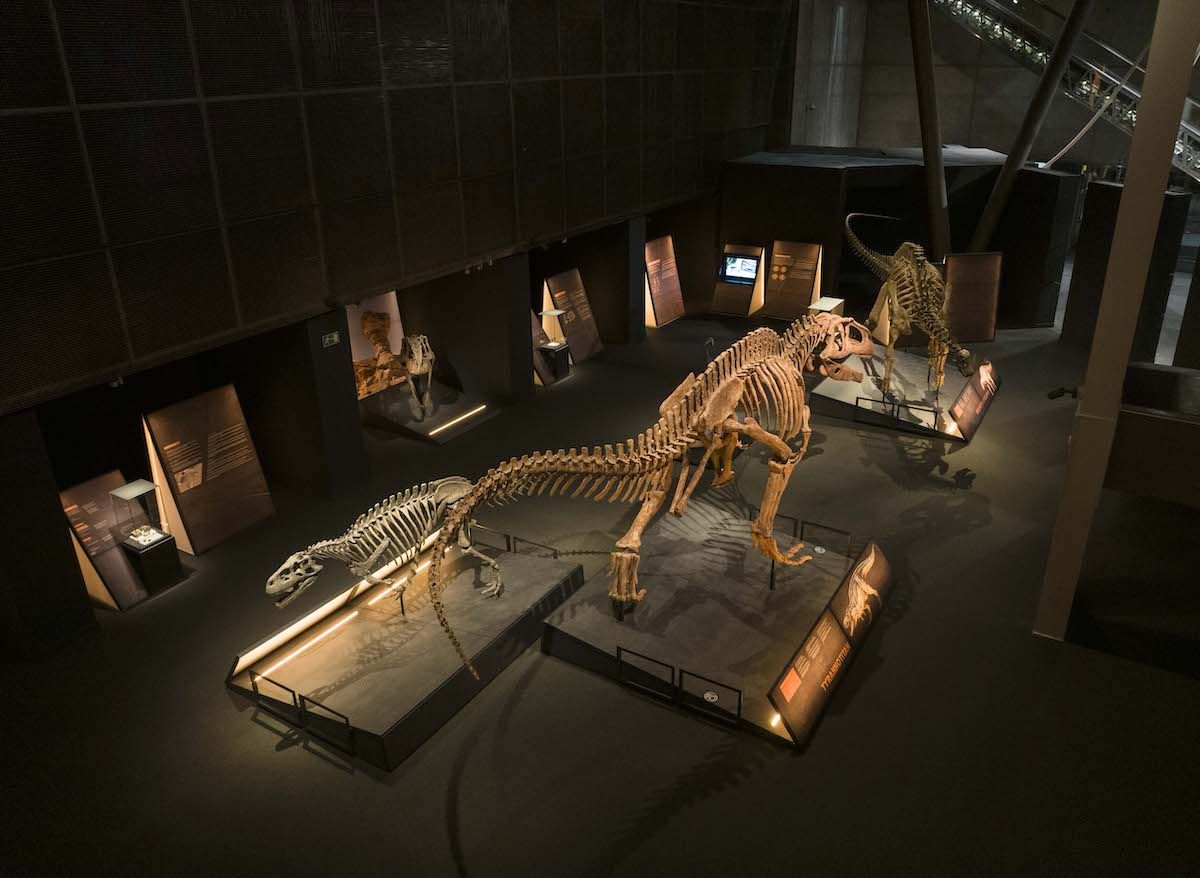
Even if they are silent, it's not hard to imagine the roars they must have uttered. Some, with their mouths slightly open for us to see their teeth, seem to be gathering strength to do so. Or to take a bite if things go wrong. One walks around fascinated to see them so close, still imposing and defiant despite only their skeletons remaining. One can even feel some gratitude that a meteorite, or whatever it was, prevented them from now posing a danger to the open-mouthed humans who look at them, terrestrial animals like themselves, but more humble in their dimensions. To walk among dinosaurs, you don't have to go far. The CosmoCaixa has brought several from Patagonia, one of the richest regions in the world for fossils of these ancient inhabitants of Earth. The Dinosaurs of Patagonia exhibition at Cosmocaixa is the main bet for this season at the Barcelona science museum, also chosen for the premiere of the exhibition in Europe. It can be seen in the Catalan capital until June of next year and then it will go to Madrid.
One of the more than ten replicas of the dinosaurs that now inhabit the CosmoCaixa was so large that its bones have been distributed among two transoceanic containers. And, since the aforementioned was long-necked, its head extends beyond the exhibition area and stretches to see what's going on in the rest of the museum, perhaps wanting to see who is splashing in the flooded forest. This is the Patagotitan mayorum, the largest dinosaur ever found, measuring 38 meters long and 5 meters high. It also becomes the largest animal to have ever populated the Earth. It weighed 77 tons, that is, the same as 14 elephants. Inside its hollow interior, an entire guided tour group can fit, even if its members squeeze together, they fit into what must have been its belly. Luckily, it was herbivorous.
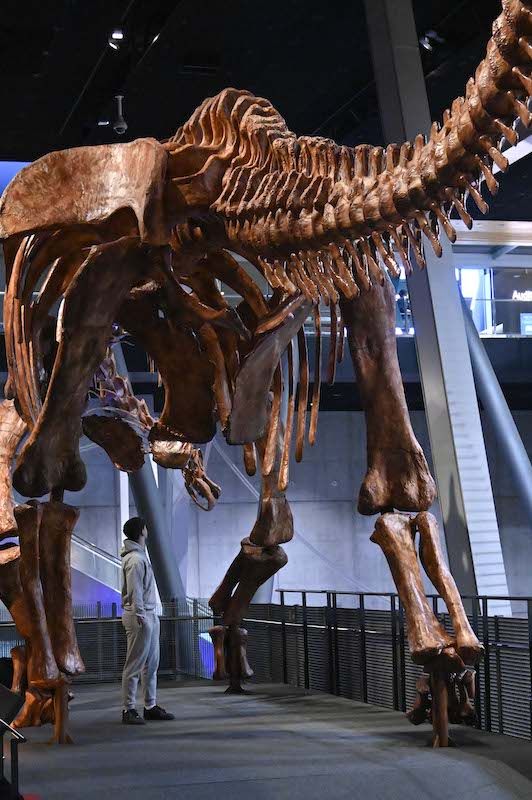
The Patagotitan mayorum lived in the Cretaceous period, the last period of the Mesozoic, also known as the age of dinosaurs. These terrestrial animals began to live on Earth more than 250 million years ago and became extinct 66 million years ago. First came the Triassic period ---from 252 to 201 million years ago--- and then the best known, the Jurassic ---from 201 to 145 million years ago---. Finally, it was the Cretaceous, when dinosaurs already dominated the planet. And it's no wonder seeing specimens like the long-necked one that strolls through CosmoCaixa.
To understand its dimension, the replica of the largest animal in history is accompanied by a real femur. The bone alone weighs 600 kilos and measures more than two meters, much more than most visitors who come to look at it. When remains like this were found 11 years ago in the Argentine province of Chubut, paleontologists had to figure out how to transport them. That is why it is covered with plaster at the base, thus preventing it from being damaged during the journey. It is noteworthy to find the small label it carries, used to know its reference, considering that more than 200 fossils were found, enough to completely reconstruct the anatomy of this dinosaur.
But not only were there remains of the Patagotitan mayorum in that area of Patagonia, but teeth of another species were also found. Not a good sign at all. It corresponded to the Tyrannotitan chubutensis, a predator of the long-necked friend. Although it only measured 12 meters and weighed 6 tons, its hind legs allowed it to run at high speed, up to 30 kilometers per hour. And the Patagotitan mayorum, in fact, moved slowly to optimize energy and oxygen consumption ---it weighed what it weighed---, as indicated by the fact that it had hollow bones. It could do little against an agile Tyrannotitan chubutensis.
Theropods or sauropods?
In addition to refreshing the three periods of the Mesozoic era, remember Triassic, Jurassic, and Cretaceous, the exhibition Dinosaurs of Patagonia, developed by the Egidio Feruglio Paleontological Museum, must serve to differentiate between the many types of these reptiles that existed, with a wide diversity according to their environment and lifestyle, giant or small, bipedal or quadrupedal... Above all, to know what they ate in case they return someday. In the case of Patagonia, the dinosaurs that predominated most were the saurischians, characterized by having a hip similar to that of lizards.
The exhibition Dinosaurs of Patagonia at Cosmocaixa must serve to differentiate between the many types of these reptiles that existedWithin the saurischians, there are theropods and sauropods. To distinguish them, the easiest clue is that the former walked on two legs and the latter on four. There are more differences, such as that theropods had large heads, short necks, and small arms, while sauropods were the opposite, with small heads and long necks. But the most important thing is to look at those teeth shown by the different dinosaurs that are in the CosmoCaixa.If the teeth were V-shaped, it meant they were carnivores (theropods), and if they were U-shaped, herbivores (sauropods). To top it off, theropods had a highly developed sense of smell, which allowed them to sniff out the fresh meat of visitors looking at the exhibit at CosmoCaixa, located on floor -5, from the very entrance of the museum. This is the case of theGiganotosaurus caroliniithat is exposed. Oh, and it had teeth that regenerated so as not to lose strength.
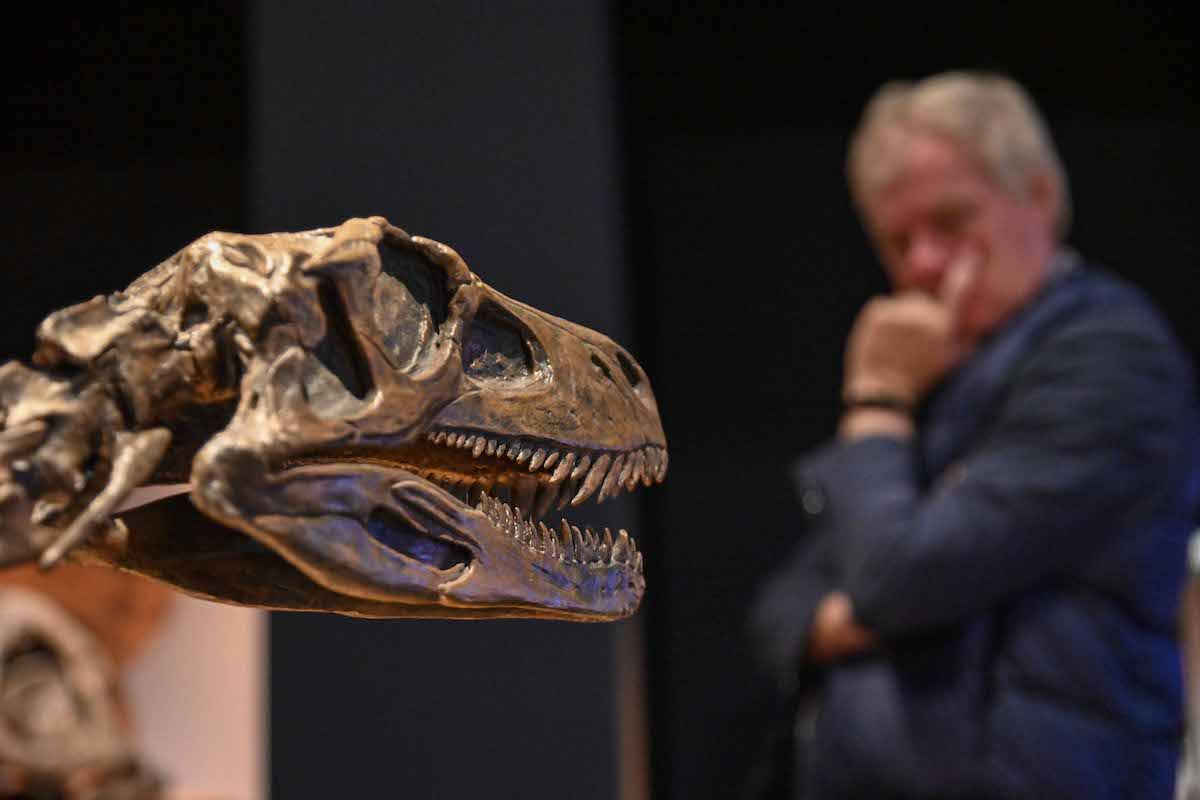
Luckily, not all the dinosaurs that will inhabit the city throughout this course are so terrifying. There are some that look like the little, very little, brothers of the rest of the guests at the science museum. They are the Manidens condorensis and measured around 75 centimeters. In addition, they were herbivores. They are accompanied by the Gasparinasaura cincosaltensis, also small and named after Zulma Brandoni de Gasparini, an internationally renowned Argentine paleontologist. Both species were ornithischians, with a hip that resembles those of birds, the opposite of saurischians.
If you want to know even more about dinosaurs, the exhibition is complemented by multiple talks. In them, they will discuss whether it was really a meteorite that wiped them out and delve into the figure of flying dinosaurs, from which the first birds are believed to have evolved. You can even spend a night at the museum sleeping at the feet of the specimens that make up the exhibition. Of course, if it says do not touch, do not touch. Bones have already been seen fallen in the exhibit due to some people's desire to defy luck and not respect what has existed for many more millions of years than them.
Add The New Barcelona Post as your preferred Google source for free
Stay informed with the latest news.
