[dropcap letter="E"]
n the 21st century, we consider ourselves free of taboos, but death still makes us uncomfortable. We venerate forever young, promote second and third youths, and applaud 'young' seventy-year-olds, but we find it hard to talk about death and accept it. We can live saturated with images, but we always shy away from that of death. At a funeral, for example, when someone asks to see the deceased, they are often taken for a lunatic, a morbid person, or a fan of thanatopraxy. And that's despite the fact that, with television, death entered every home and we have daily catalogs in all news reports.
[subscribe_newsletter_esp]
In a chapter of the essay L'ull i la navalla [The Eye and the Razor], Íngrid Guardiola enumerates the multiple faces of death on screens, from "indexical images," such as skid marks used in traffic accidents, through iconic images of mass death—the Twin Towers—to the video-clip pornography of massacres and beheadings that ISIS publishes on social media. Guardiola finds it paradoxical that, while "television has the capacity to fill itself with mortuary narratives," it maintains death as a taboo, because "it is never represented."
And it is precisely because we always shy away from death that many artists have made it their raw material, inspired by this desire to exhibit what we do not want to see and to hit a nerve. At the Royal Academy in London, for example, this winter a retrospective of video artist Bill Viola was on display, featuring a multi-screen installation that showed a real birth and a real death. During the 30 minutes that the simultaneous projections of the Nantes Triptych lasted, we could see a woman giving birth in real time on the left channel, while on the right we saw a life extinguishing on a hospital bed, specifically Bill Viola's mother, filmed with her consent as she faded away. The viewer had to choose which image to lean towards, whether the life beginning or the one departing, and for most eyes in the room, the fixed shot of the elderly woman breathing ever more slowly was much more hypnotic than any primal roar. Rarely have I felt so many things in a museum: voyeurism and fear quickly gave way to a strange sense of intimacy, and in the end, it was all kindness and extraordinary affection for that stranger embarking on the long journey.
From fiction, Banyoles filmmaker Albert Serra proposed a similar experience a couple of years ago in The Death of Louis XIV. The film describes the last days of the Sun King -Jean-Pierre Léaud with a sensational wig- as he agonizes surrounded by doctors who don't know what else to do with him. The most powerful man in the world is dying of gangrene, and Serra's film, which takes place entirely in the monarch's room, is so distressing and realistic that the viewer ends up feeling like they can smell the protagonist's rotten leg.
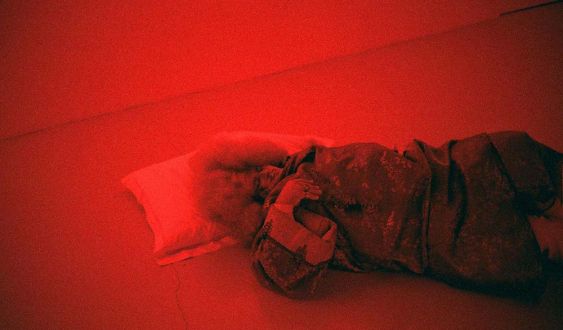
In parallel to the feature film, which premiered in Cannes, Serra had planned to hang a transparent cube with a bed in the middle of the George Pompidou center's hall, where he intended to place Jean-Pierre Léaud himself, characterized as the Sun King, with the idea that the Parisian public would see the agonizing actor during the three months the installation would last. Finally, the project was discarded -due to budget and because the French star backed out- and Serra and his troupe made a low-cost version at the Graça Brandao Gallery in Lisbon. For a week, the Sun King died every afternoon before the attending public, but on that occasion, Louis XIV was not Truffaut's fetish actor, but Serra's fetish actor. After being Sancho, Fassbinder, and one of the Eastern kings, Lluís Serrat still needed to be the Roi Soleil.
Until mid-June, the Tàpies Foundation allows us to relive that experience with Roi Soleil, a 62-minute video documenting the monarch's agony within the white walls of the art gallery, a tour de force by Lluís Serrat, who every afternoon had to spend four hours dying, without being able to speak or recline much to avoid the risk of falling asleep. Real or fictional, the opportunity to see a death live is always a challenge for ourselves.
Add The New Barcelona Post as your preferred Google source for free
Stay informed with the latest news.